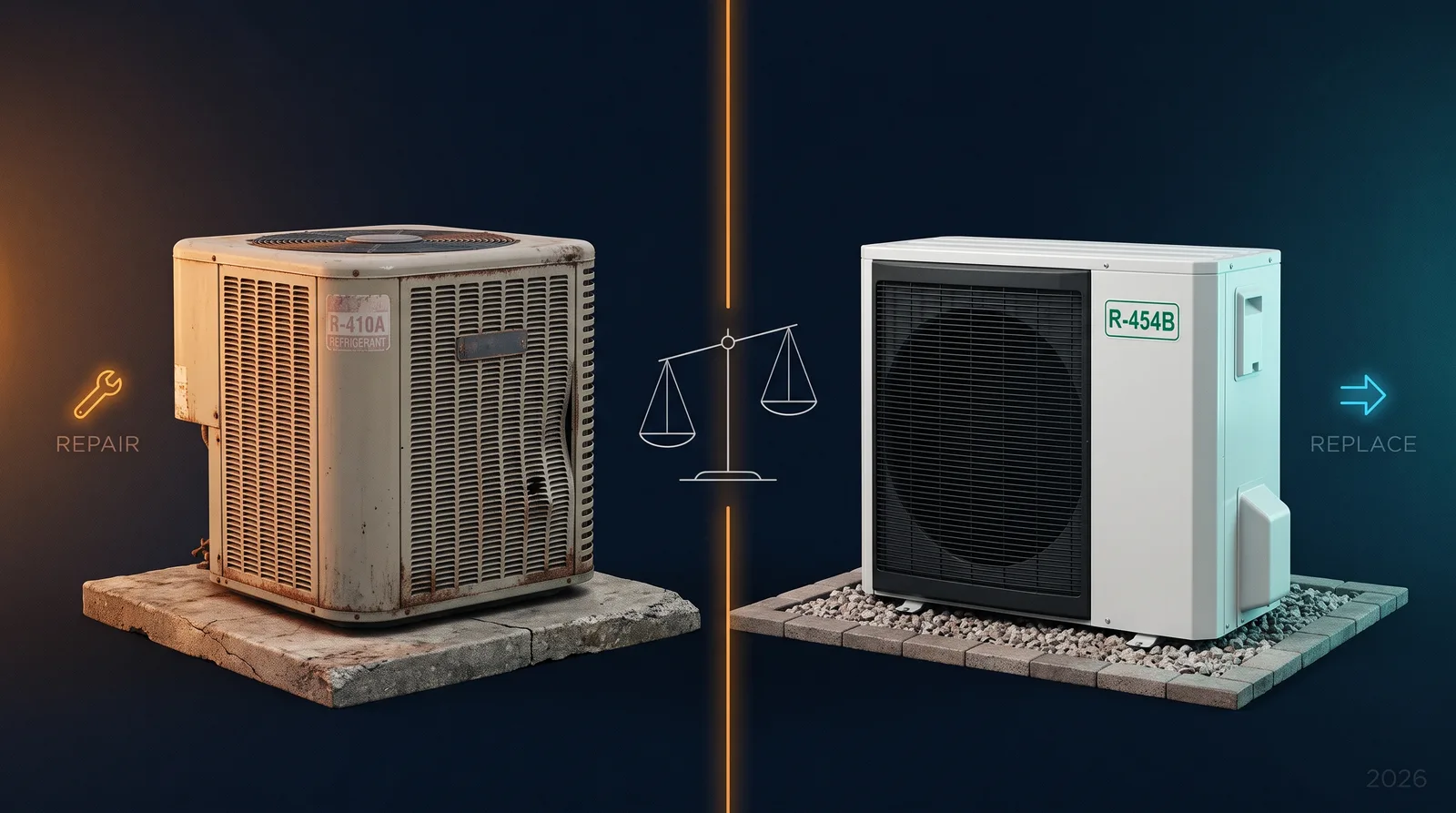
The traditional AC repair-or-replace calculation is no longer a mechanical question about parts and age. In 2026, three federal-level shifts have rewritten the math: the AIM Act's HFC phase-down, the January 2025 R-410A manufacturing halt, and the May 2026 EPA rule that lifted the hard installation deadline on pre-2025 R-410A inventory. The right decision now sits between refrigerant price trajectory, SEER2 measurement changes, and the state your house is in — literally. Here is the framework that actually works.
The Rule of 5,000, Updated for 2026
The old shorthand — multiply the unit's age (years) by the repair cost; if it exceeds $5,000, replace — remains the useful starting line. What has changed is that 2026 repair quotes on R-410A systems now carry a rising refrigerant recharge cost, which pushes more systems past the threshold.
Worked example: A 12-year-old R-410A system with a leaking evaporator coil. Coil replacement: $1,500. Refrigerant recharge (6 lb at 2026 price): $600. Total repair: $2,100.
12 years × $2,100 = 25,200. Far above 5,000 — this is a replace, not a repair. Even before this year, the answer would have been "replace," but the 2026 refrigerant recharge inflates the marginal case dramatically.
The 2026 Refrigerant Price Ladder
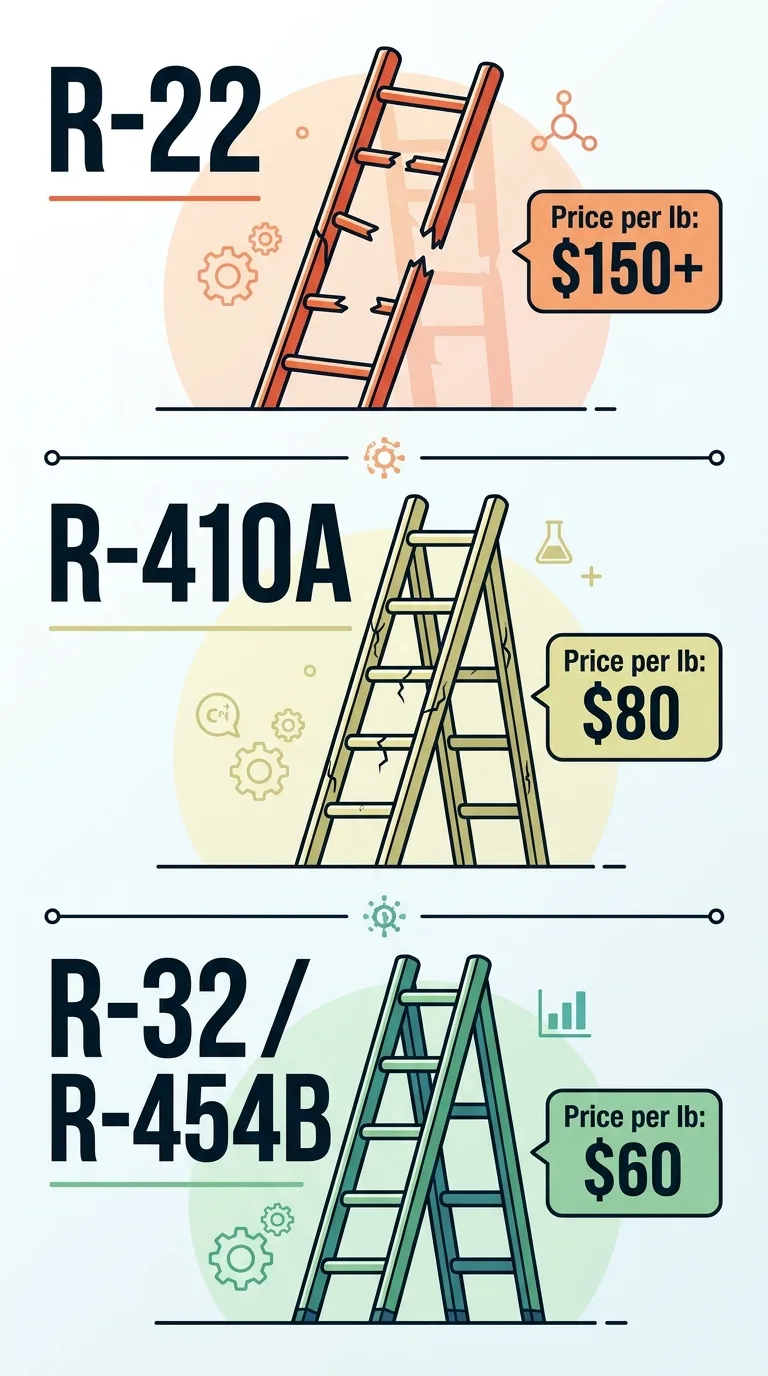
| Refrigerant | 2026 installed cost / lb | Trajectory |
|---|---|---|
| R-22 (Freon) | $100–$250 | Obsolete; reclaimed stock only |
| R-410A (Puron) | $75–$100 | Rising sharply — production cut 40% in 2024, another 30% in 2029 |
| R-32 (A2L) | $60–$90 | Current standard; wide supply |
| R-454B (A2L) | $60–$110 | Patent-constrained supply, tightening |
By 2036, R-410A production will be capped at 15% of the historic baseline. Repair economics for R-410A systems degrade every year the AIM Act phase-down steps down. See our R-410A phase-out breakdown for the full timeline.
The May 2026 EPA Reversal — And Why Your State Might Not Care
On May 21, 2026, the EPA finalized a rule that dropped the original January 1, 2026 installation cutoff for R-410A split systems. Contractors can now continue installing equipment manufactured before 2025 until existing inventory is exhausted. That creates a real "overstock window" for a homeowner buying an R-410A unit in 2026 — a familiar non-flammable refrigerant, no A2L sensor lockouts, and typically 10–15% below A2L equivalent pricing.
The state-level exception. New York codified the original January 2026 deadline in Part 494 and did not follow the federal reversal. In New York, installing an R-410A split system in 2026 is not legal even if the contractor has pre-2025 stock. Minnesota and Maine have parallel environmental posture and may follow. Verify local building codes before you sign — federal permission does not override state prohibition.
SEER vs. SEER2: The Numerical Downgrade Trap
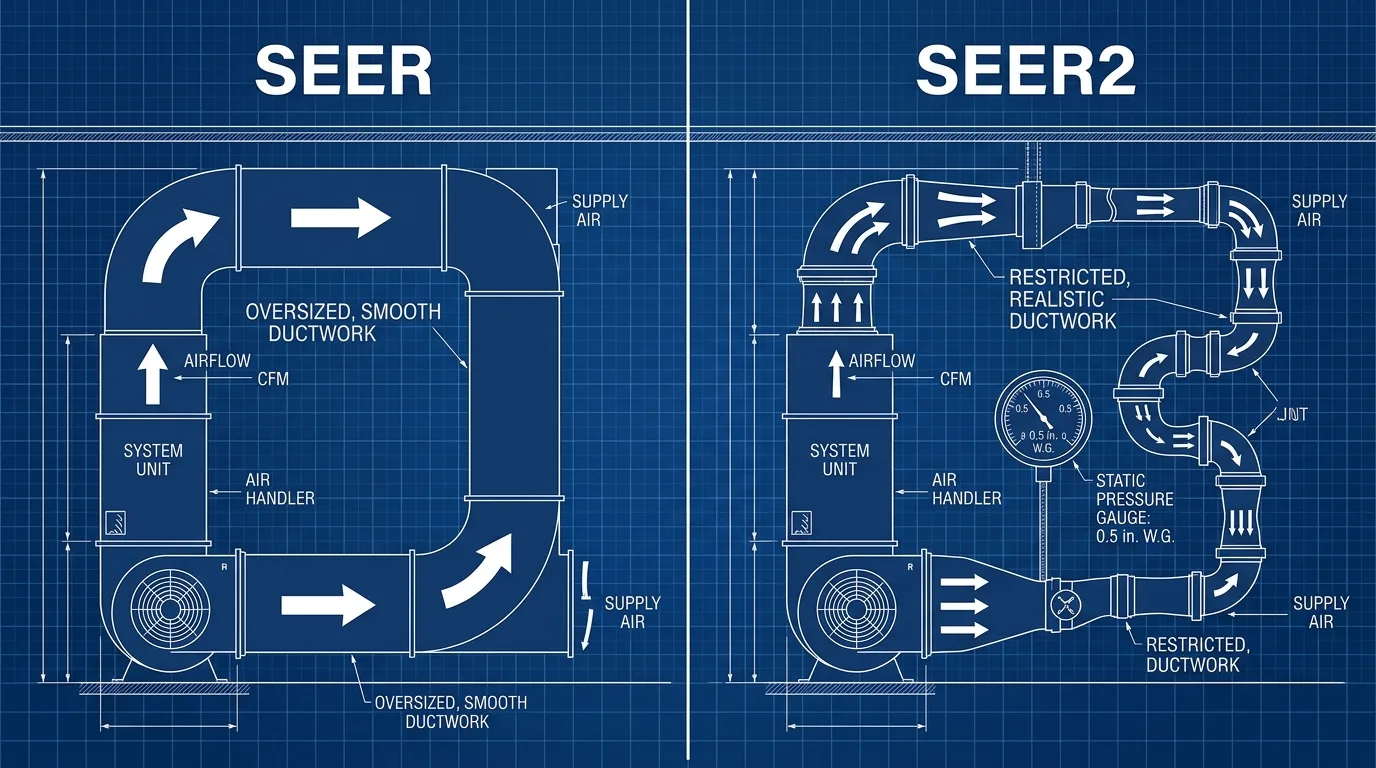
In 2023 the DOE moved AC efficiency testing from SEER to SEER2 (the "M1" test procedure). SEER2 tests use 0.5 inches of water column external static pressure — five times the load of the original SEER test — to reflect real-world duct restriction. The result: numerical ratings look lower for the same or better performance.
- Old 10 SEER ≈ new 9.55 SEER2
- Old 14 SEER ≈ new 13.4 SEER2
- Old 18 SEER ≈ new 17.2 SEER2
To compare apples to apples, multiply the old SEER by 0.955. A 10-SEER unit from 2010 replaced with an 18 SEER2 variable-speed system typically cuts cooling bills 45–50%. In high-cooling climates (Florida, Texas, Arizona) that's $300–$500 a year.
The "Weak Compressor" Diagnosis: When It's a Scam
The most persistent 2026 diagnostic scam is the "weak compressor" call — a vague finding used by sales-oriented technicians and home inspectors to push a full replacement. Compressors have three real failure modes, all measurable:
- Grounded windings. Measurable with a megohmmeter — resistance to ground below ~0.5 megohms indicates internal short.
- Open windings. Continuity test at the compressor terminals.
- Failed valves. Verified by amp draw compared to nameplate rating, and a pressure test showing the compressor can't develop rated head pressure.
If a tech recommends a $12,000 replacement based on a "weak compressor" without producing amp-draw data next to the unit's nameplate, get a second opinion. On r/hvacadvice, this is the single most flagged upsell pattern.
The A2L Nuisance Alarm Reality
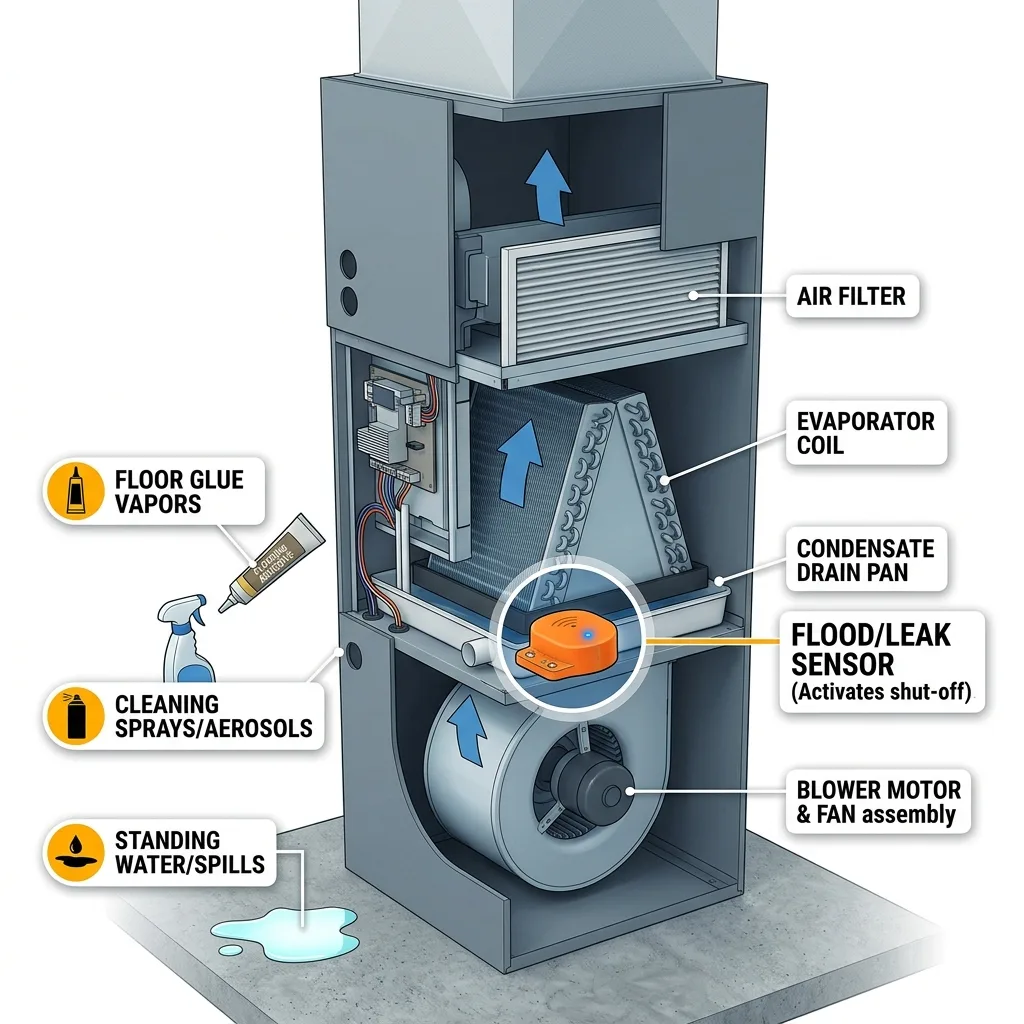
New A2L systems ship with an integrated Refrigerant Detection System that shuts off the compressor and forces the blower on if refrigerant is detected. The mitigation works. The sensors, in some 2025 models, don't — MOS-based sensors are triggered by household VOCs (paint, floor sealants, cleaning sprays, hairspray). If you install A2L in 2026, ask your contractor whether the sensor is NDIR or MOS. The premium is real; so is the reliability gap. Full detail in our A2L technician's guide and the R-32 vs R-454B comparison.
Financial Stacking in 2026
The 25C federal residential HVAC credit sunset on December 31, 2025 under the OBBBA (see our heat pump vs. gas cost breakdown for the full incentive landscape). What remains for 2026 installs:
- HEEHRA point-of-sale rebates. Up to $8,000 for qualifying heat pumps for income-qualified households, where state programs have launched.
- Utility rebates. Typically $300–$1,500 per qualifying high-efficiency system, and often stackable with HEEHRA.
The 2026 Decision Matrix
| Scenario | Recommendation | Why |
|---|---|---|
| < 5 years old, any refrigerant | Repair | Warranty coverage; refrigerant cost impact still low |
| 5–10 years, R-410A, no leak | Repair | Minor repairs pay back before the recharge trap hits |
| 5–10 years, R-410A, with leak | Case-by-case | Recharge cost pushes marginal cases toward replace |
| > 10 years, R-410A | Replace | Rule of 5,000 threshold typically exceeded |
| Any age, R-22 | Replace | Refrigerant is functionally obsolete |
| Compressor "weak" diagnosis without data | Second opinion | Most common 2026 upsell pattern |
Frequently Asked Questions
Is it worth repairing a 10-year-old AC in 2026?
Usually not, if a refrigerant recharge is required. Apply the Rule of 5,000 (age × repair cost). Once you cross 5,000, the math almost always favors replacement. Rising R-410A prices push the marginal case toward replace.
Can I still buy an R-410A AC in 2026?
Yes — but only from pre-2025 inventory, and only where state law allows. The EPA lifted the hard installation deadline in May 2026. New York's Part 494 still prohibits it.
Why is my new AC's SEER rating lower than my old one?
It isn't. In 2023 the DOE moved from SEER to SEER2 testing, which uses 5× the static pressure of the old test. Multiply an old SEER by 0.955 to compare. An "18 SEER2" unit is roughly equivalent to a 19 SEER on the old scale.