The R-410A production phase-out that took effect January 1, 2025 forced residential HVAC onto A2L refrigerants — with Global Warming Potential below 700. Two chemicals took the market: R-32 (single-component) and R-454B (a zeotropic blend). Both cut environmental impact sharply against R-410A's GWP of 2,088. Their operational differences quietly decide brand availability, service economics, and long-term reliability. Here is the comparison that matters to a homeowner picking a system in 2026.
The Numbers Side by Side
| Metric | R-32 | R-454B | R-410A (legacy) |
|---|---|---|---|
| GWP (AR5) | 675 | 466 | 2,088 |
| Composition | 100% R-32 | 68.9% R-32 / 31.1% R-1234yf | 50% R-32 / 50% R-125 |
| Temperature glide | Zero (azeotropic) | ~1.5°F (zeotropic) | Near-zero |
| Operating pressure | ~5–10% above R-410A | Nearly identical to R-410A | Baseline |
| Efficiency | 5–12% higher than R-454B | Similar to R-410A | Baseline |
| Charge size vs R-410A | ~40% less | ~5–10% less | Baseline |
| PFAS exposure | None | Contains R-1234yf | None |
The Manufacturer Split — And Why It Matters
Manufacturers picked sides based on patents, chiller compatibility, and how far they wanted to redesign their compressor platforms:
| Refrigerant | Manufacturers | Rationale |
|---|---|---|
| R-32 | Daikin, Goodman, Amana, most Mitsubishi lines | Higher single-component efficiency; Daikin's own patent portfolio |
| R-454B | Carrier, Trane, Lennox, Bryant, York, Rheem, Bosch | Pressure profile lets OEMs reuse R-410A system architectures |
This matters at the service level. If your nearest reliable HVAC company services only one brand family, that brand's refrigerant is your refrigerant. Refrigerant availability, tool inventory, and technician training all cluster around the local dealer network. See our companion A2L technician's guide for how tooling differs between the two.
Efficiency: R-32's Structural Edge
R-32 is a single-component molecule with a higher critical temperature than R-454B. In practical terms, that gives it 5–12% higher thermodynamic efficiency at rated conditions. It also lets systems run on ~40% less refrigerant mass — smaller charge sizes, lower total environmental footprint per unit. That's why R-32 dominates the mini-split market where charge size and efficiency are pricing pressure points.
R-454B doesn't chase peak efficiency. It's engineered to match R-410A's pressure profile so OEMs can bolt A2L onto architectures they'd already invested in — a lower-risk transition path for large ducted-central AC platforms.
The Fractionation Problem R-454B Owns
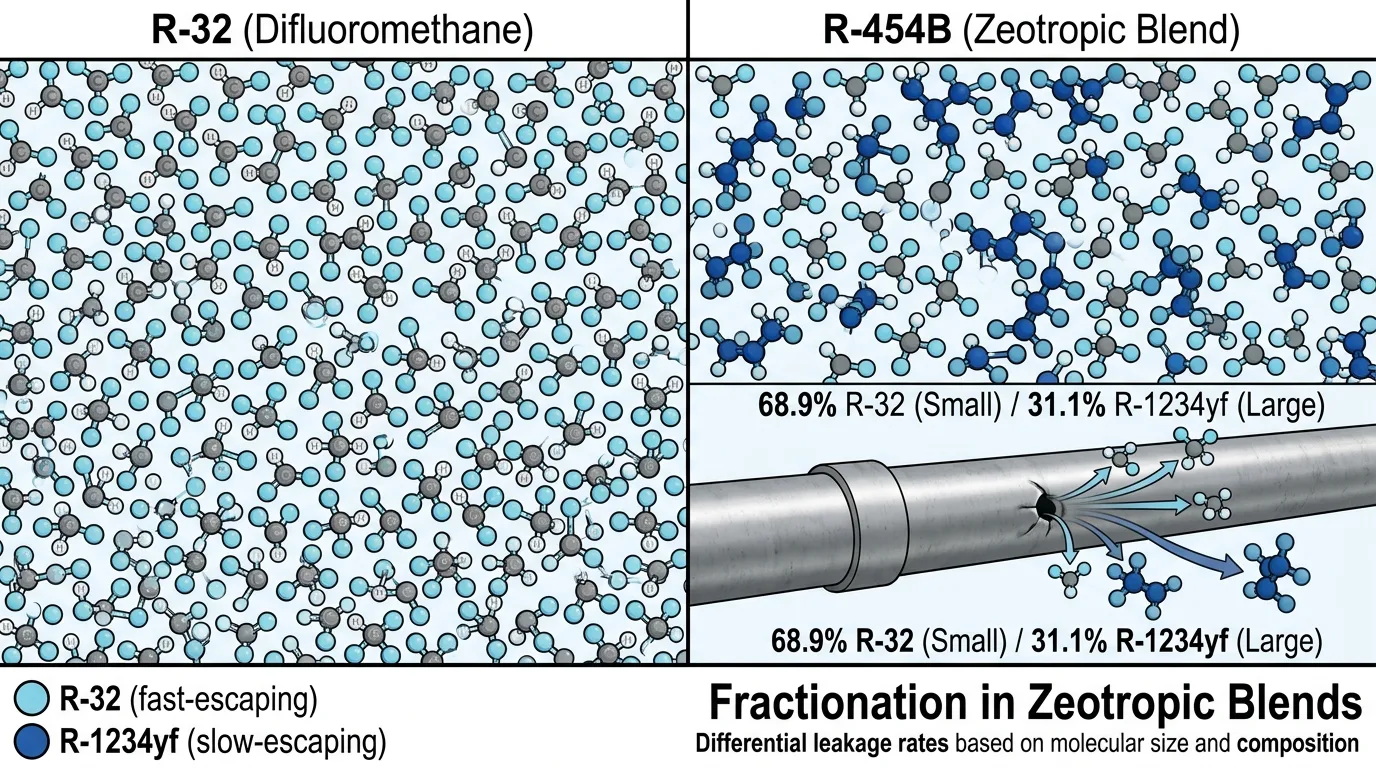
R-454B is a zeotropic blend, which means it evaporates and condenses across a small temperature band (the ~1.5°F glide). Under Graham's Law of Effusion, the lighter R-32 molecule escapes through a pinhole leak faster than the heavier R-1234yf. Over multiple slow leaks, the composition of the remaining charge shifts — the refrigerant is no longer the same blend by mass fraction that the system was designed for.
Practical consequences:
- Charging is liquid-only. Vapor charging on a blend selectively removes the lighter component from the cylinder, leaving unusable heavy residue.
- Repair-and-top-off is not always safe on R-454B. After a significant slow leak, best practice is full recovery and fresh recharge.
- R-32 has none of this. Pure component means top-off is straightforward. Any technician can find the leak, patch it, and add the missing weight.
Cost and Supply in 2026

As of early 2026, R-454B pricing runs materially higher than R-32 — reports through the supply chain put it at up to 4× per pound in constrained periods, driven by patents held by Honeywell and Chemours. R-32 is unpatented and produced by 50+ global suppliers, keeping wholesale pricing closer to legacy R-410A. That gap should compress as R-454B production scales, but for 2026 service work R-32 is the cheaper refill.
| Refrigerant | 2026 installed cost / lb | Supply notes |
|---|---|---|
| R-32 | $60–$90 | Widely available, unpatented |
| R-454B | $60–$110 | Patent-constrained, still tightening |
| R-410A | $75–$100 (rising) | Production capped and falling |
PFAS and Long-Horizon Regulatory Risk
R-454B contains R-1234yf, an HFO (hydrofluoroolefin). HFOs break down in the atmosphere into trifluoroacetic acid (TFA), which is a PFAS. Minnesota and Maine have already passed PFAS-restriction laws with effective dates in 2032 and 2040 respectively; neither currently applies to HVAC refrigerants but the trajectory matters. R-32 contains no HFO component. If PFAS regulation tightens on refrigerants over the next decade, R-32 systems are more insulated.
The Safety Story: Same UL Standard
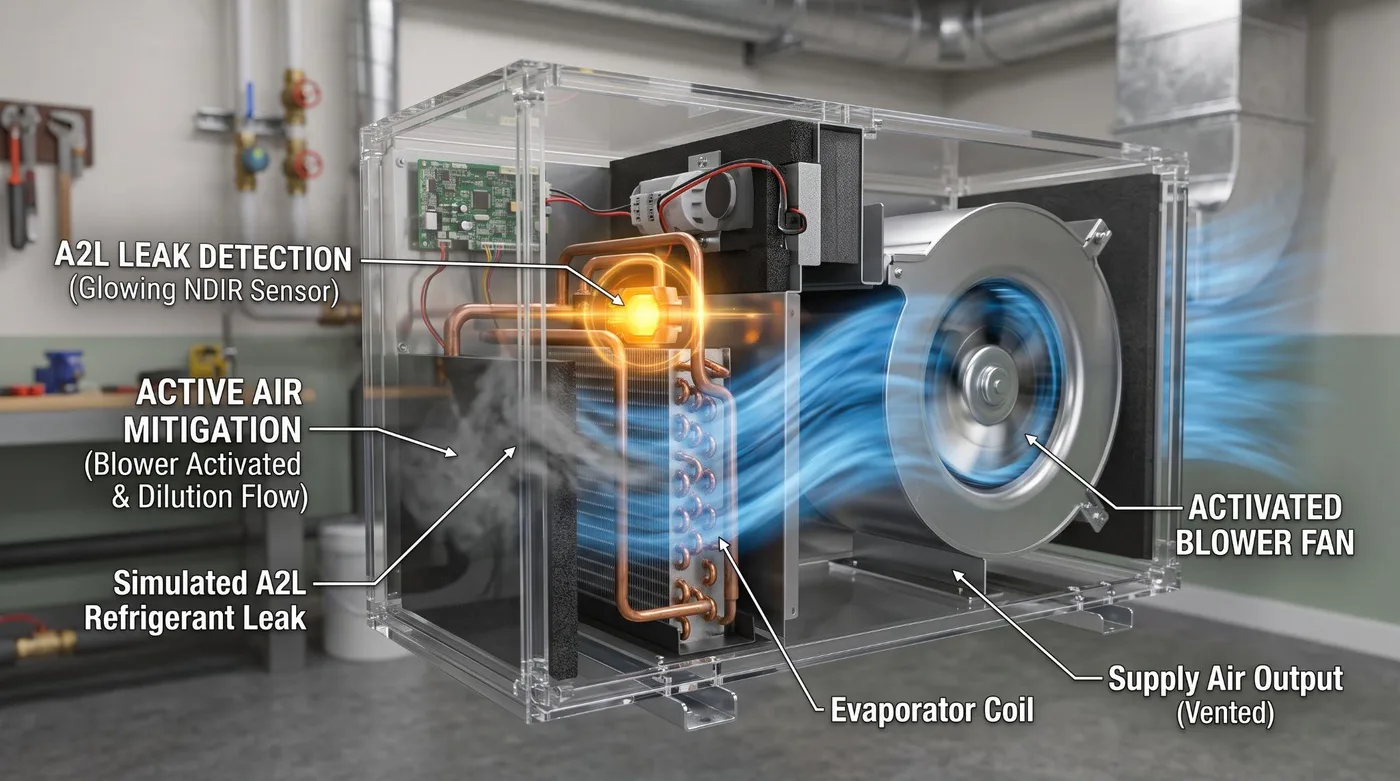
Both refrigerants operate under UL 60335-2-40. Both require a Refrigerant Detection System that shuts off the compressor and forces the blower on if refrigerant concentration crosses 25% of the Lower Flammability Limit. Neither is meaningfully more or less flammable than the other in field conditions. Nuisance sensor trips are a hardware problem — not a refrigerant one.
Which Should You Pick?
- Mini-split or ductless install: R-32 dominates the segment and its efficiency edge is real at part load.
- Central ducted replacement: R-454B dominates the OEM lineup from the big three (Carrier, Trane, Lennox). If your local pro is a Carrier or Trane dealer, R-454B is your practical answer.
- Long service horizon & simple repair economics: R-32 wins on fractionation, cost per pound, and PFAS insulation.
- Retrofit onto an R-410A architecture: R-454B is the cleaner path — it was engineered specifically for pressure compatibility.
For the underlying phase-out timeline and rebate landscape, see the R-410A phase-out overview. For the buy-vs-repair math on an aging R-410A unit, the 2026 repair-vs-replace framework.
Frequently Asked Questions
Which is better, R-32 or R-454B?
R-32 has higher efficiency, no fractionation risk, lower price per pound, and no PFAS-adjacent components. R-454B has a lower GWP (466 vs 675) and matches R-410A pressure profiles, which lets OEMs retrofit existing platforms. Both are safe when installed to code with working RDS mitigation.
Can R-32 and R-454B be mixed?
No. Systems are designed for one specific refrigerant. Mixing changes pressure behavior, oil compatibility, and lubrication — and voids UL 60335-2-40 compliance and manufacturer warranty.
Do R-32 and R-454B use different oils?
Both use POE (polyol ester) oil, but formulations are refrigerant-specific and generally not interchangeable across brands. Always match the OEM-specified oil.