The 2025 shift from R-410A to A2L refrigerants — principally R-32 and R-454B — was not a badge on a nameplate. It was a rebuild of the HVAC service kit and a new class of onboard safety hardware inside every indoor unit. In 2026, most of the field noise around A2L systems traces back to a small number of components: the Refrigerant Detection System (RDS) board, the sensor it depends on, and the tools that touch the refrigerant circuit. Here is what changed, and where the real failure modes are.
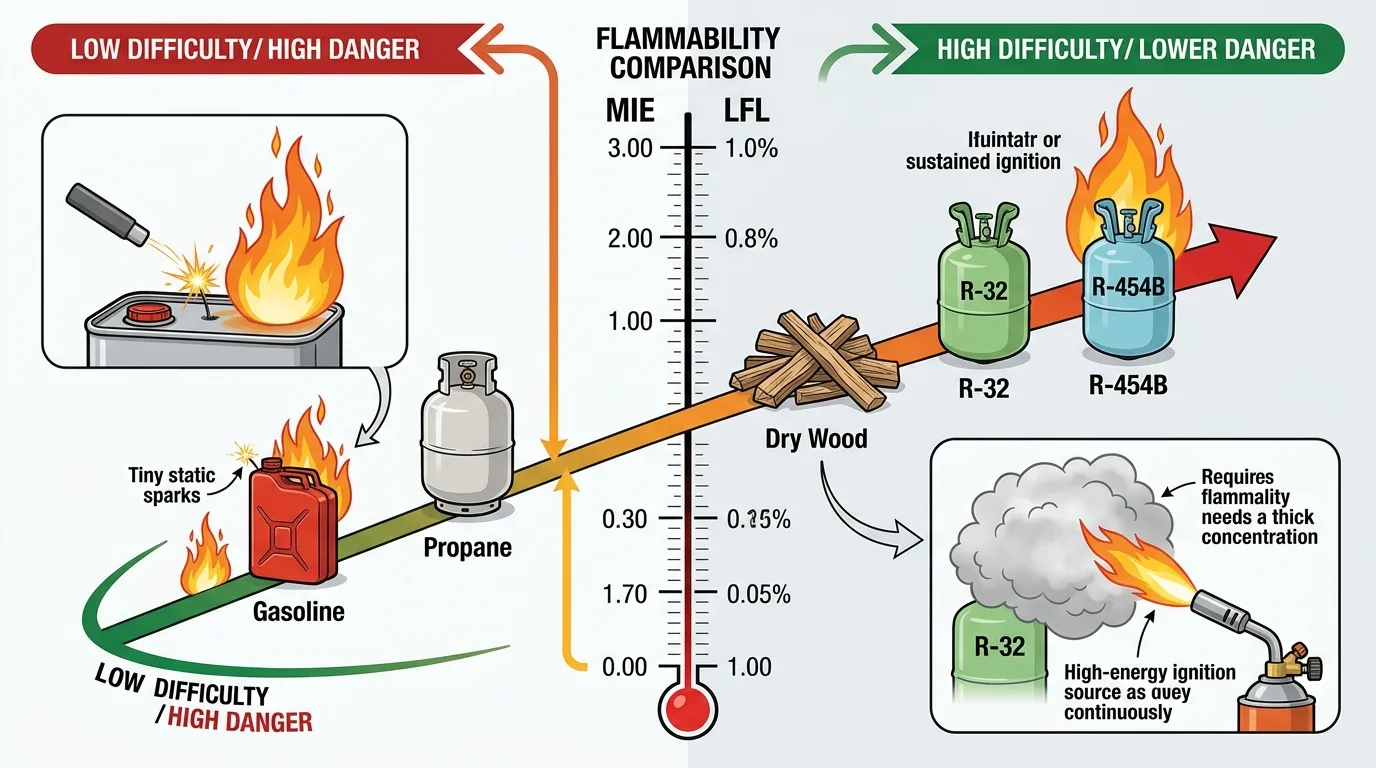
Why "2L" Isn't "3": The Flammability Numbers That Matter
ASHRAE Standard 34 classifies refrigerants by toxicity (A/B) and flammability (1, 2L, 2, 3). A2L is the "lower flammability" band. Three metrics explain why the tooling requirements shifted:
| Metric | A1 (R-410A) | A2L (R-32, R-454B) | A3 (Propane) |
|---|---|---|---|
| Lower Flammability Limit | None | High — hard to reach | Low — easy to reach |
| Minimum Ignition Energy | N/A | High — intense heat needed | Low — static spark ignites |
| Burning velocity | 0 cm/s | <10 cm/s | >40 cm/s |
R-454B's burning velocity is about 1.5 cm/s — roughly 1/30th of propane's. Ignition requires 30–100 mJ; a normal static discharge is 1–10 mJ. That's why A2L systems are safe in occupied space with the right hardware. It's also why the wrong hardware still creates a genuine ignition risk.
The Toolkit Rebuild
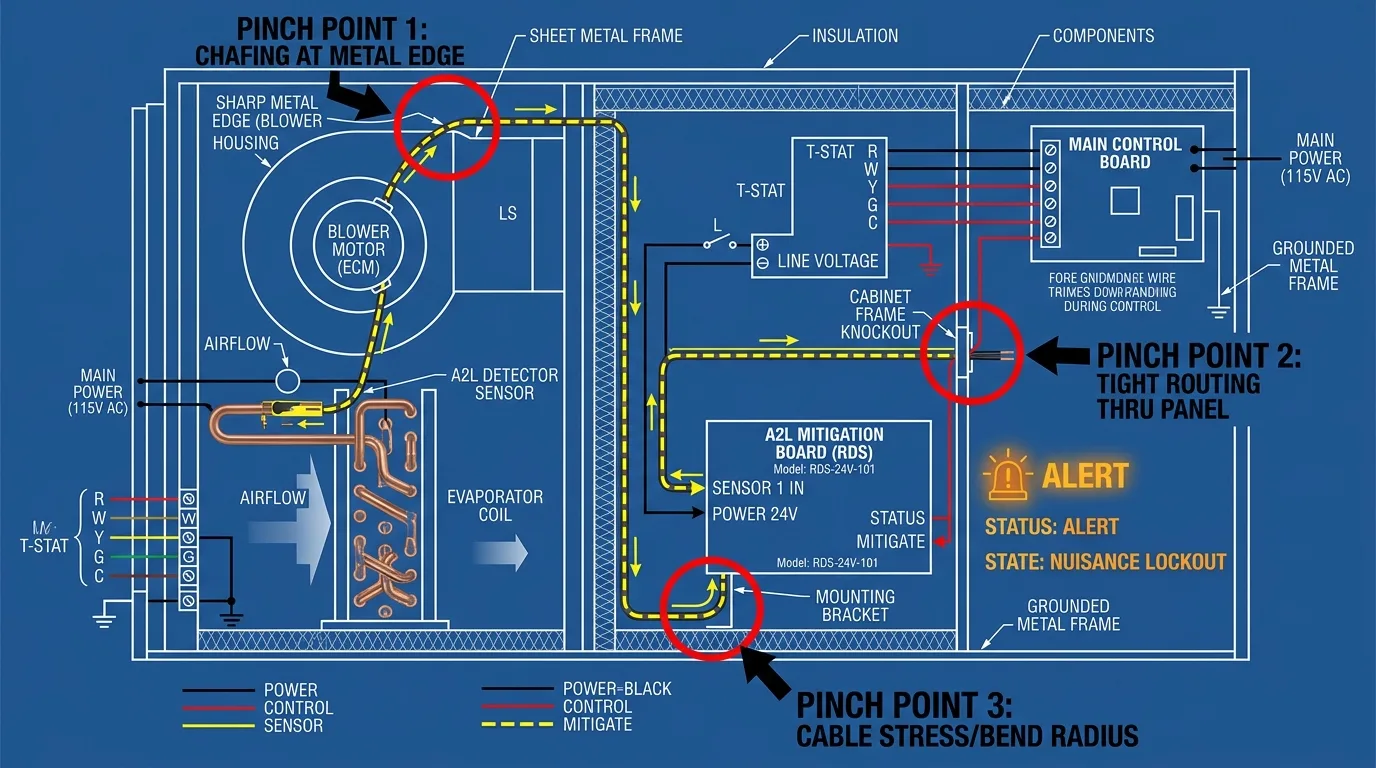
Recovery machines: DC brushless is not marketing
Legacy recovery machines run AC induction motors with mechanical relays and brush contact that arc during start/stop. Inside an A2L environment, that arc is a real ignition source. A2L-rated recovery machines use sealed DC brushless motors and non-sparking switches, certified to UL 1650 and CSA 22.2. The change is structural, not a sticker.
Leak detectors: corona is out
The old corona-discharge and heated-diode sniffers ran a high-voltage arc across the sensor tip. Under A2L rules that arc is an ignition hazard. Modern detectors — Fieldpiece DR82, Inficon D-TEK Stratus and equivalents — use non-dispersive infrared (NDIR) sensing: optical detection with no arc, refrigerant-specific, less prone to false positives from cleaner or paint vapor.
Vacuum pumps and manifolds
A2L-rated vacuum pumps isolate the power switch from the discharge vapor path. Manifolds use hoses and fittings rated for A2L pressures and the left-hand thread on A2L tanks. That left-hand thread and red shoulder band on A2L cylinders is a mechanical safety check — you can't cross-connect an A2L tank to A1 manifold set by accident.
The Refrigerant Detection System (RDS) — And Where It Fails
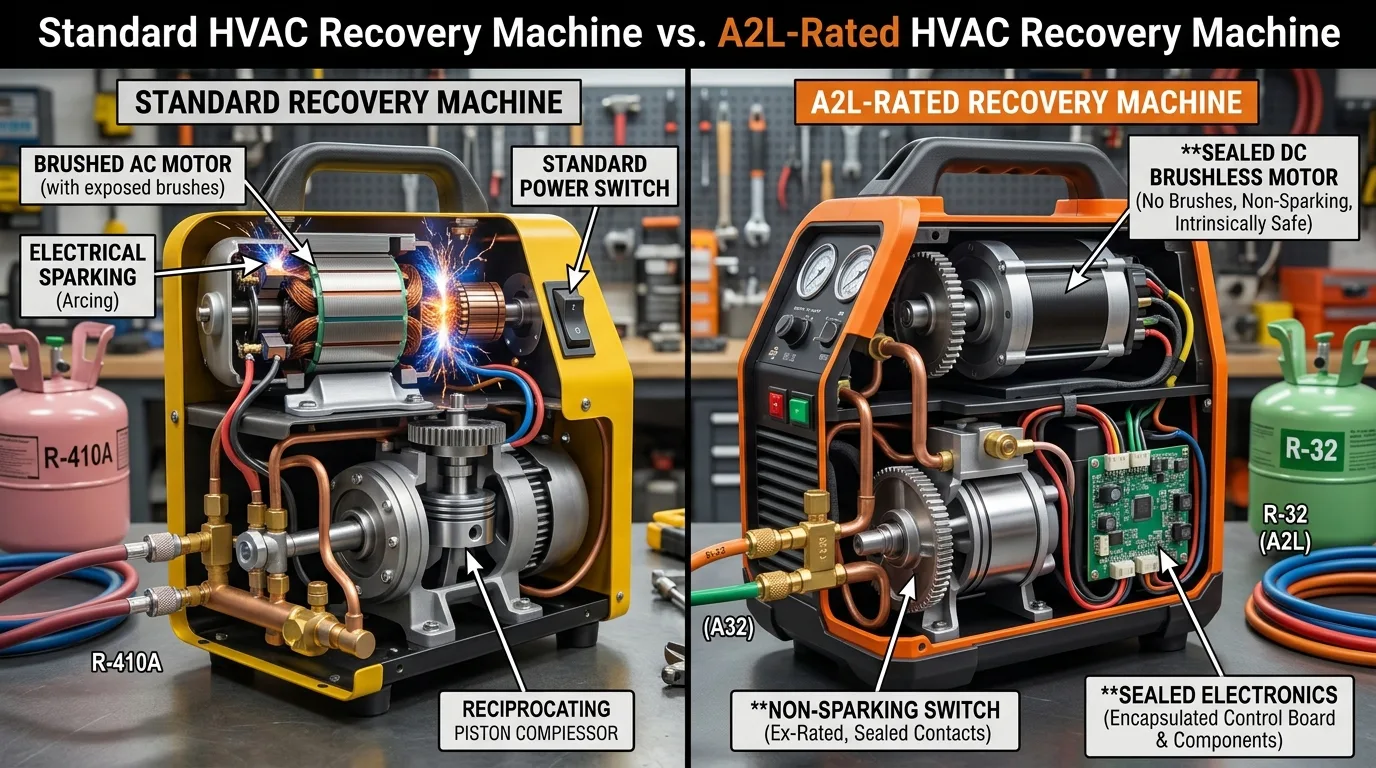
Every A2L residential air handler ships with an integrated RDS: a sensor in the evaporator cabinet wired to a mitigation board. When the sensor reads above 25% of the Lower Flammability Limit, the board runs a two-step lockout:
- Compressor cut. Outdoor unit shuts down to stop refrigerant flow.
- Blower forced on. Indoor fan runs at high speed to dilute the leaked refrigerant below the LFL.
The design is correct. The failure isn't the logic — it's the sensor. Threads on r/hvacadvice and r/HVAC are full of nuisance trips: sensors triggered by VOCs from floor sealants, fresh paint, cleaning sprays, even hairspray. The homeowner sees the fan running 24/7 with no cooling.
NDIR vs. MOS: The Silent Cost Split
| Sensor | Detection | Selectivity | Nuisance risk |
|---|---|---|---|
| Non-Dispersive Infrared (NDIR) | IR absorption at refrigerant-specific wavelength | High — targets specific molecule | Low |
| Metal Oxide Semiconductor (MOS) | Resistance change on gas contact | Low — reacts to many VOCs | High — "poisoned" by cleaners, paint |
NDIR is expensive; MOS is cheap. Some early A2L OEMs cut cost with MOS and shipped nuisance-trip problems to the field. If a system is throwing lockout codes with no leak, sensor swap-outs are the first move. Bypass is illegal, voids warranty, and defeats the safety case — even if r/HVAC threads periodically debate it while waiting on backordered sensors.
R-32 vs. R-454B: The Servicing Split
Both refrigerants meet the sub-700 GWP target the EPA imposes on new residential AC/heat pump manufacture from January 1, 2025. Servicing them is not the same job:
| Trait | R-32 | R-454B |
|---|---|---|
| Composition | Single-component (100% R-32) | Blend — 68.9% R-32 / 31.1% R-1234yf |
| Temperature glide | Zero | ~1.5°F |
| Charging method | Liquid or vapor | Liquid only |
| Fractionation risk | None | Real — see below |
| Manufacturer adoption | Daikin, Goodman, Amana, Mitsubishi | Carrier, Trane, Lennox, Bryant, Rheem |
Fractionation is real, per Graham's Law of Effusion. Lighter R-32 molecules escape through a pinhole leak faster than heavier R-1234yf. A slow, persistent leak on an R-454B system can shift the remaining charge's ratio out of spec — eventually the system won't run to design without a full recovery and fresh recharge. On an R-32 system you find the leak, patch it, and top off. That single difference dictates a lot of long-term service economics.
Code Nuance: The Shaft Ventilation Problem
ASHRAE 15 and 15.2 require mechanical or natural ventilation on refrigerant piping in multi-story shafts if joints exist inside the shaft. The industry workaround — increasingly common in retrofit — is "continuous copper": running unbroken factory-drawn tube through the shaft with all brazed joints outside it. That reclassifies the shaft as a straight refrigerant conduit and sidesteps the ventilation mandate. It also puts pressure on line-set logistics, since standard 50-ft coils no longer cover taller shafts cleanly.
Field Realities, Documented
- Sensor DOA rate is not zero. Multiple 2025-vintage air handlers shipped with sensors that failed within 6–12 months. Check firmware and sensor batch when commissioning.
- Line-set reuse rules changed. A2L installs require verified flush and pressure test on any reused line set. Some OEMs void warranty on reuse. Ask.
- POE oil moisture matters more. The oil chemistry on A2L systems is less forgiving of humidity intrusion during evacuation. Longer, deeper vacuums pay off.
Companion reading: our R-410A phase-out breakdown for the consumer angle, the R-32 vs R-454B comparison, and the 2026 repair-vs-replace framework.
Frequently Asked Questions
Are A2L refrigerants really dangerous?
They are classified "lower flammability" — burning velocity under 10 cm/s and ignition energies 30–100 mJ. In properly installed systems with RDS mitigation, they meet UL 60335-2-40 safety requirements.
Why does my A2L system's fan run non-stop?
Almost always a nuisance sensor trip. VOCs from paint, floor sealants, or cleaning sprays can trigger MOS-based leak sensors. Diagnostic is a sensor read, not a refrigerant chase.
Can I keep using my R-410A tools?
Not on A2L work. Recovery machines, leak detectors, and manifolds must be A2L-rated. Corona-discharge and heated-diode leak detectors are ignition hazards on A2L systems.