The residential HVAC industry is in the middle of its biggest chemical transition since R-22 came out of production. Driven by the American Innovation and Manufacturing (AIM) Act of 2020 and follow-on EPA rulemaking, R-410A — the refrigerant in nearly every central AC and heat pump installed since 2010 — is being phased down in favor of two "A2L" alternatives, R-32 and R-454B. For homeowners in 2026, that shift shows up as higher new-equipment prices, a coming spike in repair costs on older systems, and a tax-credit landscape that was completely rewritten in mid-2025.
Why R-410A Is Being Phased Down
Unlike R-22, which was banned for its ozone-depleting properties, R-410A is being cut for its Global Warming Potential (GWP) — how much heat the gas traps in the atmosphere relative to CO₂ over 100 years. R-410A's GWP is 2,088. Its replacements are dramatically lower.
| Refrigerant | GWP | Ozone Depletion Potential | Status in 2026 |
|---|---|---|---|
| R-22 (Freon) | ~1,810 | High | Production banned since 2020 |
| R-410A (Puron) | 2,088 | Zero | Being phased down |
| R-32 | 675 | Zero | New A2L, single-component |
| R-454B | 466 | Zero | New A2L, blend |
The AIM Act's goal is an 85% reduction in HFC production by 2036, executed through a stepped production cap. The most consequential step for consumers arrived on January 1, 2025: new residential air conditioners and heat pumps manufactured after that date must use a refrigerant with a GWP under 700. R-410A does not qualify.
The A2L Reality: Mildly Flammable, and Regulated Accordingly
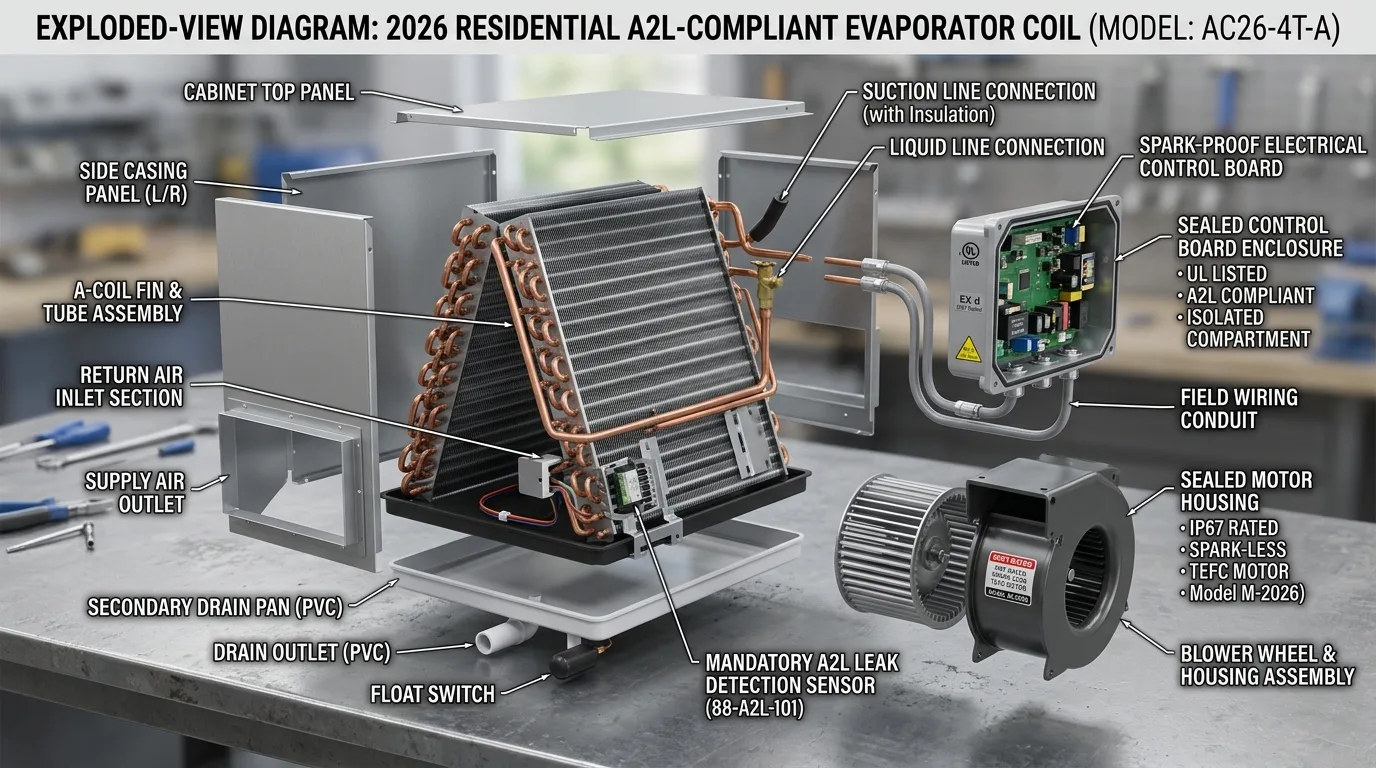
ASHRAE classifies R-32 and R-454B as A2L — "lower flammability" — which is a real change from R-410A (A1, non-flammable) even if the flame speed is roughly 1/10th that of propane. In practice, A2L classification drives three hardware requirements that show up on your invoice:
- Mandatory leak sensors inside indoor units, which trigger the blower to purge and lock out the compressor if refrigerant is detected.
- Redesigned components — hermetic electrical connections, revised service valves, updated brazing procedures.
- New service tooling. Manifold gauges, recovery machines, and vacuum pumps rated for A2L are required; hoses and fittings differ.
Combined, these push new-system prices roughly 15–30% above pre-transition R-410A equivalents. Some of that will come down as manufacturers scale — but the sensor and redesign costs are permanent.
R-32 vs. R-454B: The Manufacturer Split
The industry did not converge on a single fluid. Manufacturers picked sides based on patent access, chiller compatibility, and mildly different pressure characteristics.
| Refrigerant | Type | Major manufacturers | Practical trait |
|---|---|---|---|
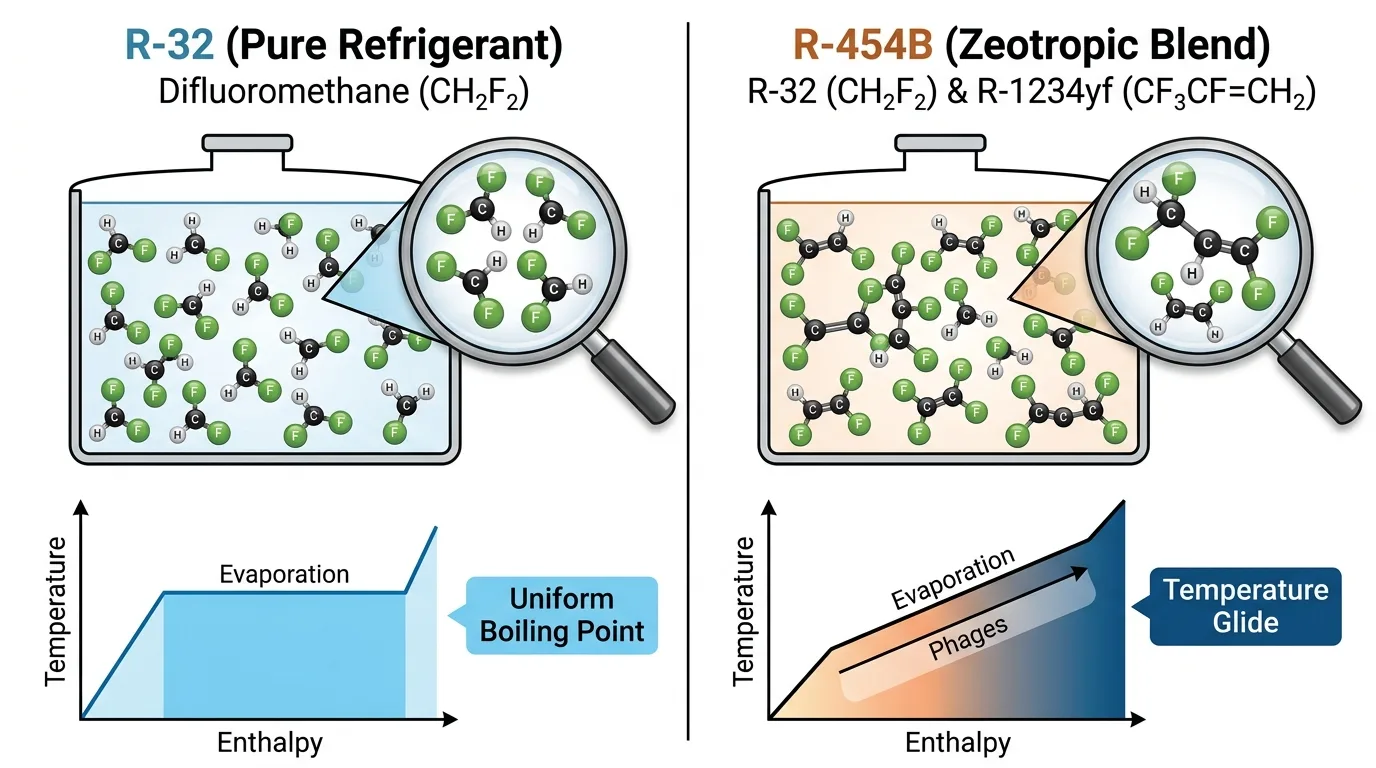
| R-32 | Single component | Daikin, Goodman, Amana, most Mitsubishi lines | No "glide" — leaks vent uniformly, topping off is straightforward |
| R-454B | Blend (R-32 + R-1234yf) | Carrier, Trane, Lennox, Bryant, Johnson Controls | Small temperature "glide"; a slow leak may fractionate, sometimes requiring full recovery and recharge |
Discussions on the r/hvacadvice community have called this a "Betamax vs. VHS" moment. In field terms it mostly is not. Both refrigerants perform well; the divergence matters chiefly for service techs (two toolkits, two training paths) and for homeowners whose brand loyalty is now a refrigerant commitment.
What Happens to Your Existing R-410A System
Existing R-410A equipment can keep running. R-410A itself is not illegal to service, and service technicians can continue to charge and recover it. What changes is supply. As production ratchets down, R-410A prices for service refills have already climbed and will keep climbing. Two practical numbers to keep in mind:
- Repair-vs-replace inflection. A compressor replacement or major leak repair on a 10-year-old R-410A system in 2026 often costs enough — with the higher refrigerant charge — that the math tips to replacement. Get the full recovery-and-recharge quote, not just the parts price.
- "Deprioritized enforcement" window. The EPA has signaled discretionary enforcement for R-410A equipment already in the distribution channel through much of 2026, so field stock is still being installed. That does not extend to future manufacturing.
The 2025 Federal Credit Rewrite
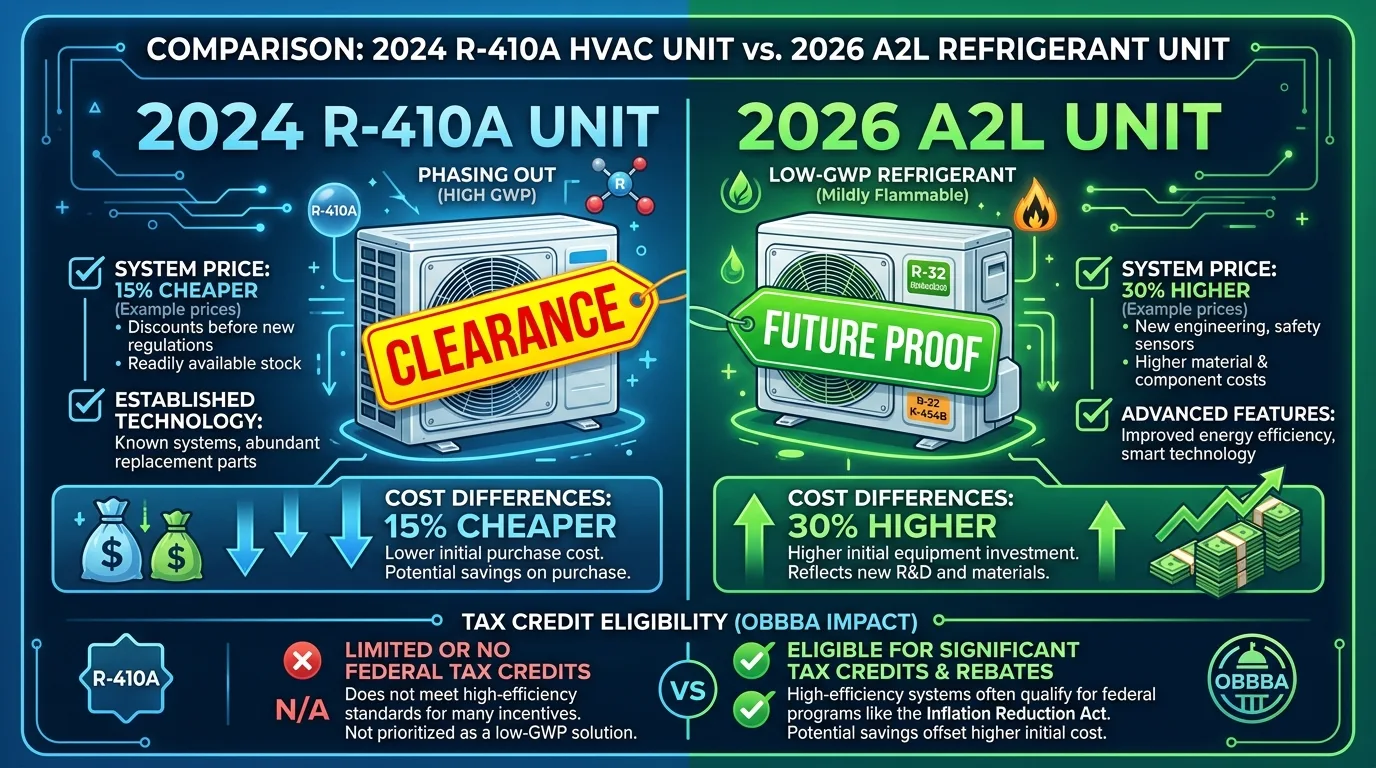
The Inflation Reduction Act's Section 25C credit — up to $2,000 for a qualifying heat pump — was originally scheduled to run through 2032. That timeline changed. The One Big Beautiful Bill Act (OBBBA), enacted in mid-2025, sunset the residential 25C and 25D credits for HVAC equipment placed in service after December 31, 2025. Homeowners planning a 2026 install should therefore not assume federal credits are available; the incentive layer that remains is state and utility.
Two pieces of the incentive stack survived and matter:
- HEEHRA point-of-sale rebates where states have launched their programs, offering up to $8,000 for heat pump installations for qualifying low- and moderate-income households. Availability varies sharply by state and by program capacity.
- Utility rebates — often $500–$3,000 per qualifying heat pump, with better tiers for cold-climate-rated units. These are set by the utility, not the federal calendar.
Field Realities Manufacturers Don't Advertise
- Early A2L sensor false-alarms. Some early A2L units logged nuisance leak-sensor trips at commissioning. Manufacturers issued firmware and sensor updates; if you install a 2025-vintage unit, ask whether the update has been applied.
- R-454B glide is real but small. Field techs report a 1–2°F glide that matters for superheat/subcool calculations but not for day-to-day cooling.
- Line-set reuse rules changed. A2L installations require verified flush and pressure testing on any reused line sets; some manufacturers void warranty on reuse. Ask.
What This Means for Buying Decisions
- Don't rush a healthy R-410A system into replacement for phase-out reasons alone. It is legal to operate and service; replacement math should be driven by failures, efficiency gain, and utility rebates.
- Get an itemized 2026 quote that shows equipment, refrigerant charge, mandatory A2L installation labor, and any needed panel or line-set work separately.
- Confirm state rebate eligibility in writing before signing. HEEHRA programs are first-come; the contractor's assumption is not enough.
- Match refrigerant to service reality. If your only nearby HVAC company services one brand, that de facto picks your refrigerant.
For deeper on the equipment side, see our companion piece on cold-climate heat pumps and the 2026 heat pump vs. gas furnace cost comparison.
Frequently Asked Questions
Is R-410A illegal to service in 2026?
No. R-410A can still be recovered, recharged, and repaired legally. What is being phased down is production of new R-410A refrigerant, which pushes service refill prices higher over time.
Do I have to replace my current air conditioner?
No. Existing R-410A systems can operate indefinitely. Replacement is driven by equipment failure, efficiency payback, or rebate opportunity — not by the phase-out itself.
Is A2L refrigerant dangerous in my home?
A2L refrigerants are classified "lower flammability" and require mandatory leak sensors, ventilation logic, and revised installation practices. Properly installed A2L equipment meets UL 60335-2-40 safety standards.
Is the federal heat pump tax credit still available in 2026?
The 25C credit for residential HVAC equipment sunset on December 31, 2025 under the OBBBA. State and utility rebates — especially HEEHRA where funded — remain the primary incentive layer in 2026.