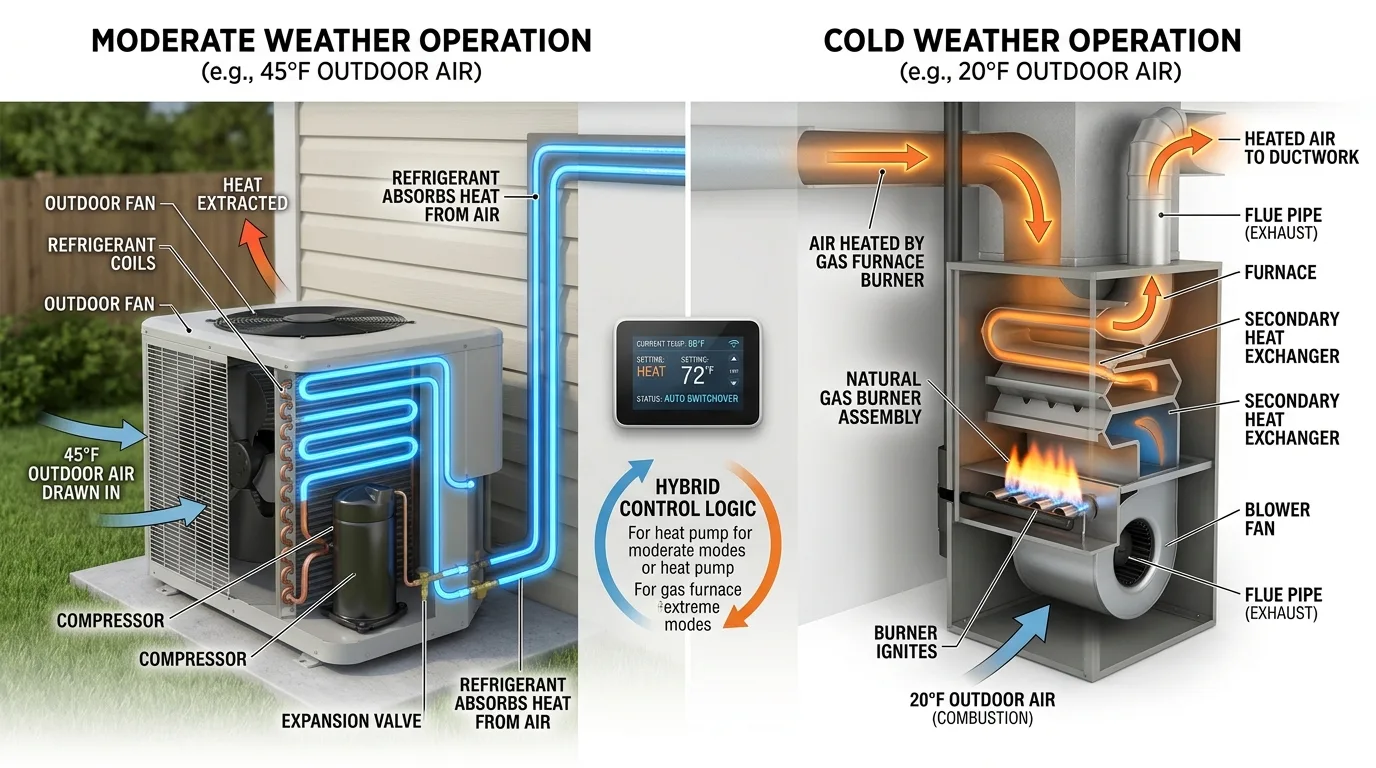
A hybrid — or "dual-fuel" — HVAC system pairs an inverter-driven air-source heat pump with a gas furnace and hands off between them at a tuned balance point. The heat pump runs the fall and spring, and much of an average winter; the furnace steps in on the coldest hours. Done right, it captures the operating-cost win of a heat pump without giving up the recovery speed and comfort of a gas system. Done wrong — usually a retrofit with the wrong blower or a lazy 40°F switchover — it burns more gas than a straight furnace.
How the Two Sources Actually Share the Job
A hybrid system uses one blower and one distribution network, with two independent heat sources:
- Cooling season. The heat pump operates as a standard central AC. Furnace is inactive.
- Mild heating (roughly 30–55°F outdoor). The heat pump reverses and runs alone. COP is typically 2.5–3.5, so 1 kWh of electricity delivers 2.5–3.5 kWh of heat.
- Cold heating (below the balance point). The thermostat locks out the heat pump and the furnace fires, producing 120–140°F supply air at 90–96% AFUE.
The handoff is controlled by an outdoor sensor and a smart thermostat, not by the heat pump "giving up." A good controller uses a slightly hysteretic band so the two sources don't cycle back and forth on marginal days.
The Balance Point: Thermal vs. Economic
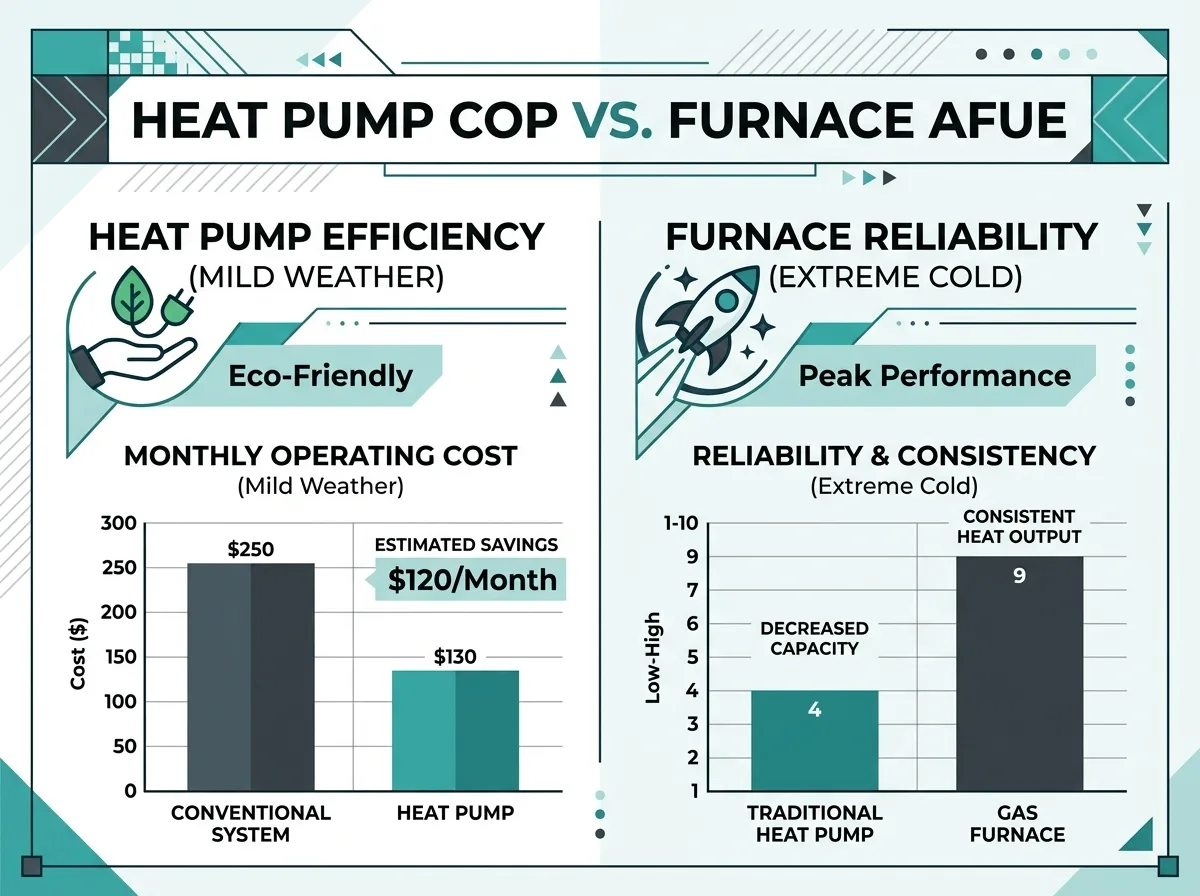
There are two balance points a hybrid installer should be tuning, and they are not the same number.
- Thermal balance point. The outdoor temperature at which the heat pump's output equals the home's heat loss. Below this, the heat pump alone can't keep up.
- Economic balance point. The outdoor temperature at which cost-per-BTU is equal for heat pump and gas. Below this, gas is cheaper per BTU delivered.
The economic balance point depends on your electricity price, gas price, and heat pump COP curve. In practice most systems ship configured to switch over at 35–40°F outdoor. That number is a legacy default from the era of standard heat pumps. Modern CCHPs paired with mid-range electricity rates typically have an economic balance point of 25–30°F. Leaving the default 40°F setpoint on a CCHP hybrid installs the "burn gas earlier than needed" mistake by default.
Reverse Staging, and Why "Cold Air Blast" Complaints Come From It
A properly tuned hybrid does reverse staging: on a cold start, the furnace fires first for a couple of minutes to preheat the ducts and coil, then hands off to the heat pump if outdoor conditions warrant. Without reverse staging, the heat pump on a cold morning pushes 85°F air across a cold coil and delivers 78°F air to your registers for the first ten minutes. That is the "cold blast" complaint that drives return calls.
The Retrofit Trap: PSC Blower Motors
The biggest single reason hybrid retrofits fail is the existing furnace blower. Legacy furnaces use Permanent Split Capacitor (PSC) motors that spin at one or two fixed speeds. Modern inverter heat pumps modulate output continuously and need an Electronically Commutated Motor (ECM) blower that can vary airflow to match the heat pump's variable output. A PSC blower forces the heat pump to operate outside its designed static-pressure window; you get short-cycling, coil freeze-ups in cooling, and low-side pressure faults in heating.
The clean answer: replace the furnace blower with an ECM (some furnaces support a drop-in module; some require a control board swap; some need a new furnace) as part of the retrofit. Ask the installer specifically. Getting past this is the difference between a hybrid that works for 15 years and one that fights itself for two.
Where Hybrid Still Beats a Pure Heat Pump
Even with the 2025 policy changes, hybrid systems still win the total-cost math in three clear scenarios:
- Cold climates with cheap gas. When your electricity-to-gas ratio is above roughly 4× and winter design temperatures are below 0°F, a hybrid burns dramatically less than either alone.
- Home already has a healthy furnace. Adding an outdoor heat pump to a functional furnace (with an ECM blower) is often the cheapest path to heat pump operating economics.
- Peak-price electric utility. Time-of-use rate structures that spike on winter mornings punish pure-heat-pump homes. A hybrid switches to gas at exactly the wrong-price hours.
Where hybrid is a bad answer: mild climates with a healthy grid, where the added complexity and gas connection fee never pay back. See our 2026 cost comparison and the CCHP guide.
The 2026 Regulatory and Refrigerant Layer
- 25C credits are gone. Federal residential HVAC credits sunset December 31, 2025 under the OBBBA. State HEEHRA rebates and utility incentives remain live.
- A2L refrigerant. The heat pump side of a 2026 hybrid uses R-32 or R-454B, adding 15–30% to sticker versus pre-transition pricing. Full detail in the R-410A phase-out piece.
- Panel and gas-line checks. A hybrid needs both a healthy electric service (some retrofits force a panel upgrade) and a functional gas line. Cost surprises usually hide here.
Field Realities from Reddit
- Static pressure is where hybrid retrofits die. Techs on r/hvacadvice routinely warn that a hybrid installed on a duct system with 0.8+ inches WC of external static will underperform in both modes.
- Set the switchover with the outdoor sensor, not the thermostat. Ecobee and Nest can control switchover reasonably; a dumb thermostat with a fixed setpoint cannot see the actual balance point in real time.
- Two-stage furnaces are the good pairing. Single-stage furnaces make the low-load handoff too abrupt; two-stage or modulating furnaces marry cleanly to a variable-speed heat pump.
What to Ask Before You Sign
- Blower motor: ECM or PSC? If PSC, what's the upgrade path?
- External static pressure measurement at commissioning — written on the invoice.
- Thermal and economic balance points calculated for your fuel prices — not a default 40°F.
- Reverse-staging enabled at the thermostat.
- Manual J load calculation. Non-negotiable.
Frequently Asked Questions
What is a hybrid HVAC system?
A dual-fuel system that pairs an electric heat pump with a gas furnace, sharing one blower and one distribution network. A smart thermostat hands off between them at a tuned outdoor-temperature balance point.
Can I add a heat pump to my existing gas furnace?
Usually yes, but the furnace must have (or be upgraded to) an ECM variable-speed blower. Adding a modulating heat pump to a legacy PSC blower forces the system outside its designed static-pressure envelope and causes short-cycling and cold-blast complaints.
What temperature should a hybrid HVAC switch to gas?
Not the factory-default 40°F. The right switchover is your economic balance point — the outdoor temperature where gas becomes cheaper per BTU delivered than the heat pump. For most 2026 electricity and gas prices with a modern CCHP, that's 25–30°F, not 40°F.