The single most persistent myth about heat pumps is that they "stop working in the cold." The 2026 reality — driven by vapor-injection compressor design and inverter modulation — is that certified cold-climate heat pumps (CCHPs) hold their rated heating capacity to 5°F and continue operating to -13°F. What sales pages leave out is why they still sometimes underperform in the field, and it is almost never the physics.
The Physics: You Are Moving Heat, Not Making It
A heat pump is a refrigeration cycle run in reverse. Its outdoor refrigerant boils at a temperature well below outdoor air — modern blends boil around -60°F to -50°F at atmospheric pressure — so it can pick up thermal energy from air that feels frigid to a human hand. That gas is then compressed, which spikes its temperature, and dumped into the indoor coil.
Efficiency is measured as Coefficient of Performance (COP) — heat delivered divided by electricity consumed. A COP of 3.0 means 3 units of heat delivered per unit of electricity. It falls as outdoor temperature drops, because the compressor has to work harder to bridge the gap.
| Outdoor temperature | Typical CCHP COP | What it means |
|---|---|---|
| 47°F | 3.5–4.0 | Ideal range — 3.5–4× the heat per kWh |
| 17°F | 2.2–2.8 | Still ~2.5× more efficient than resistance heat |
| 5°F | 1.8–2.2 | CCHP-rated units hold rated capacity here |
| -13°F | 1.4–1.8 | Cutoff for most CCHP units; still beats electric strip |
The Innovation: Vapor Injection
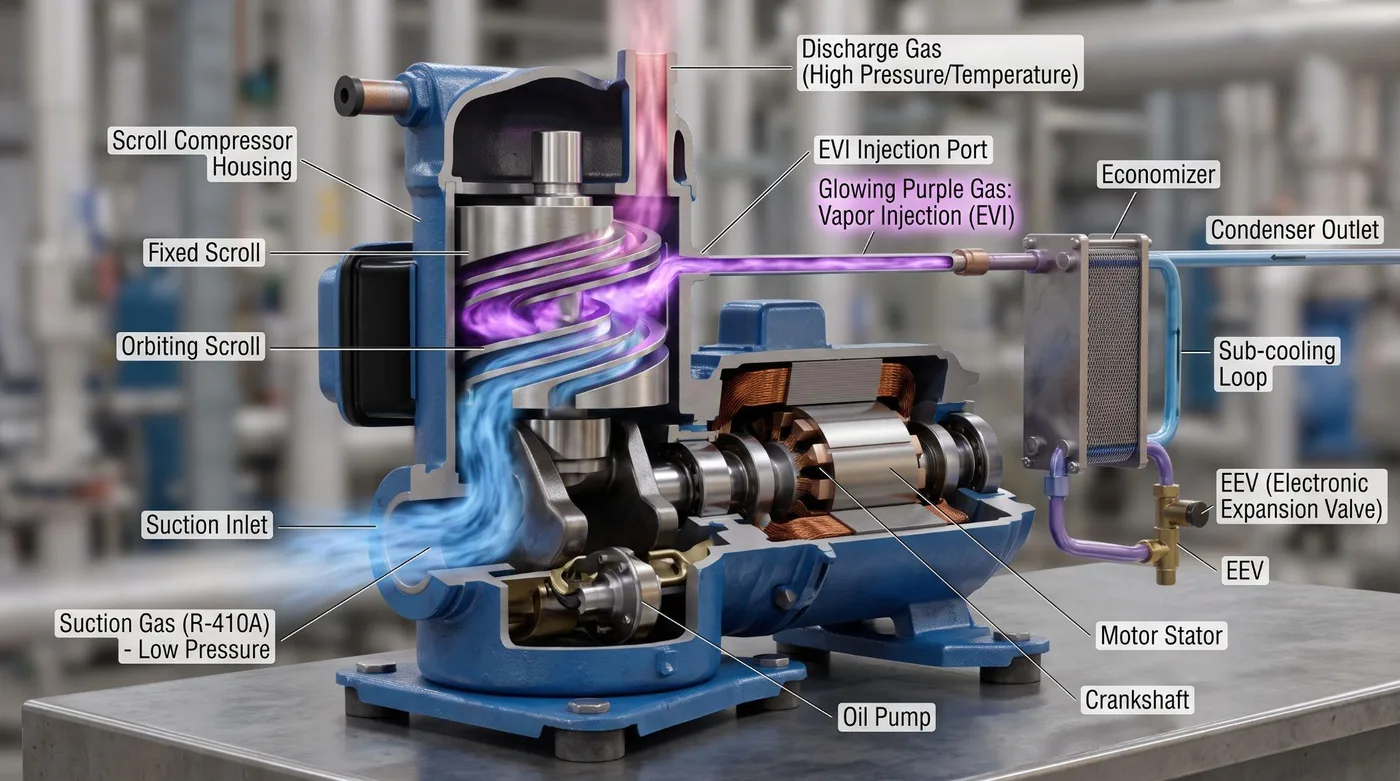
What separates a CCHP from a standard heat pump is Enhanced Vapor Injection (EVI). An intermediate-pressure refrigerant stream is injected into the compression chamber mid-stroke through an economizer circuit. That extra mass flow does two useful things at once: it raises heating capacity at low ambient temperatures and it cools the compressor motor, extending its safe operating envelope. It is the single design change that lets units like Mitsubishi Hyper-Heat, Bosch IDS Ultra, and Carrier Infinity CCHP hold rated capacity at 5°F where a standard heat pump would already be at 60% of rating.
Two other design elements ride along with EVI:
- Inverter-driven compressor. Variable speed lets the unit modulate output from ~20% to 120% of nominal rather than cycling on and off, which cuts electric strip usage.
- Base pan heaters. A small resistance element in the drain pan (typically 30–100W) keeps defrost meltwater from refreezing into an ice mound that eats the fan blade.
What Actually Breaks: The Field Reality
Physics rarely fails at -10°F. Installation does. Discussions on r/heatpumps and r/hvacadvice come back to the same short list.
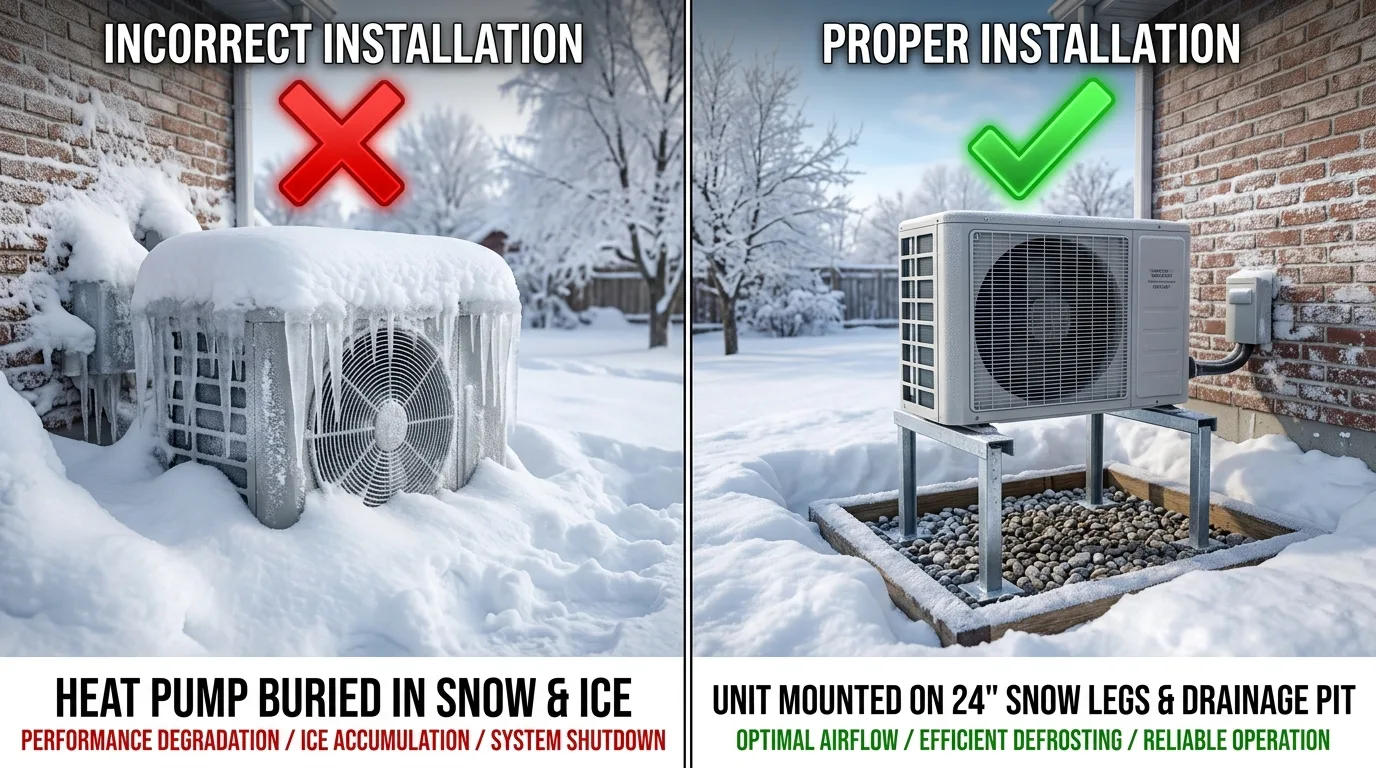
- The ice mound. Every heat pump periodically reverses to melt frost off the outdoor coil (the "defrost cycle"). The meltwater has to drain away. If the condenser sits on a low pad and drainage is blocked, the meltwater refreezes under the unit and grows upward — sometimes into the fan blade. Fix: mount the condenser on 18–24 inch "snow legs" over a gravel drainage pit.
- The "screaming" compressor. A high-pitched squeal at -10°F is usually refrigerant equalization through an Internal Pressure Relief valve or a base-pan sensor error. It is not always a failure, but it is diagnosable — don't accept "they all do that" as an answer.
- Undersized Manual J. The heat pump has to be sized to a real load calculation, not a rule-of-thumb sqft number. Oversized units short-cycle and lose efficiency; undersized units run backup electric strips constantly and drive $700+ winter bills.
- Wrong balance point. On a hybrid or backup-strip system, the switchover temperature has to be tuned. Default 40°F setpoints are conservative and burn electricity.
Understanding HSPF2 and What "Cold-Climate Rated" Means
The 2023 U.S. efficiency standard shifted from HSPF to HSPF2, which uses more realistic external static pressure assumptions. HSPF2 numbers look lower than HSPF — a 10 HSPF unit is roughly an 8.5 HSPF2 unit. That is not a performance downgrade; it is a measurement change.
A unit qualifies as CCHP under the Northeast Energy Efficiency Partnerships (NEEP) specification when it delivers:
- At least 70% of rated capacity at 5°F
- Documented COP ≥ 1.75 at 5°F
- Continued operation below 0°F
If a unit is not on the NEEP Cold-Climate ASHP list, its "cold-climate" marketing claim is not third-party verified.
The Bill-Shock Question
Homeowners in Massachusetts, New York, and other high-electric-rate states occasionally post $1,000+ January bills after a heat pump conversion. In almost every case it is one of three causes: an undersized unit forcing constant backup-strip runtime, a poorly tuned setback thermostat treating the heat pump like a furnace, or a hybrid system with a switchover point that never gives the pump a chance to run. Heat pumps are "maintainers," not "recoverers" — big overnight setbacks work against them.
For the full cost math, see our 2026 heat pump vs. gas furnace comparison. For system layout, see the ductless vs. ducted layout guide.
The Contractor Skepticism Problem
A recurring theme in northern-state Reddit threads: an older HVAC company insists a heat pump "can't handle" a Vermont or Minnesota winter and recommends a gas furnace instead. That was true a decade ago. It has not been true of NEEP-listed CCHPs since roughly 2018. The way through this is to bring the NEEP data sheet for the specific model to the sizing conversation and ask for a written Manual J.
Frequently Asked Questions
At what temperature does a cold-climate heat pump stop working?
Certified CCHP units continue to operate down to -13°F, with capacity gradually falling below the 5°F rating point. Below that, most units switch to backup electric or hybrid gas heating.
Do I need a backup heat source with a cold-climate heat pump?
In most Zone 6+ climates, yes — either electric-resistance strips built into the air handler or a hybrid gas furnace. The backup runs only when the heat pump's output falls below the home's design heat load.
Why is my heat pump making a screaming noise?
At extreme cold, a high-pitched sound often traces to refrigerant equalization through an Internal Pressure Relief valve. It can also indicate base-pan heater or defrost sensor issues. A properly commissioned CCHP should not scream in normal operation — get it diagnosed.
How high should a cold-climate heat pump be mounted?
18–24 inches above the average local snow line, on rated snow legs, over a gravel drainage pit. Elevation prevents defrost meltwater from refreezing into an ice mound that can damage the fan blade.