The Short Answer
During an active rainstorm, focus on protecting your interior first and postpone any exterior roof work until it is safe. Contain the leak with buckets, plastic sheeting, and a small hole poked in a bulging ceiling to release water in a controlled way. Do not climb on a wet roof in high wind. Once the rain slows and the roof is not slick, a temporary tarp secured with furring strips or a fiber-reinforced wet-patch roofing cement can seal the leak for 30 to 90 days until a professional repair. Photograph everything and save receipts for the insurance mitigation claim.
Immediate Interior Steps (Do These First)
- Move furniture, electronics, and rugs away from the leak area.
- Place buckets or plastic bins under active drip points. Layer old towels around the edges to absorb splash.
- Cover valuables with plastic sheeting if you can not move them.
- If the ceiling is bulging with trapped water, put a bucket underneath, then poke a small hole in the center of the bulge with a screwdriver. This releases the water in a controlled way, and it is safer than waiting for the bulge to fail on its own and drop the whole soaked chunk of drywall at once.
- Shut off power to any circuit near the leak if water is dripping near a light fixture, electrical outlet, or panel. Water follows the path of least resistance and often enters ceiling electrical boxes. That is an active fire and shock hazard.
- Head into the attic (if you can safely) to trace the leak. Water often enters at one point and travels along a rafter before dripping. Placing a bucket where it actually enters, rather than where you see it drip, catches more of it. A tarp draped over insulation directs the flow to a container.
- Photograph and video everything before and after your temporary work. This documentation is critical for an insurance claim.
Is It Safe to Go Outside During the Storm?
Generally, no. Wet asphalt shingles are slick, and displaced granules act like ball bearings underfoot. OSHA ladder safety guidance is unambiguous that wet, windy, and low-visibility conditions dramatically raise fall risk. Wait for the rain to slow to a light drizzle or stop, and for the wind to drop, before attempting any exterior work. If the storm is severe or the roof is steep, wait for a professional. No temporary patch is worth a fall from a roof.
If the situation is genuinely urgent (a large hole letting in significant water) and you cannot wait, and the roof is low-slope and accessible, work with a spotter, wear a harness anchored to a substantial anchor point, and use slip-resistant footwear.
Exterior Temporary Fixes (Once the Weather Clears)
Tarping the Roof
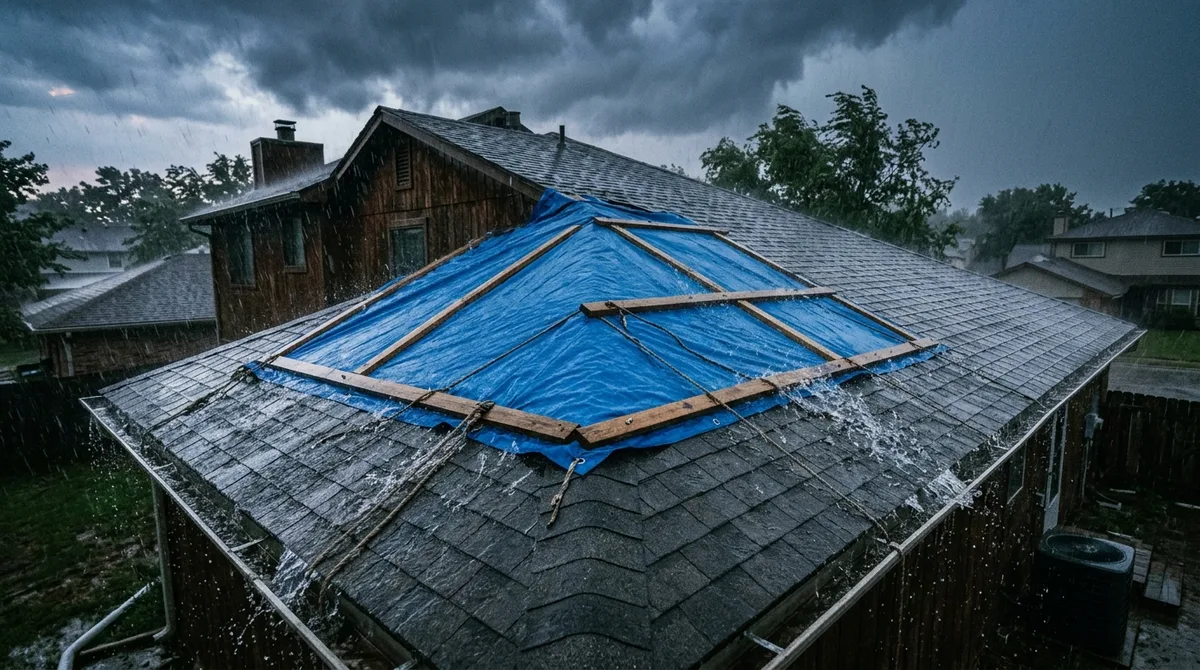
A properly secured tarp is the most reliable temporary fix and buys 30 to 90 days for a permanent professional repair.
- Use a heavy 6-mil polyethylene tarp large enough to cover the damaged area plus at least four feet of overlap on all sides. It must extend over the ridge if the leak is high on the slope.
- Sandwich the tarp edges between two-by-four furring strips. Screw the strips through the tarp into the roof deck so the wind cannot pull the tarp free.
- Wrap the top edge of the tarp over the ridge and secure it on the opposite slope. Water flowing off the tarp then runs onto healthy shingles, not underneath.
- Check the tarp after every storm. UV and wind degrade blue tarps within 30 to 90 days.
Wet-Patch Roofing Cement
For a small, defined leak (a lifted shingle, a cracked flashing, a puncture from a fallen branch), a fiber-reinforced wet-patch roofing cement is often the fastest fix. It bonds to wet or dry surfaces and stays flexible. Trowel it under and over the damage, extending several inches past the visible failure in every direction. It is designed for temporary use, not as a permanent repair.
Some homeowners on the r/Roofing community report that spray sealants like Flex Seal often fail to bond well to the oily, granular surface of asphalt shingles. Roofing cement is a much more reliable option and is inexpensive at any hardware store.
Insurance and the Duty to Mitigate
Most U.S. homeowners policies cover roof leaks caused by covered perils like wind, hail, or fallen trees. However, coverage almost always depends on the homeowner's duty to mitigate further damage. If you do nothing and mold or secondary water damage develops, the insurer can deny that portion of the claim.
Practical claim protection during a leak:
- Photograph and video everything before you start any work, then after each mitigation step.
- Save every receipt for tarps, plastic sheeting, buckets, sealant, wood strips, and any temporary repair materials. Mitigation costs are typically reimbursable as part of the claim.
- Do not throw away damaged material if you can avoid it. The adjuster may want to see it.
- File promptly. Most policies require notification within a defined window after the storm. Guidance from carriers such as the Insurance Information Institute notes that prompt reporting and clear documentation are the two variables that most consistently correlate with successful roof-leak claims.
Be aware that wear and tear on a roof older than about 15 to 20 years is a common exclusion. Insurers view those leaks as maintenance failures rather than sudden accidental damage.
Repair vs. Replacement: When a Patch Is Not Enough
A temporary patch is short-term. If any of the following are true, you are looking at more than a patch:
- Damage covers more than about 30 percent of the roof area.
- You have multiple leaks across different roof sections.
- The roof deck itself feels spongy or sagging, indicating rot.
- The roof is already past its expected service life (15 to 20 years for three-tab asphalt, 25 to 30 for architectural).
A localized professional repair typically runs $400 to $2,000. A full asphalt replacement for an average U.S. home runs $9,500 to $24,000 depending on materials and region.
Estimated Cost Ranges
| Repair Type | DIY Material Cost | Professional Emergency Cost |
|---|---|---|
| Minor Shingle Repair | $20 to $100 | $400 to $1,200 |
| Emergency Tarping | $50 to $200 | $500 to $1,500 |
| Flashing or Vent Boot Fix | $30 to $150 | $600 to $2,000 |
| Flat Roof Membrane Patch | $50 to $150 | $800 to $2,500 |
Prevention and Ongoing Maintenance
- Clean gutters twice a year. Clogged gutters back water up under the starter shingle course, which is one of the most common leak sources.
- Trim branches at least 10 feet from the roof. Windblown limbs are a leading cause of storm-driven punctures.
- Inspect flashings around chimneys, skylights, and vent penetrations annually. Most non-hail leaks start at these penetrations from cracked caulk or rusted metal.
- Watch granule loss. Sand-like grit in the gutters means shingles are losing UV protection and getting brittle.
Frequently Asked Questions
Does Flex Seal or similar spray sealant actually work on a roof leak?
It is often less effective on asphalt shingles than the marketing suggests. Aerosol sealants struggle to bond to the oily, granular shingle surface and can trap moisture against the underlying wood decking, which leads to rot. Fiber-reinforced wet-patch roofing cement is a more reliable temporary choice for shingle roofs.
How long does a temporary roof tarp last?
A high-quality 6-mil tarp secured with furring strips typically holds up for 30 to 90 days. In areas with strong UV or frequent high winds, it can start degrading in as little as 30 days. Check it after every storm.
Can I fix a roof leak from inside the attic?
You can contain and redirect water from inside using buckets and plastic sheeting, but you cannot make a permanent repair from underneath. Sealants applied to the underside of the deck often cause water to travel horizontally to a different rafter bay, creating hidden damage you will not see until it is much worse.
Will insurance pay for my temporary repair materials?
Yes, most policies reimburse the reasonable cost of tarps, buckets, plywood, and sealant when the underlying leak was caused by a covered event. Keep the receipts and take photos of your work to include with the claim.
Is it safe to go on my roof while it is still raining?
Almost always no. Wet shingles are extremely slippery, and the risk of a fall is high. Unless the roof is low-slope, the wind is calm, and you have professional-grade fall protection, manage the leak from inside and wait for the rain to stop.
Why is my roof leaking near a light fixture?
Water enters somewhere on the roof, runs down a rafter, and drips into a ceiling electrical box because the box is the largest opening in the ceiling near it. This is an active shock and fire hazard: shut off the circuit at the breaker before doing anything else.