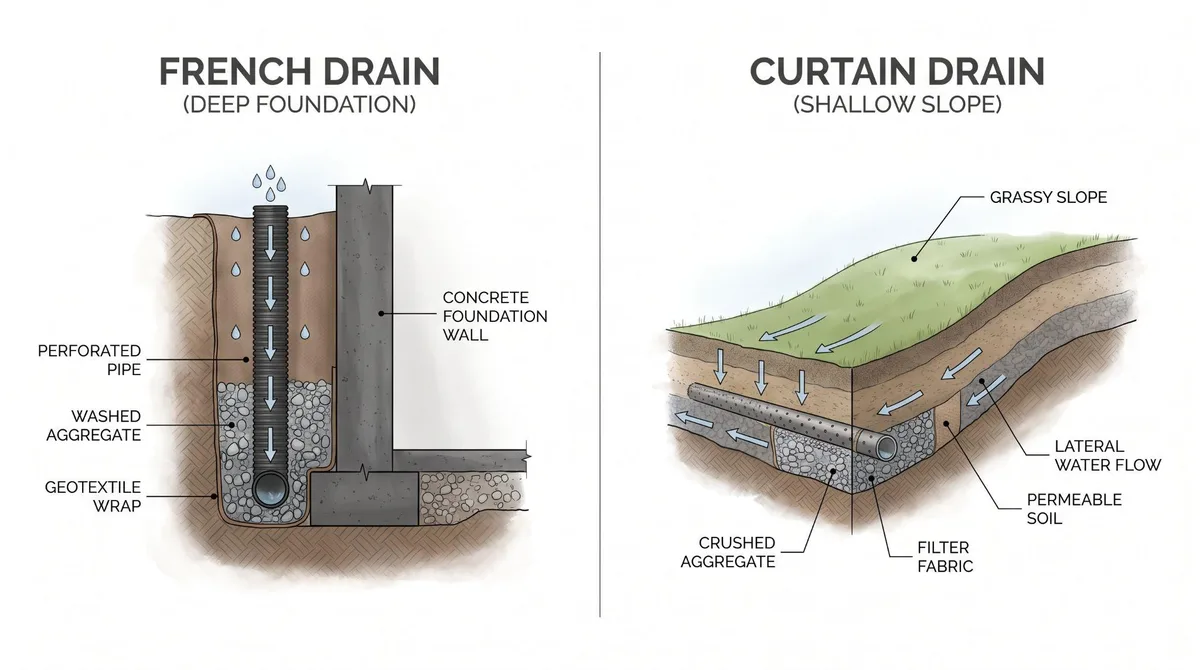
Homeowners use "French drain" and "curtain drain" interchangeably, but to a drainage contractor they are different tools for different problems. A French drain is a deep system that relieves groundwater that has already saturated the soil around your foundation. A curtain drain is a shallow interceptor that catches water moving across a slope before it reaches the house. Choosing the wrong one means paying for a system that doesn't touch your actual problem — so the distinction matters more than the naming suggests.
The 60-Second Diagnostic: Watch Your Yard in a Rainstorm
Before comparing specs, run the test professionals use. During or just after a heavy rain:
- Water pools in the yard, but the basement stays dry → shallow surface and lateral water is your issue. A curtain drain (or even simple regrading) is likely enough.
- The basement is damp or musty after rain → groundwater is rising against the foundation. You need a true French drain — interior or exterior — to relieve hydrostatic pressure.
How Each System Actually Works
The French Drain: Deep and Reactive
Named after Henry French, who popularized the design in 1859, the French drain is a trench — often 2 to 8 feet deep when protecting a foundation — containing a perforated pipe surrounded by washed stone and wrapped in geotextile fabric (installers call this the "burrito"). When the water table rises, water percolates into the gravel, enters the pipe, and gets carried away before it can push against basement walls. That pressure — hydrostatic pressure — is the primary cause of basement cracks and seepage.
Two variants matter for existing homes: an exterior French drain requires excavating down to the footings (effective but disruptive and expensive), while an interior French drain is installed by trenching the perimeter of the basement slab and routing water to a sump pump — the common retrofit for older houses because it avoids tearing up the landscape.
The Curtain Drain: Shallow and Proactive
A curtain drain is typically only 12 to 24 inches deep and sits upslope from whatever it protects. It works like an underground gutter: shallow lateral water moving through the upper soil hits the gravel trench and gets diverted around the house, to a storm drain, or to a low point on the property. On rural properties, curtain drains also protect septic leach fields from uphill runoff — those versions have precise design specs, including placement 10–15 feet upslope of the field and a monitoring port for inspection.
Side-by-Side Comparison
| Feature | French Drain | Curtain Drain |
|---|---|---|
| Hydraulic goal | Relieve deep groundwater pressure | Intercept shallow lateral runoff |
| Typical depth | 2–10 ft (to foundation footing) | 12–24 inches |
| Placement | At the foundation or in low spots | Upslope of the protected area |
| Complexity | High (major excavation) | Moderate (shallow trenching) |
| Typical cost per 100 ft | $2,800–$6,500 | $1,000–$2,500 |
The Materials Debate: What Professionals Argue About
The lifespan of either system is decided by resistance to siltation — fine soil particles slowly clogging the gravel and pipe. Three component choices dominate the contractor discussions on this:
- Pipe: The cheap corrugated "black pipe" from big-box stores is widely criticized by pros — its internal ridges trap sediment and it's too weak to clean with a pressure jetter. Rigid PVC (with cleanout ports) is the professional standard; its smooth walls move water faster and survive maintenance. In very cold climates, engineered HDPE has an edge because PVC turns brittle below roughly −10°F.
- Gravel: Angular #57 washed stone is the standard — the angular edges interlock and leave large voids for water. Pea gravel compacts and clogs; avoid it for functional drains.
- Fabric: Use non-woven geotextile (felt-like, at least 4 oz). A common DIY error is substituting woven weed-barrier fabric, which behaves like a tarp and eventually seals the drain shut.
Holes Up or Holes Down? (Settled: Down)
The most persistent myth in DIY drainage is that perforated pipe should be installed holes-up to "catch" water. Manufacturer specs and hydraulic testing say the opposite: with holes facing down, water in the trench enters the pipe as soon as it reaches the pipe's bottom edge, keeping the trench drier and letting inflowing water carry sediment away ("self-cleaning"). Holes-up forces the trench to fill several extra inches before any water evacuates — which keeps the soil at the bottom permanently saturated. The exception is distribution systems like septic leach fields, which are designed to leak water out rather than collect it.
Heavy Clay Soil Changes the Design
Clay particles are small enough to pass through or blind standard fabric. In high-clay ground, engineers line the trench with a layer of ASTM C33 concrete sand against the clay wall — a graded sand filter that blocks clay migration while passing water. It's a standard detail in agricultural and civil drainage that rarely appears in homeowner guides, and it's the difference between a system that lasts 5 years in clay and one that lasts decades.
The Legal Side: You Can't Just Aim Water at the Neighbor
Redirecting water has legal consequences that vary by state. U.S. jurisdictions follow one of three doctrines: the common enemy rule (each owner fends for themselves), the civil law rule (you're liable if you alter natural flow onto a neighbor), or — in most states — the reasonable use rule (changes are fine unless they cause substantial harm). The practical guidance installers follow: discharge at least 20–25 feet from any structure, toward a storm sewer or a low point on your own land, never toward a neighbor's foundation.
Cost and Lifespan Expectations
DIY installation of 100 feet runs roughly $700–$1,400 in materials and equipment rental plus 20–40 hours of labor; professional installation commonly runs $2,000–$18,000 depending on depth, access, and region — specialized foundation drains in expensive markets have been quoted at $98–$150 per linear foot. A well-built system performs at its peak for about a decade, gradually slows over years 10–25 as fines accumulate, and may need replacement past 25 years as fabric degrades. Annual outlet checks and periodic flushing through cleanouts (only possible with rigid pipe) meaningfully extend that life — the basic French drain concept hasn't changed in 165 years, but the maintenance features are what separate modern installs from failures.
The Golden Rule Either Way
Never tie roof downspouts directly into a perforated drainage system. High-volume downspout water carries debris that clogs perforated pipe and can force water out into the soil right at your foundation — the opposite of the goal. Downspouts get their own solid pipe; perforated pipe is for groundwater only. If your project involves new construction, this separation is far cheaper to plan up front than to retrofit.
Frequently Asked Questions
Can one property need both?
Yes, and it's common on sloped lots: a curtain drain upslope intercepts surface water while a French drain at the foundation handles the groundwater that still gets through. They solve different layers of the same problem.
Does a curtain drain need a pipe at all?
Not always. Because it handles shallower, lower-volume water, a gravel-only ("blind") curtain drain can work for mild cases — but adding a perforated pipe dramatically increases capacity for minimal extra cost.
How do I know if my existing drain has failed?
Water reappearing in an area the drain used to keep dry, an outlet that no longer flows during rain, or a sunken gravel line all point to siltation or a crushed pipe. If the original installer used rigid PVC with cleanouts, a plumber's camera can confirm without digging.