Every April 14, search interest in "world quantum day" spikes hard — and most of the pages that rank for it repeat the same one-line explanation without ever showing the arithmetic, naming the organizers, or distinguishing the day from the separate UN observance it is routinely confused with. This is the complete account.
The Short Answer
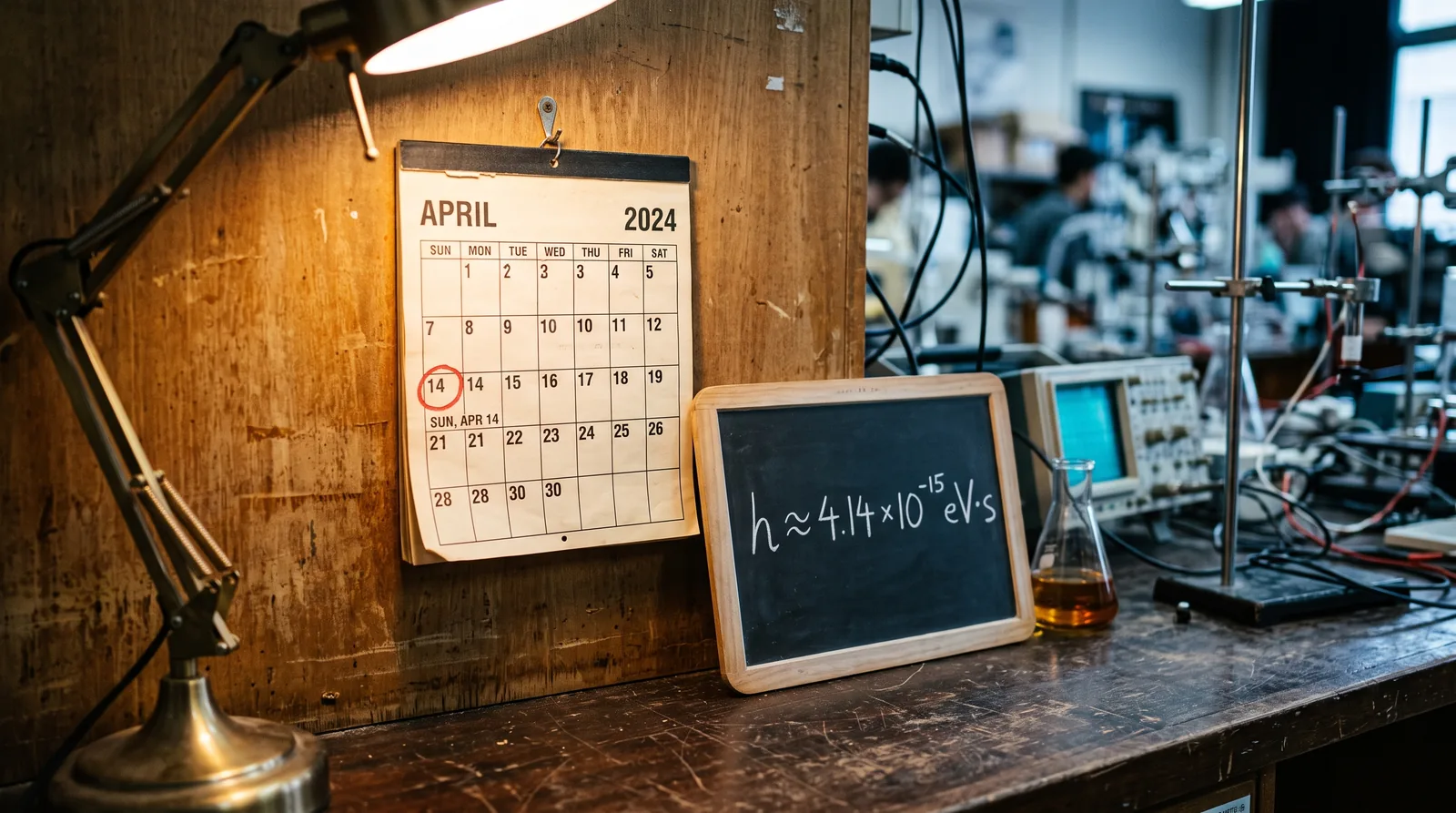
World Quantum Day is an annual, decentralized celebration of quantum science and technology held on April 14. The date is a numerical pun: written US-style as 4.14, it matches the rounded first three digits of the Planck constant expressed in electron-volt seconds — 4.14 × 10⁻¹⁵ eV·s. It was proposed on April 14, 2021 and first observed on April 14, 2022.
The Arithmetic Nobody Shows You
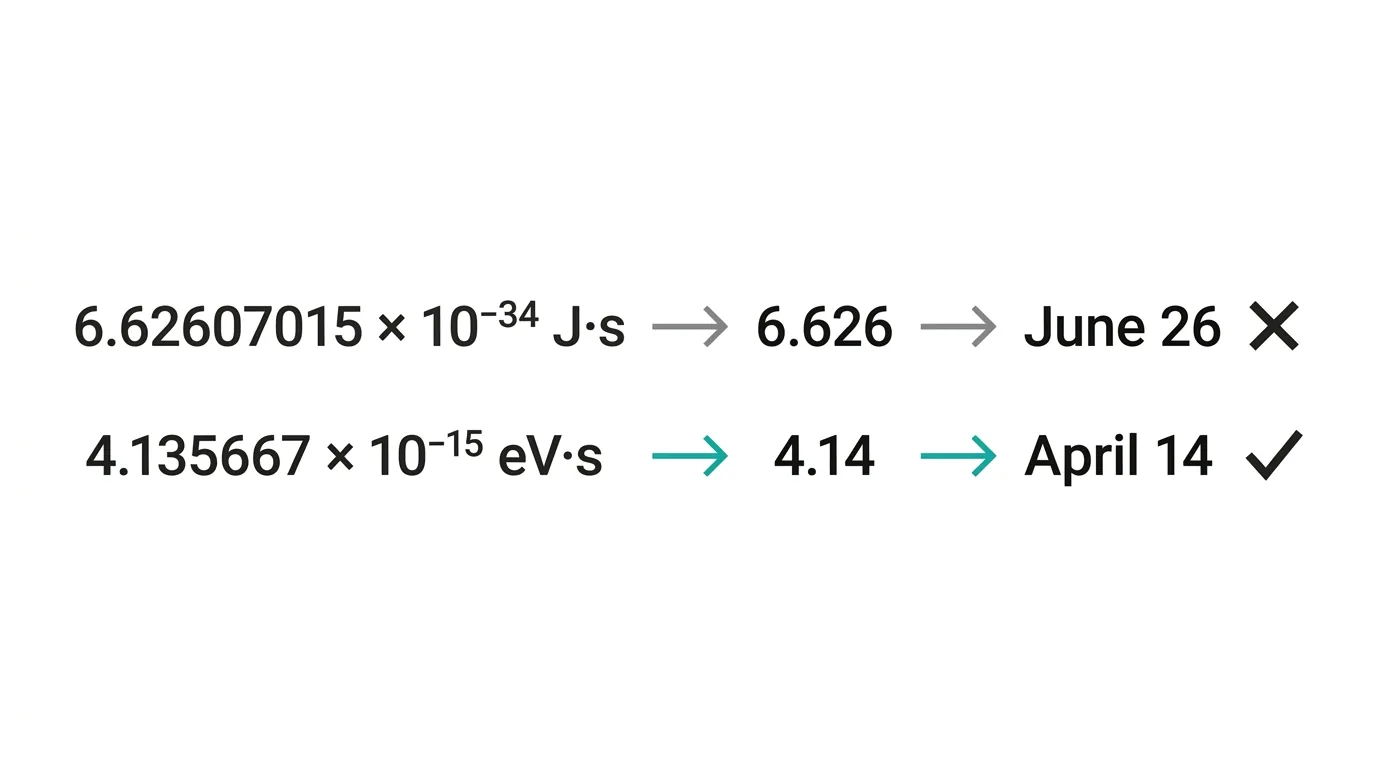
The Planck constant is the proportionality factor linking a photon's energy to its frequency — the single number that makes quantum mechanics quantum. Since the 2019 SI redefinition it has an exact defined value:
| Unit system | Value of h | Leading digits |
|---|---|---|
| SI (joule-seconds) | 6.62607015 × 10⁻³⁴ J·s | 6.626 — would give June 26 |
| Electron-volt seconds | ≈ 4.135667696 × 10⁻¹⁵ eV·s | 4.14 (rounded) — gives April 14 |
This is the detail almost every competing article omits, and it is the one that makes the date make sense. In joules, Planck's constant starts 6.626, which would have produced a "June 26" quantum day. The April 14 date only works in the electron-volt convention that particle and quantum physicists actually use day to day. Note too that 4.135667... rounds up to 4.14, not down to 4.13 — so the day is built on a deliberate rounding choice, not an exact match. It is a physicists' in-joke, and the organizers have never pretended otherwise.
Who Actually Runs It
World Quantum Day has no single owning institution — a fact that surprises people who assume UNESCO or the UN declared it. It was launched by an international group of quantum scientists as an intentionally decentralized initiative, coordinated by a volunteer World Quantum Day Coordination Team drawing representatives from more than 65 countries. Anyone — a university lab, a high school, a national metrology institute, a startup — can register an event under the banner without seeking approval.
That decentralization is the model's strength and its main source of confusion. There is no official theme handed down, no central budget, and no authoritative list of "the" events. In the United States, the National Quantum Initiative promotes participation across the Department of Energy national labs, NIST, and NSF-funded centers; the U.S. Senate passed a resolution supporting the observance in May 2023. Those are endorsements, not ownership.
Scale: What "Global" Actually Means Here
The growth curve is the strongest evidence the day has stuck. Per the initiative's own event registry, the 2026 observance recorded roughly 530 events across 318 cities in 83 countries — talks, lab open days, symposiums, panel discussions, art installations, and school workshops. Activities are spread across the week surrounding April 14 rather than confined to the single date, which is why local coverage often appears "late."
World Quantum Day vs. the International Year of Quantum — Not the Same Thing
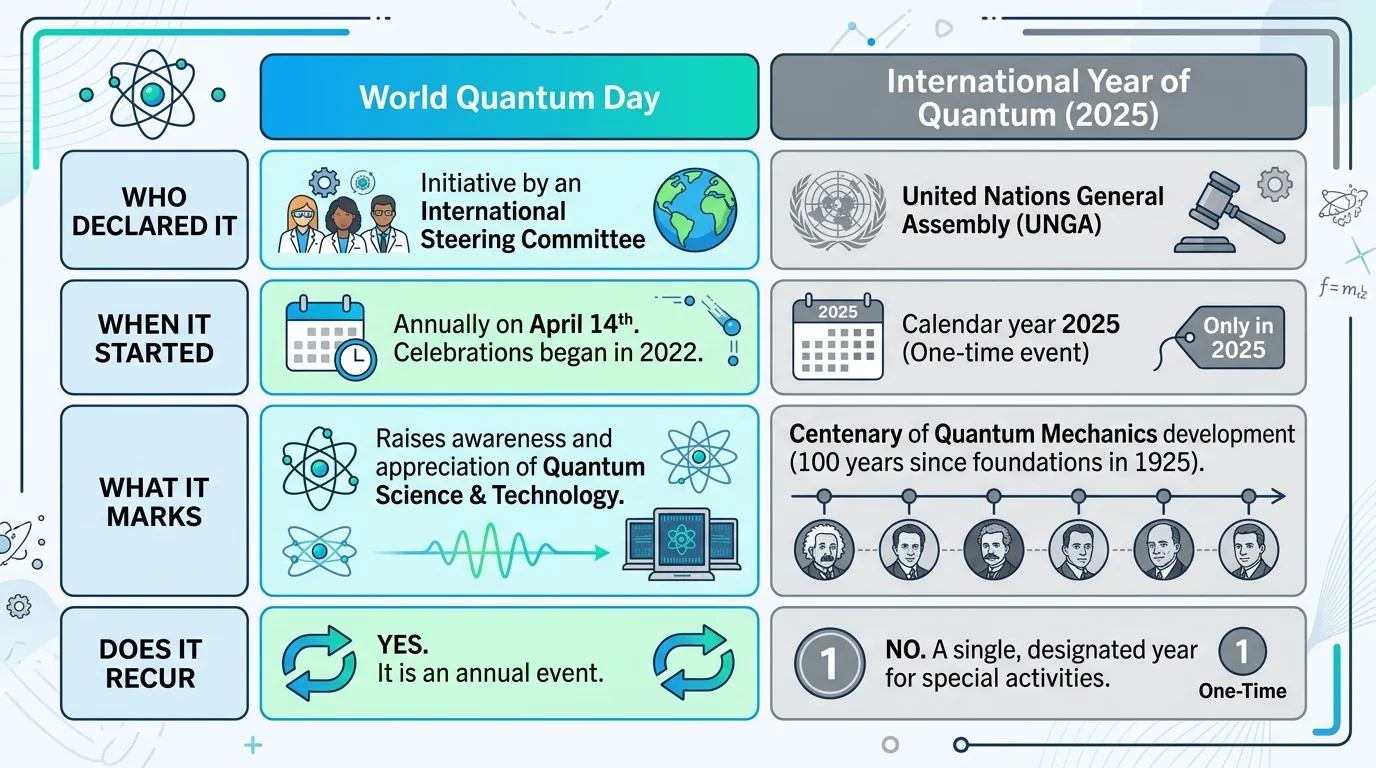
This is the single biggest factual error circulating in coverage of the topic. They are separate observances with different sponsors:
| World Quantum Day | International Year of Quantum Science and Technology | |
|---|---|---|
| What it is | Annual one-day (one-week) grassroots observance | A single designated calendar year |
| Started | Proposed 2021, first held 2022 | 2025 |
| Declared by | No one — volunteer scientist coalition | United Nations General Assembly, led by UNESCO |
| Marks | Planck's constant (4.14) | 100 years since Heisenberg's 1925 formulation of matrix mechanics |
| Recurs | Every April 14 | One-off |
The 2025 International Year gave World Quantum Day a large publicity tailwind, which is exactly why the two got conflated. If a source tells you "the UN created World Quantum Day," it is wrong.
Why the Search Spike Is Bigger Than the Holiday
Search volume for the term dwarfs what a niche physics observance would normally generate. The reason is straightforward: on years when Google marks the occasion with a homepage Doodle, tens of millions of users who have never heard of the day click through to find out what it is. That produces a one-day traffic mountain dominated by people asking the most basic possible question — what is this? — rather than by physicists. Any page ranking for this term needs to answer at a genuine beginner level first.
What People Actually Do on the Day
- Lab open days. University quantum groups and national labs run public tours of dilution refrigerators, ion-trap benches, and photonics setups — usually the single most effective outreach format, because the hardware is visually alien.
- Cloud-QPU workshops. Free sessions where attendees run a two-qubit circuit on real hardware through a cloud provider. This is now the standard "first quantum program" experience.
- School activities. Superposition and entanglement demos using polarizing filters and coin-flip analogies, aimed at ages 12–18.
- Art and music. Quantum-random-number-generated compositions and installations — a recurring and genuinely popular strand.
- Careers panels. Increasingly the most attended sessions, reflecting hiring growth in quantum error correction, cryogenic engineering, and control electronics.
What the Day Gets Used to Oversell
Outreach days attract hype, and quantum computing attracts more than most. Three claims worth treating carefully when you see them recycled around April 14:
- "Quantum computers will break all encryption tomorrow." Cryptographically relevant quantum computers require error-corrected logical qubits at a scale not yet demonstrated. The genuine near-term risk is harvest-now-decrypt-later — which is why NIST's post-quantum standards matter now, not because current machines can break RSA.
- "Quantum computers are just faster computers." They are not general accelerators. They offer advantage on a narrow class of problems — simulation of quantum systems, certain optimization and factoring structures — and are worse than a laptop at almost everything else. Our explainer on why quantum computers can’t replace regular computers covers the architectural reasons.
- Qubit-count headlines. Raw physical qubit counts are close to meaningless without coherence time, gate fidelity, and connectivity. A 1,000-physical-qubit machine may deliver fewer usable logical qubits than a 100-qubit machine with better error rates.
Frequently Asked Questions
When is World Quantum Day?
April 14, every year. Events are commonly spread across the surrounding week.
Why is World Quantum Day on April 14?
Because 4.14 is the rounded first three digits of the Planck constant expressed in electron-volt seconds (4.135667 × 10⁻¹⁵ eV·s). In SI joule-seconds the constant begins 6.626, which would have produced a different date.
Who created World Quantum Day?
An international group of quantum scientists proposed it on April 14, 2021. It is coordinated by a volunteer World Quantum Day Coordination Team with representatives from over 65 countries, not by any single government or UN body.
Is World Quantum Day an official UN holiday?
No. It is a decentralized grassroots observance. The separate United Nations International Year of Quantum Science and Technology in 2025 was a UNESCO-led designation and is frequently confused with it.
When was the first World Quantum Day?
April 14, 2022 — one year after the initiative was proposed.
How can I take part?
Check the initiative's event registry for local listings, or register your own. No permission or affiliation is required; the model is deliberately open.