Edge computing is a distributed model that puts computation and storage close to where data is generated — a factory sensor, a smart camera, an autonomous vehicle — instead of shipping everything to a far-away cloud data center. It matters for a reason rooted in physics: for time-critical decisions, the round trip to the cloud is simply too slow. Here's how the architecture works, why it's not a cloud replacement, and the messy field realities that vendor decks skip.
The Three-Tier Architecture
The edge isn't one thing — it's a layered ecosystem:
| Layer | Components | Job |
|---|---|---|
| Device layer | Sensors, cameras, drones, phones | Collect data, react locally and immediately |
| Edge/local layer | Gateways, micro-data-centers, edge servers | Aggregate, run real-time analytics, filter |
| Cloud layer | Centralized data centers (AWS, Azure, GCP) | Long-term storage, heavy AI training, global coordination |
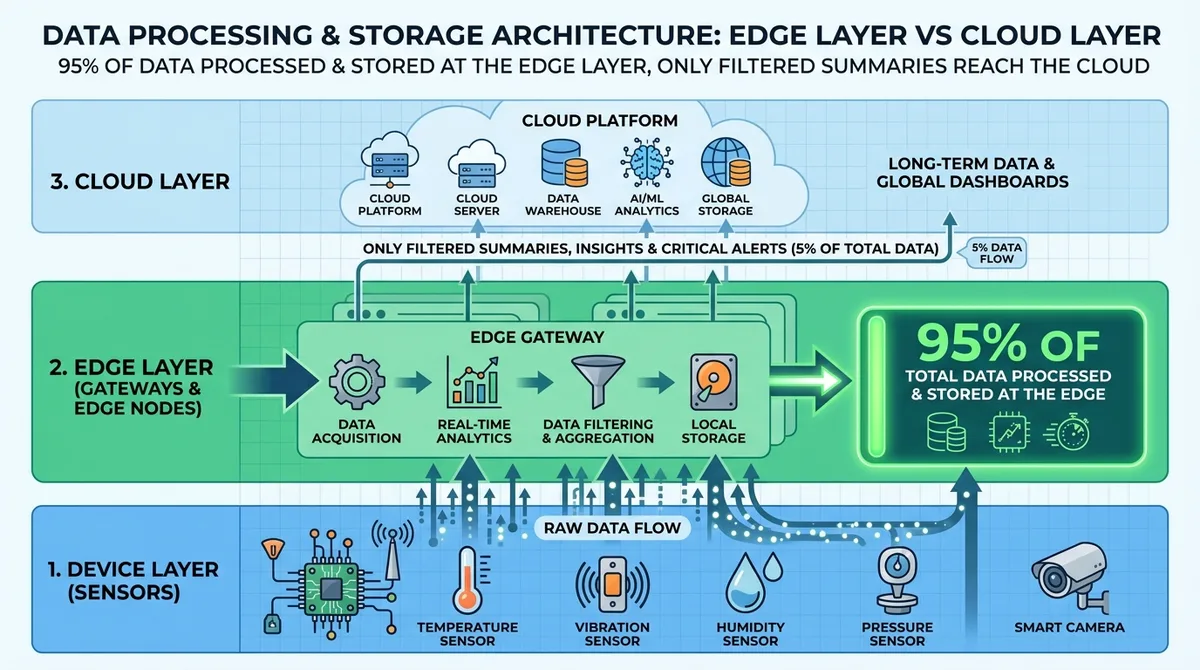
This enables a "split-brain" design: safety-critical decisions (an autonomous vehicle braking) happen at the device in milliseconds, while long-term optimization happens in the cloud over days.
Why It Matters: The Physics of Latency
The core driver is the speed of light through fiber. A signal from an autonomous vehicle to a central cloud server and back can take 50–200 milliseconds round-trip. At highway speed, a 200 ms delay is several meters of travel — the gap between a safe stop and a collision. When the decision has to happen faster than the cloud can answer, the computing has to move to the edge.
| Application | Required latency | Cost of failure |
|---|---|---|
| Industrial robotics | under 10 ms | Mechanical damage, injury |
| Autonomous vehicles | under 10 ms | Safety-critical failure |
| Remote surgery | under 20 ms | Surgical error |
| VR/AR | under 20 ms | Motion sickness, user churn |
The Economics: Bandwidth Is the Other Reason
A single industrial turbine can generate terabytes of data a day. Streaming that to the cloud is economically unviable. Edge gateways use "selective transmission" — processing raw data on-site and forwarding only the ~5% that contains anomalies or critical trends, cutting bandwidth needs by up to 95%.
The Hardware Question: Power vs. Performance
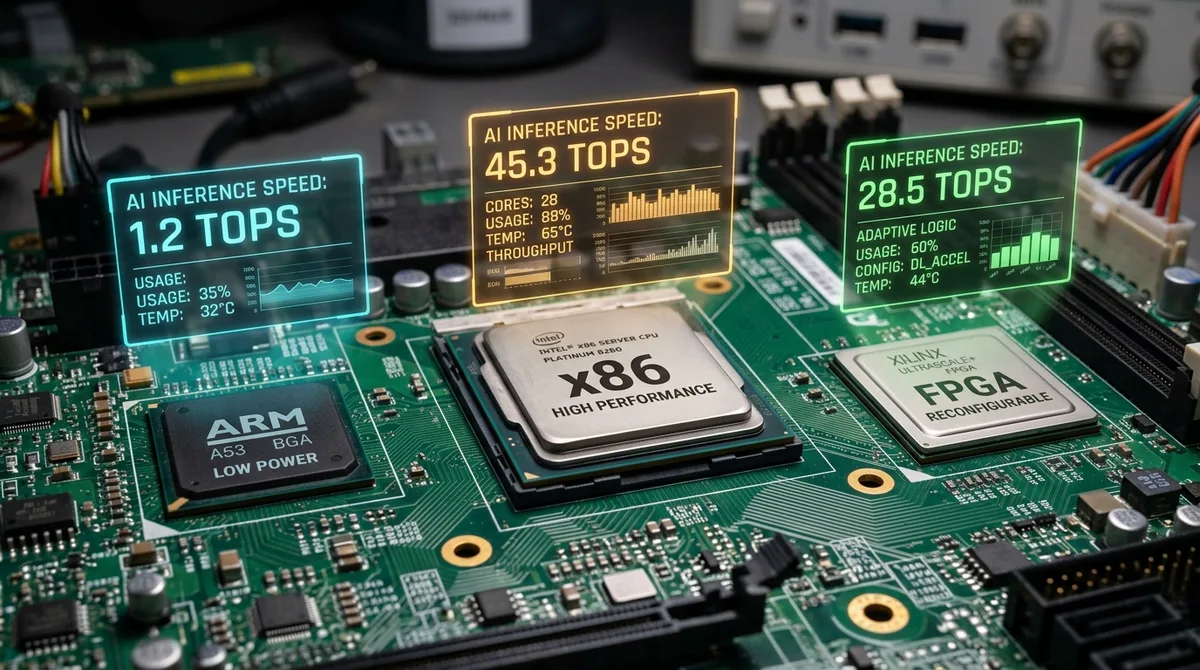
Unlike the cloud's effectively infinite resources, edge devices are constrained by power, heat, and space:
- ARM: high performance-per-watt, drawing 4–15W — standard for battery-powered or fanless devices.
- x86 (Intel/AMD): higher throughput at 35–500W, needed for edge servers running multiple concurrent AI models.
- FPGAs: reconfigurable chips with deterministic latency and 10+ year lifecycles.
- TPUs/ASICs: purpose-built AI accelerators — hugely efficient for tensor math but inflexible.
The Myth: Edge Will Replace the Cloud
It won't. Edge and cloud are symbiotic — the edge handles real-time, local tasks; the cloud handles global coordination and the heavy model training that edge hardware can't. The second common myth is that edge is "inherently more secure." The reality is the opposite on one axis: keeping data local improves privacy, but the physical attack surface expands enormously because thousands of devices sit in unsecured locations. That drives a shift to "Zero Trust" security, where every device authenticates continuously via a hardware root of trust and signed firmware.
The Field Realities Vendors Skip
Engineering communities like edge computing practitioners surface problems marketing decks don't:
- The "bad data" loop: a misconfigured sensor's erroneous values get processed and acted on faster than a human or cloud audit can intervene. Real systems need "sanity check" validation.
- Disk overflow during isolation: when an edge site loses cloud connectivity, it keeps collecting data — and can fill local storage and crash.
- Thermal throttling: edge hardware often runs in harsh heat and dust; a warehouse robot flawless at 20°C can suffer inference delays past 35°C.
The Regulatory Frontier
Security for edge devices is shifting from voluntary to mandatory. The EU Cyber Resilience Act, entering full force by late 2027, will require any product with digital elements sold in the EU to provide security updates for at least five years, maintain a Software Bill of Materials, and report vulnerabilities within 24 hours — with fines up to €15 million or 2.5% of global turnover for non-compliance.
Frequently Asked Questions
What's the difference between edge and fog computing?
Fog computing is often treated as a sub-layer of the edge ecosystem. "Edge" refers to processing at the device or local gateway; "fog" refers to the broader decentralized network structure.
Is edge computing more expensive than cloud?
The upfront hardware cost is higher, but operational expenses are often lower thanks to major savings on bandwidth and cloud data-processing fees.
Can edge devices run large language models?
Yes — through "quantization" and "distillation," which shrink models so specialized edge processors can run smaller, optimized LLMs efficiently on-device.