
A hybrid car uses two power sources — an internal combustion engine and one or more electric motors — working together to move the vehicle. That definition is accurate and almost useless, because it covers four architectures that behave so differently they should arguably not share a name.
The single most consequential distinction: some hybrids you plug in, and some you never do. Getting that wrong is how people end up with a plug-in hybrid they never charge, running heavier and thirstier than the conventional car they replaced.
The Core Mechanism: Recovering Energy You Were Throwing Away
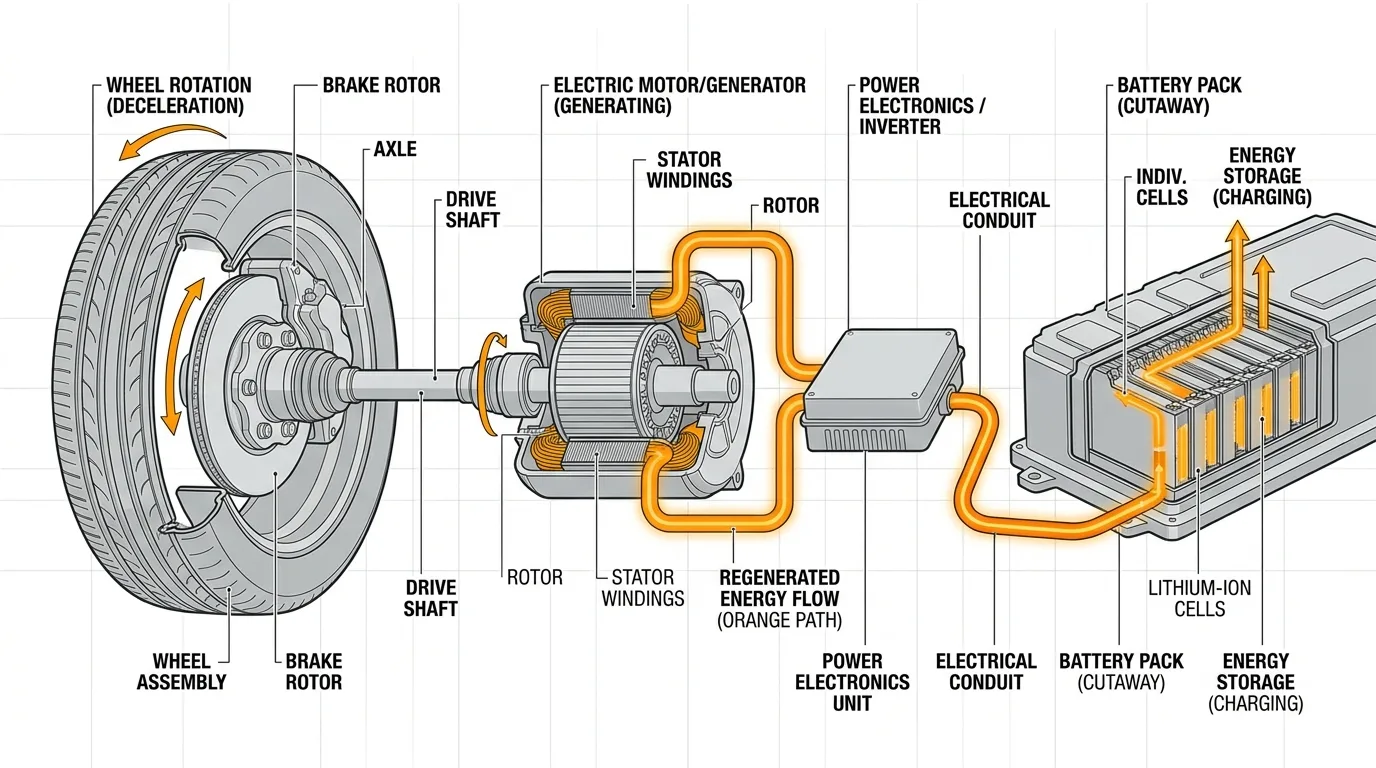
A conventional car converts fuel into motion, then converts that motion into waste heat every time you brake. A hybrid's central trick is regenerative braking: when you lift off or brake, the electric motor runs backwards as a generator, converting the car's momentum back into electricity and storing it in the battery instead of burning it off in the brake pads.
Three consequences follow, and they explain almost everything about hybrid behaviour:
- Hybrids are most efficient in stop-start traffic — precisely the conditions in which conventional cars are least efficient. This inverts the usual intuition that motorway driving is the economical kind.
- Hybrid brake pads last remarkably long, often well over 100,000 miles, because friction braking is used comparatively little. This is a real and rarely mentioned ownership saving.
- Motorway gains are modest. At a constant 70 mph there is little braking energy to recover, and the engine is doing nearly all the work while carrying the extra weight of a battery and motor.
The engine also gets to run in its efficient band more often, with the motor filling in during acceleration — where petrol engines are least efficient — and the engine shutting off entirely at a standstill.
The Four Types
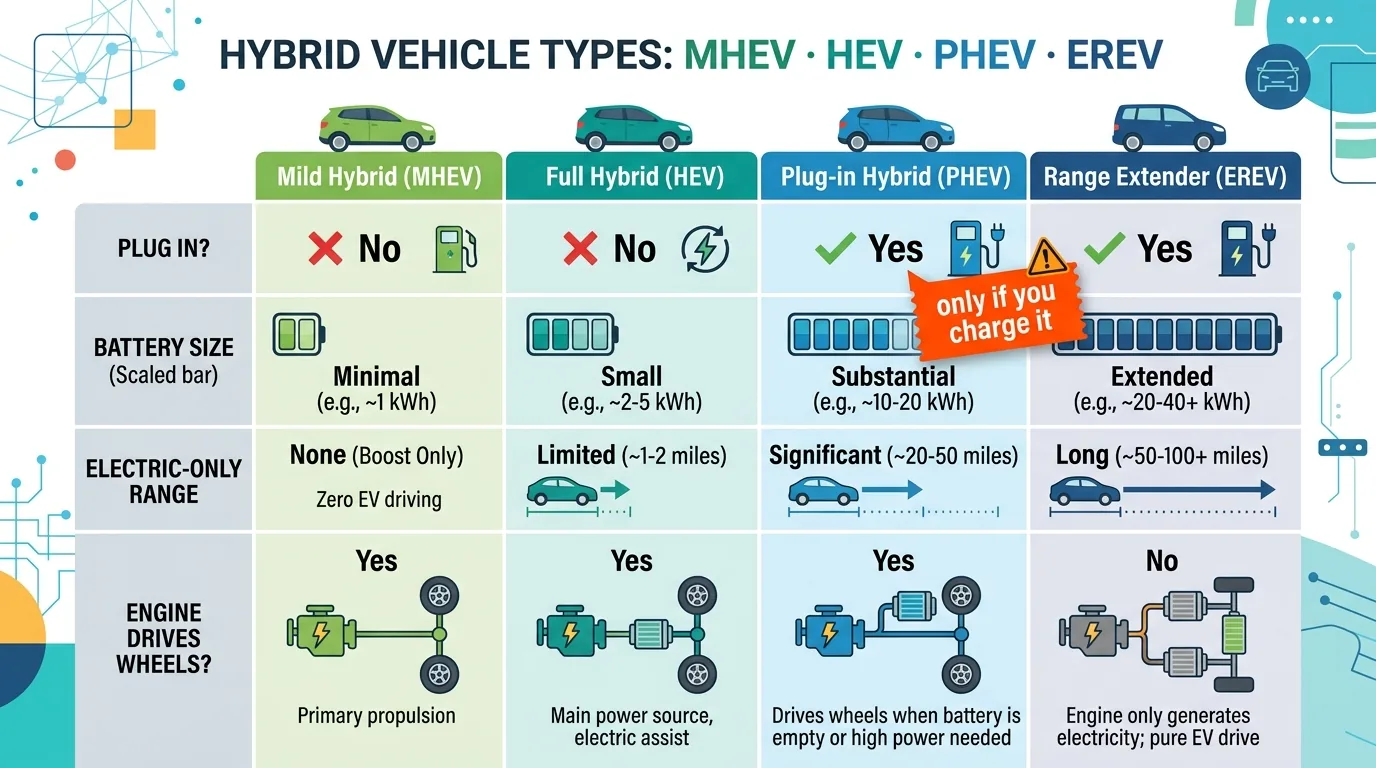
| Mild hybrid (MHEV) | Full hybrid (HEV) | Plug-in hybrid (PHEV) | Range extender (EREV) | |
|---|---|---|---|---|
| Plug in? | No | No | Yes | Yes |
| Drives on electricity alone? | No | Briefly, at low speed | Yes — typically 25–60 miles | Yes — always |
| Battery size | Very small | Small | Medium | Large |
| Engine drives wheels? | Yes | Yes | Yes | No — generator only |
| Typical economy gain | ~10–15% | ~30–40% in city use | Huge if charged; poor if not | EV-like when charged |
| Price premium | Small | Moderate | Large | Large |
Mild hybrid (MHEV)
A small battery and integrated starter-generator assist the engine and enable smoother stop-start. The car cannot move on electricity alone. Mild hybrids are cheap to build, which is why they have spread so widely — and it is why the "hybrid" badge on a forecourt increasingly means very little. If a listing says hybrid and the economy gain looks like 10%, it is a mild hybrid.
Full hybrid (HEV)
The classic self-charging architecture. It can drive short distances on electricity alone at low speed, switching seamlessly between sources. You never plug it in — the battery is charged by the engine and by regenerative braking. This is the type that delivers large, genuinely effortless real-world savings for urban and suburban drivers, and requires no behaviour change whatsoever.
Plug-in hybrid (PHEV)
A much larger battery charged from mains or a charge point, giving a usable pure-electric range — typically 25 to 60 miles — before the petrol engine takes over. For a driver whose daily commute fits within that range and who charges nightly, a PHEV can go weeks without using fuel while retaining unlimited range for long trips.
The critical caveat: an uncharged PHEV is a heavy conventional car carrying a dead battery, and it performs worse than the equivalent non-hybrid. Real-world fuel consumption studies have repeatedly found PHEV emissions substantially higher than official figures, precisely because many owners — especially company-car drivers who took one for the tax treatment — rarely charge them. This is the single biggest gap between hybrid marketing and hybrid reality.
Range extender (EREV)
Electric motors always drive the wheels; the petrol engine exists only as a generator to recharge the battery. It drives like an electric car and eliminates range anxiety without requiring charging infrastructure on long trips. The category has seen renewed interest as a bridge technology.
Series, Parallel, Series-Parallel — The Layout Underneath
- Series: engine generates electricity only; motors drive the wheels. Efficient in traffic, less so at sustained high speed.
- Parallel: both engine and motor can drive the wheels mechanically. Efficient on the motorway, less flexible in traffic.
- Series-parallel (power-split): switches between and blends both, using a planetary gearset instead of a conventional gearbox. This is the architecture behind the best-known full hybrids and the reason they feel smooth and gearless.
The Battery Question
Battery replacement fear is the most persistent obstacle to hybrid purchase, and the evidence does not support the level of concern.
- Hybrid batteries are typically warranted for 8–10 years or 100,000+ miles, with longer terms in some jurisdictions.
- Hybrid packs are cycled shallowly — kept in a middle state-of-charge band rather than repeatedly fully charged and drained — which is far gentler than the duty cycle in a phone or laptop, and is why high-mileage taxi fleets routinely exceed 300,000 miles on original packs.
- Degradation is gradual: reduced electric assist and slightly worse economy, not sudden failure.
- Replacement costs have fallen substantially, and reconditioned packs and individual module replacement are widely available — a point owner communities on r/hybrid raise often, since dealer quotes for a full new pack are frequently far above the practical repair cost.
Hybrid vs. Full EV vs. Petrol: Choosing Honestly
A full hybrid makes most sense if you drive mostly in town and suburbs, you cannot charge at home, you make occasional long trips, and you want savings without changing any habits.
A plug-in hybrid makes most sense if you have reliable home charging, your daily driving fits inside the electric range, and you regularly make long journeys that would be inconvenient in an EV. Only if you will actually plug it in.
A full EV makes most sense if you have home charging and your long trips are infrequent or well-served by fast chargers. It is simpler mechanically, cheaper per mile, and has no engine to maintain.
A conventional petrol car still makes sense if your mileage is low, most of it is motorway, and the hybrid price premium would take longer to recover than you plan to keep the car.
That last calculation is the one buyers most often skip. A hybrid premium of several thousand recovered at a few hundred a year in fuel is a long payback — and it only pencils out if your driving pattern is the one hybrids are good at. The broader pattern of computing moving toward local, efficient processing shows up in vehicles too; see our explainer on what edge computing is.
Frequently Asked Questions
What is a hybrid car in simple terms?
A car with both a petrol engine and an electric motor. The motor assists or replaces the engine at low speeds and recovers energy during braking that a conventional car would waste as heat, which reduces fuel consumption — especially in stop-start traffic.
Do you have to plug in a hybrid car?
It depends on the type. Mild and full hybrids are never plugged in — they charge themselves from the engine and regenerative braking. Plug-in hybrids and range extenders are designed to be charged from mains and deliver far worse economy if you don't.
Are hybrid cars actually cheaper to run?
In city and suburban driving, yes, often substantially. On mostly motorway driving the benefit is modest because there is little braking energy to recover. Whether the fuel saving recovers the higher purchase price depends on your annual mileage and how long you keep the car.
How long do hybrid batteries last?
Typically well beyond their 8 to 10 year, 100,000 mile warranties. Hybrid packs are cycled shallowly rather than fully charged and drained, which is far gentler than phone or laptop use, and high-mileage taxi fleets routinely exceed 300,000 miles on original packs. Degradation is gradual rather than sudden.
What is the difference between a hybrid and a plug-in hybrid?
A full hybrid has a small battery charged by the engine and braking, and can drive only short distances on electricity at low speed. A plug-in hybrid has a much larger battery charged from mains power, giving typically 25 to 60 miles of pure electric driving before the engine engages.
Is a hybrid better than an electric car?
Not better, different. Hybrids suit drivers without home charging who make frequent long journeys. Electric cars are simpler, cheaper per mile and have no engine maintenance, but require reliable charging access. The deciding factor is usually whether you can charge where you park overnight.