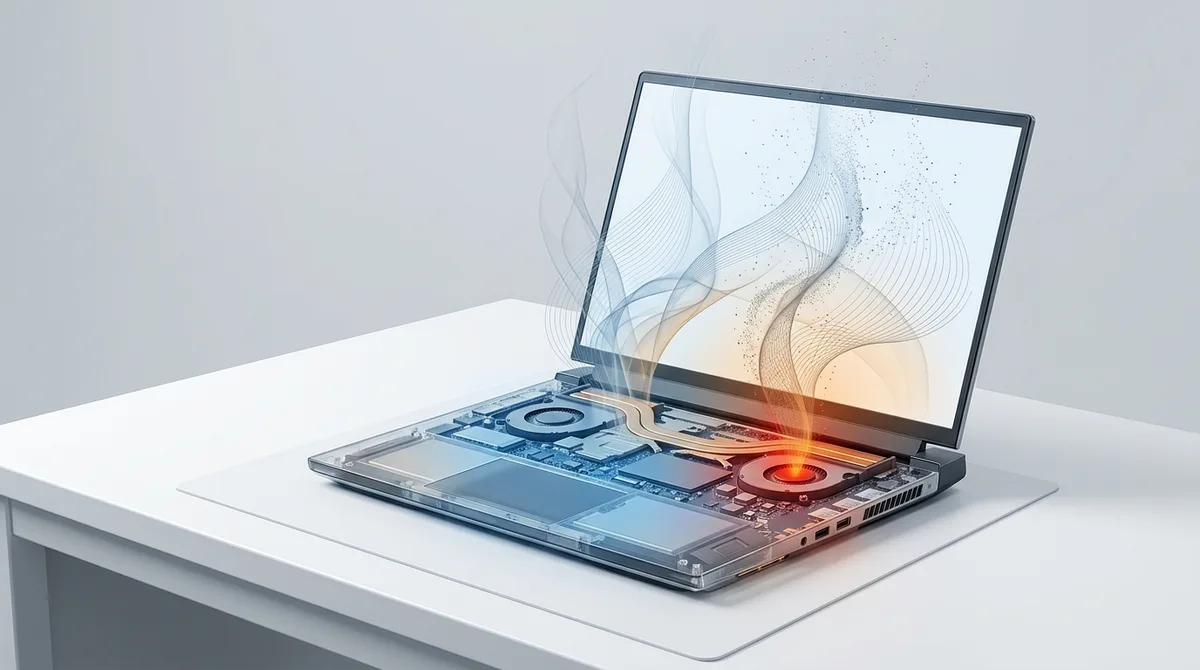
You power on a brand-new TV, console, or laptop and get a sharp, vaguely burnt chemical smell. Instinct says fire; reality says chemistry. In the large majority of cases that odor is the final stage of the device's manufacturing "cure" — but there is one specific smell that genuinely means unplug it now. This guide covers the chemistry, the borderline cases, and the decision rule that separates them.
What You're Actually Smelling: Off-Gassing
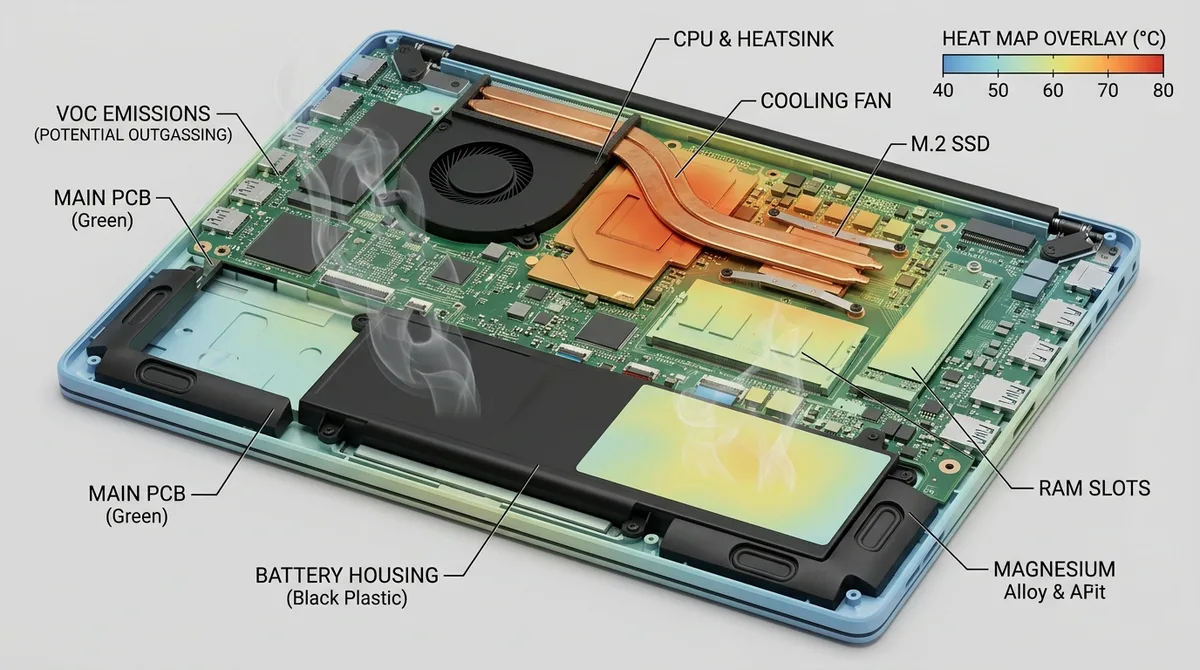
New plastics, resins, adhesives, and coatings slowly release trapped gases — volatile organic compounds (VOCs) — a process called off-gassing. VOCs evaporate at or near room temperature, and the warmer a material gets, the faster it releases them. A device's first hours of operation are its warmest hours to date, so the first power-on is when the accumulated compounds vaporize all at once.
| Compound | Where it comes from | Smell character |
|---|---|---|
| Formaldehyde | Resins and adhesives | Sharp, pungent |
| Toluene / xylene | Solvents in coatings and paints | Sweet, solvent-like |
| Styrene | Plastic housings and foams | Sweetish plastic |
| Brominated flame retardants (e.g., TBBPA) | Circuit boards and casings | Acrid "industrial" notes when first heated |
Ironically, part of the smell comes from safety itself: to meet fire-safety certifications, boards and casings are treated with flame retardants that release a transient industrial scent during the first heat cycles — an odor people routinely mistake for burning wire.
The Assembly-Line Leftovers
Materials aside, manufacturing leaves residues that literally cook off during early use. Solder flux — the rosin-based compound that helps solder flow — volatilizes the first time a GPU or power supply reaches its 60–90°C operating range, producing an acrid, woody, sometimes ozone-tinged scent. Fan bearings and hinges carry lubricants, and metal parts ship with thin anti-corrosion oil films; all of it burns off in the first hours, exactly like a new oven's break-in smell. Electronics hobbyists even note "regional" scent profiles — boards soldered with traditional rosin flux formulations have a recognizable vintage "transistor radio" smell.
The Strange Case of the Console That Smelled Fine for Years
A pattern that fills console-repair communities: a PS5 or Xbox that ran odor-free for years suddenly smells burnt after the owner upgrades to a 4K monitor. This is a thermal-load effect, not a coincidence. 4K/HDR rendering pushes the console's processor and power supply far harder than 1080p — internal temperatures that idled around 35–50°C climb into the 65–85°C range, hot enough to volatilize residues (and incinerate settled dust) that stayed dormant for years at lower loads. The ramped-up fans also dislodge dust into hot heatsinks for the first time. It smells alarming; it's usually the same benign burn-off, just delayed.
The Smell That Is Never Normal: Fishy
Here is the exception that matters. A fishy, urine-like, or ammonia-adjacent odor near a device, outlet, or switch is not off-gassing. It's the signature scent of overheating phenolic plastic and insulation — material that is actively degrading toward ignition but hasn't caught fire yet. Treat it as a pre-fire warning: unplug the device (or kill the circuit at the breaker), and if the smell traces to an outlet or a buzzing light switch rather than the device, call an electrician before using that circuit again.
The Decision Framework
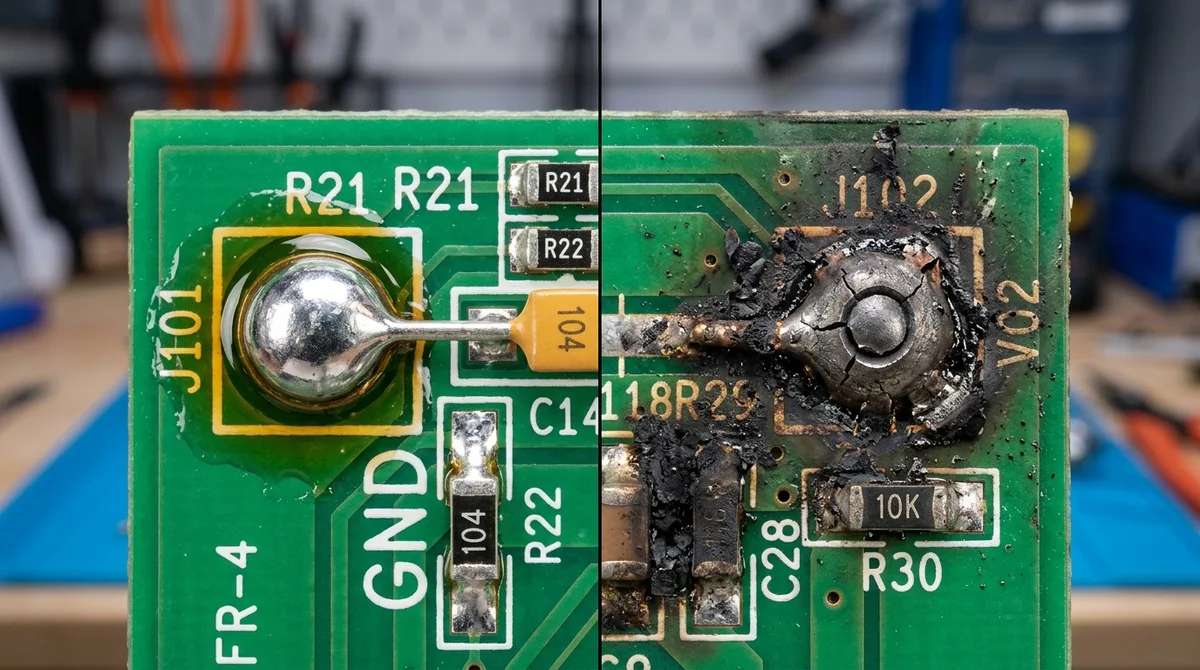
- Benign: the smell appears with a brand-new device, fades within roughly 30 minutes to a few hours, doesn't return on later sessions, and comes with no smoke, no scorch marks, and no casing too hot to touch. → Ventilate the room and carry on.
- Investigate: the smell persists past the first sessions or returns every time under a specific load (like 4K gaming). → Check for hot spots with your hand near (not on) the power supply and casing; a spot too hot to comfortably touch points to a failing component. PVC insulation starts softening around 105°C — well above normal operating range — and its acrid, chlorine-sharp pyrolysis smell is physically unpleasant to breathe in a way normal off-gassing isn't.
- Emergency: fishy odor, visible smoke, scorch marks, flickering lights, buzzing, or a smell localized to an outlet or switch. → De-energize at the breaker and get a professional.
The Health Question
Are those first-day VOCs hurting you? In a single-device dose, generally no — the realistic risk is irritation (headache, itchy eyes, scratchy throat) rather than serious harm, and symptoms fade with fresh air. But indoor VOC levels routinely run two to five times higher than outdoor levels, and small unventilated rooms concentrate everything. Children, the elderly, and people with asthma feel it first. The practical mitigation list is short:
- Break in high-heat devices in a ventilated, unoccupied room for their first several hours — concentrate the off-gassing where nobody's breathing it.
- Move air. An open window and a fan clear VOCs faster than any other measure.
- If you use an air purifier, use the right one: HEPA filters catch dust, not gases — VOC removal requires an activated-carbon filter.
Frequently Asked Questions
Is a burning smell from a new power supply normal?
Usually yes — PSUs are dense with flame retardants and transformer varnish that cure over the first heat cycles. If the smell hasn't faded after roughly 10 hours of use, or the PSU fan isn't spinning, stop using it and return it.
Why does my new OLED TV smell?
Panel adhesives and protective coatings off-gas as the panel warms. It typically fades within about 48 hours of normal use.
Does the new-electronics smell cause cancer?
Some individual VOCs (like formaldehyde) are carcinogens at sustained exposure, but the brief, small dose from one device's off-gassing period is not a meaningful cancer risk. The sensible concern is cumulative exposure when a room gains new furniture, carpet, and electronics at once — solved with ventilation.
My device smelled fine, then started smelling after months. Failure?
Check what changed. A new higher load (4K output, a demanding game, a hot room) can push temperatures into ranges that volatilize dormant residues or accumulated dust. If the smell persists across sessions at normal loads, or any spot on the casing becomes painfully hot, then treat it as a potential fault.