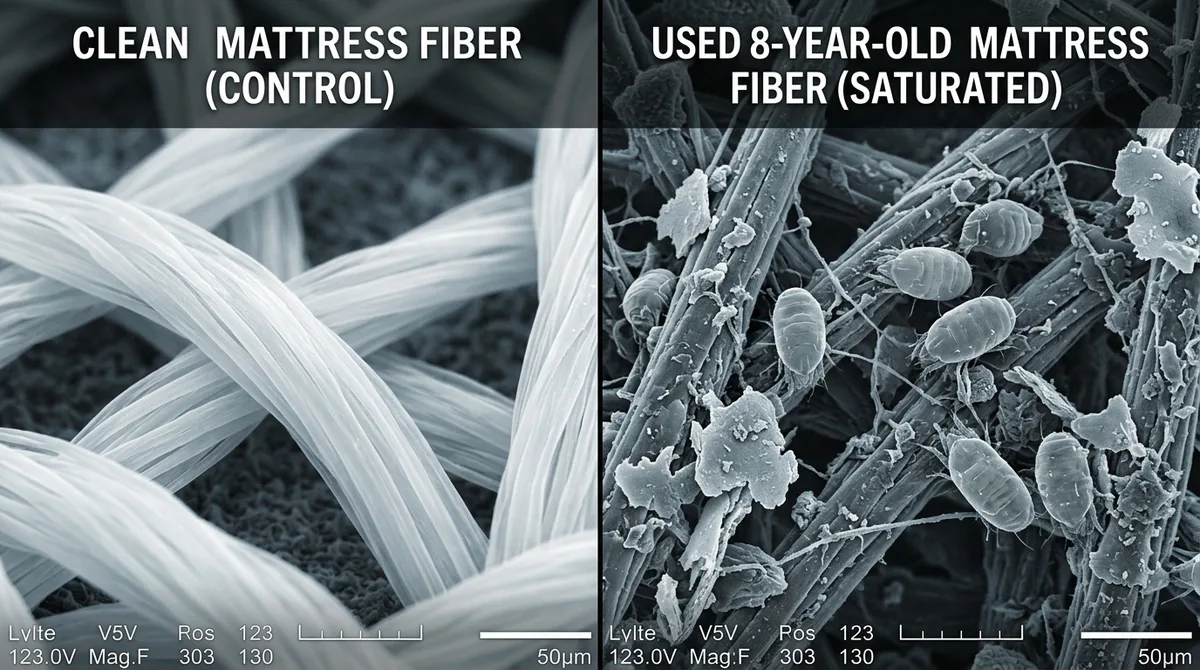
The "replace your mattress every 7 to 10 years" rule is retail shorthand, not material science. A budget foam mattress can be dead in two years; natural latex can outlast two decades. The real signal isn't the calendar — it's when the support core fails, the hygiene load maxes out, or the warranty quietly stops protecting you. Here's how to actually tell.
Lifespan Is Really About Density, Not Age
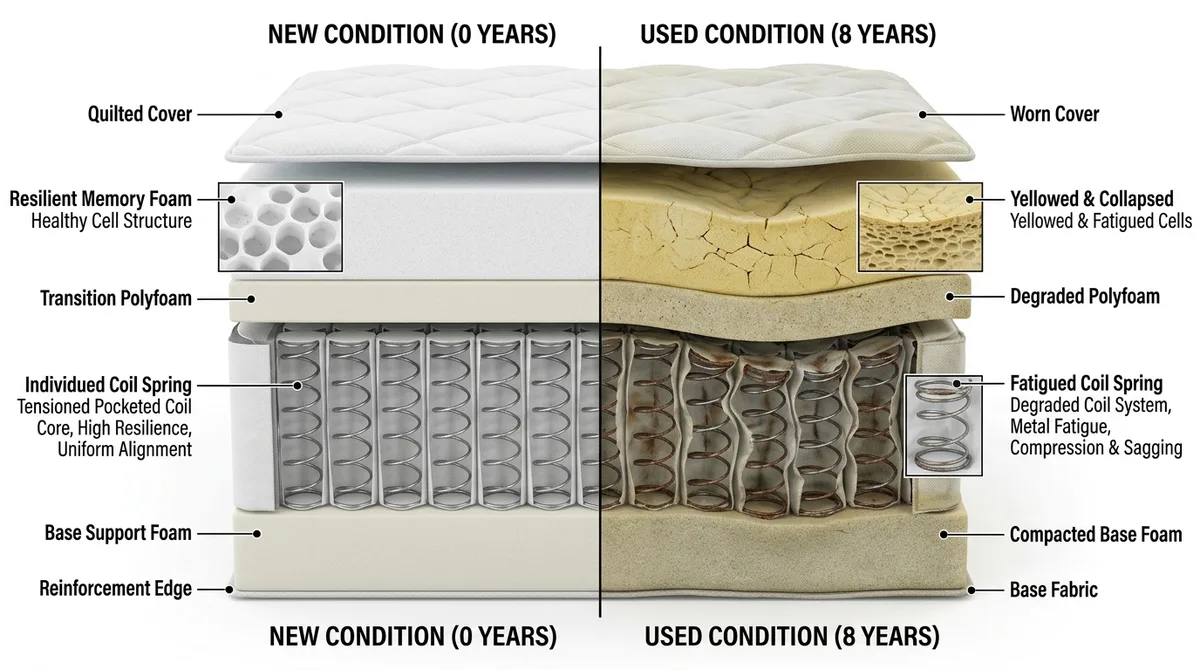
Foam mattresses fail through compression set — repeated loading permanently collapses the polymer's ability to rebound. How fast that happens is almost entirely a function of foam density (measured in pounds per cubic foot, PCF):
| Material | Density | Expected lifespan |
|---|---|---|
| Low-density polyfoam | under 1.5 PCF | 1–3 years |
| Medium-density polyfoam | 1.5–1.7 PCF | 4–6 years |
| High-density polyfoam | over 1.8 PCF | 7–10 years |
| High-density memory foam | 5.0+ PCF | 10–12 years |
| Natural latex | Cross-linked rubber | 15–25 years |
Natural latex is the durability champion — its cross-linked, open-cell rubber resists fatigue far better than synthetic foam. A $1,000 mattress with 2.0 PCF foam will genuinely outlast a $3,000 mattress built on 1.2 PCF foam. Density beats price tag.
The Invisible Breakdown: Chemical Aging
Here's what consumer guides almost never mention: polyurethane foam isn't chemically inert. It undergoes autoxidation — a slow "rusting" where body heat and oxygen break the polymer's molecular chains into shorter fragments that can off-gas as volatile organic compounds. The counterintuitive result: a very old foam mattress can be more chemically active than a new one, which is why even a lightly used guest-room mattress eventually ages out regardless of sag.
The Hygiene Clock Runs Even on a Sound Mattress
Even a structurally fine mattress accumulates a biological load over 20,000+ hours of use across eight years:
- Skin cells: humans shed ~500 million cells daily — roughly 10 pounds of dead skin trapped in the layers over eight years.
- Moisture: the average adult releases around 200 ml of sweat per night — hundreds of liters over a decade.
- Dust mites: skin plus moisture feeds mite colonies, whose fecal matter triggers allergic rhinitis, asthma, and eczema. Controlling them is the same battle covered in our guide to getting rid of dust mites.
A waterproof, mite-proof protector dramatically slows all three — and doubles as warranty insurance.
The "Warranty Trap" the Industry Won't Explain
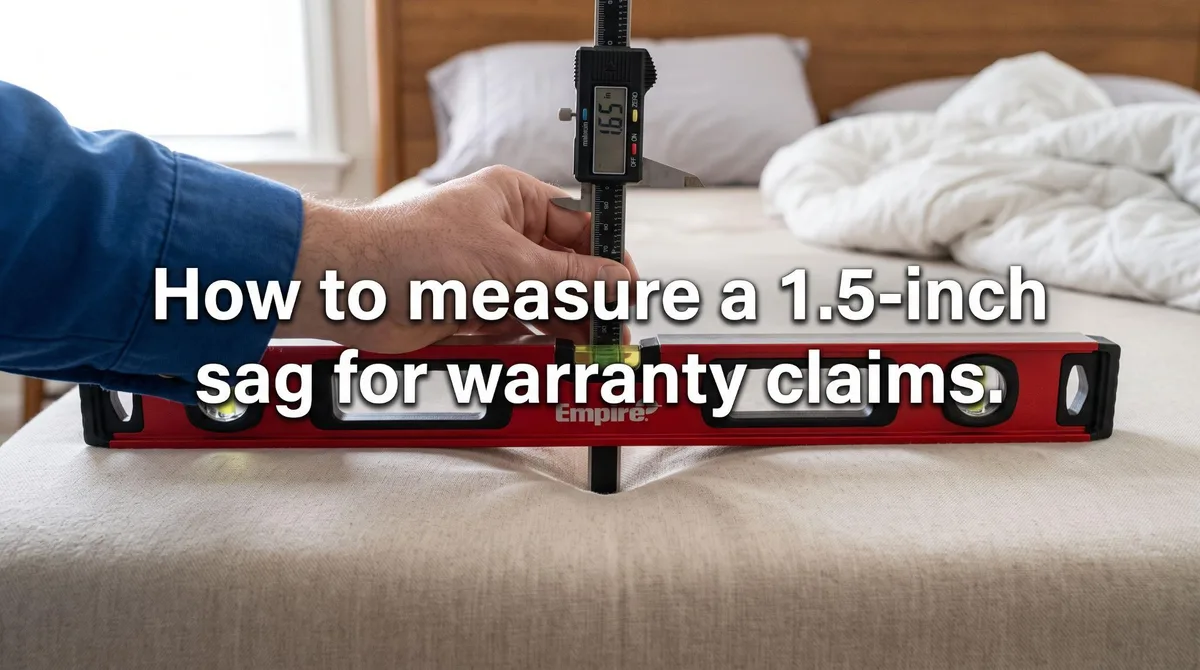
This is the single most useful thing to understand before you assume you're "covered." Most mattress warranties only pay out for a permanent indentation of 1.5 inches or more. But sleep research shows a dip of just 0.5–0.75 inches is enough to misalign your spine and cause chronic back pain. In other words, your mattress can be causing real pain while remaining "within spec."
Two more traps: warranties universally exclude "normal softening" of foam, and any stain — even unrelated to the defect — typically voids the entire warranty. That mattress protector isn't optional hygiene; it's financial protection.
Your Usage Profile Changes Everything
- Heavier sleepers (230+ lbs): more stress on foam cells cuts standard mattress life to 5–7 years. Prioritize high-PCF foam and thicker-gauge coils.
- Couples: double the weight and moisture means faster wear than a single sleeper.
- Guest rooms: can last 12–15 years thanks to minimal compression cycles — but chemical oxidation still ages the foam.
- Crib mattresses: a safety-critical exception. Replace every 3–5 years, and immediately if any softness or indentation appears, since firmness is a SIDS safeguard.
Why Mattresses Died Younger Than They Used To
In the 1990s a quality innerspring often lasted 15–20 years. Two industry shifts shortened that: the early-2000s move away from flippable, double-sided mattresses (concentrating all wear on one side), and the "bed-in-a-box" era's reliance on lower-density foams that compress for shipping but fatigue faster. Mattress-industry insiders discuss this candidly in enthusiast forums.
The Replacement Checklist
| Signal | Replace now if… |
|---|---|
| Physical condition | Visible sag over ~1 inch, lumps, or you can feel coils |
| Morning pain | Back or hip pain on waking that fades within an hour |
| Sleep location test | You consistently sleep better on a hotel bed or sofa |
| Allergies | Congestion or asthma that worsens specifically at night |
| Age | 10+ years for foam/innerspring; 3–5 for cribs |
And a note on disposal: up to 90% of a mattress is recyclable, and several U.S. states now legally ban them from landfills — check your local mattress recycling program.
Frequently Asked Questions
Can a topper let me keep my mattress for 15 years?
A topper improves surface comfort but cannot fix a structural sag — if the core is "hammocking," your spine stays misaligned regardless. And the chemical and hygienic load inside a 15-year-old synthetic bed is significant.
How do I know if my back pain is from my mattress?
If pain is present on waking and eases after 30–60 minutes of movement, it's likely postural from poor support. Sleeping noticeably better on other surfaces confirms it.
Are expensive mattresses always more durable?
No. Price often reflects marketing and shipping. Foam density (PCF) and coil gauge determine durability.