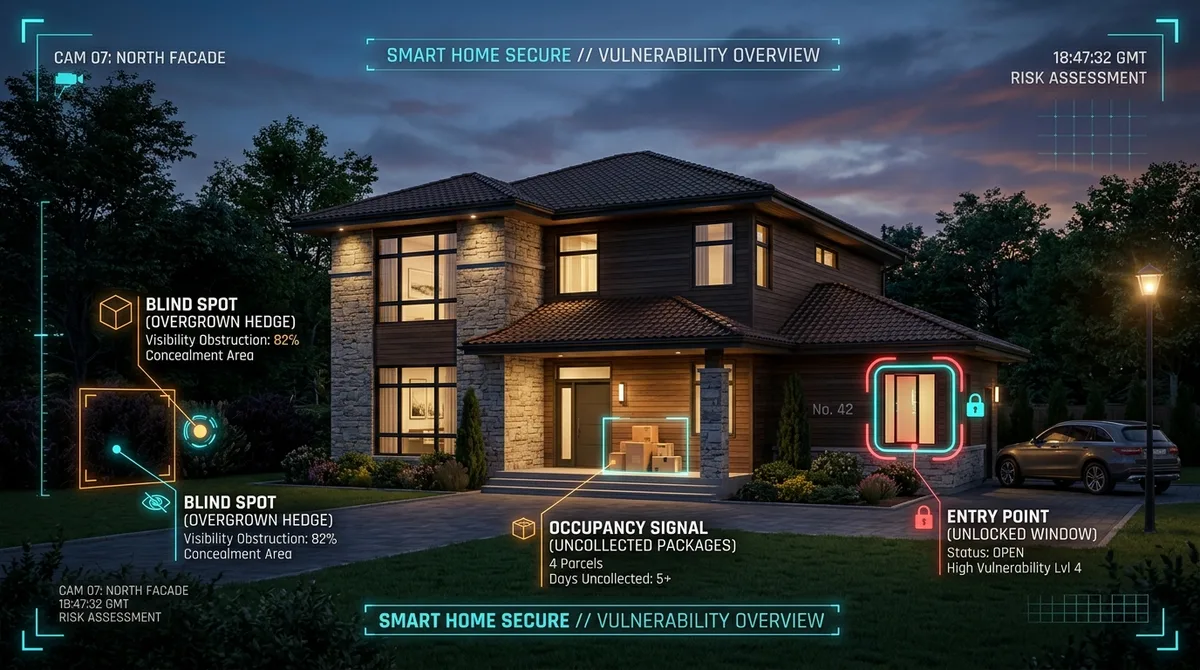
A burglar deciding whether to hit your house is running a rapid cost-benefit calculation, not acting on impulse. Criminologists model it as "optimal foraging" — the same logic a predator uses weighing food value against energy and risk. Understanding that calculation is what separates real deterrence from the security theater most homeowners buy. Here is how target selection actually works.
The Three Questions Answered in Ten Seconds
Once an offender is on your street, the decision to strike is often made in under ten seconds, hinging on three quick reads:
- Is anyone home? Cars in the driveway, noise, lights that change — occupancy is the single biggest deterrent.
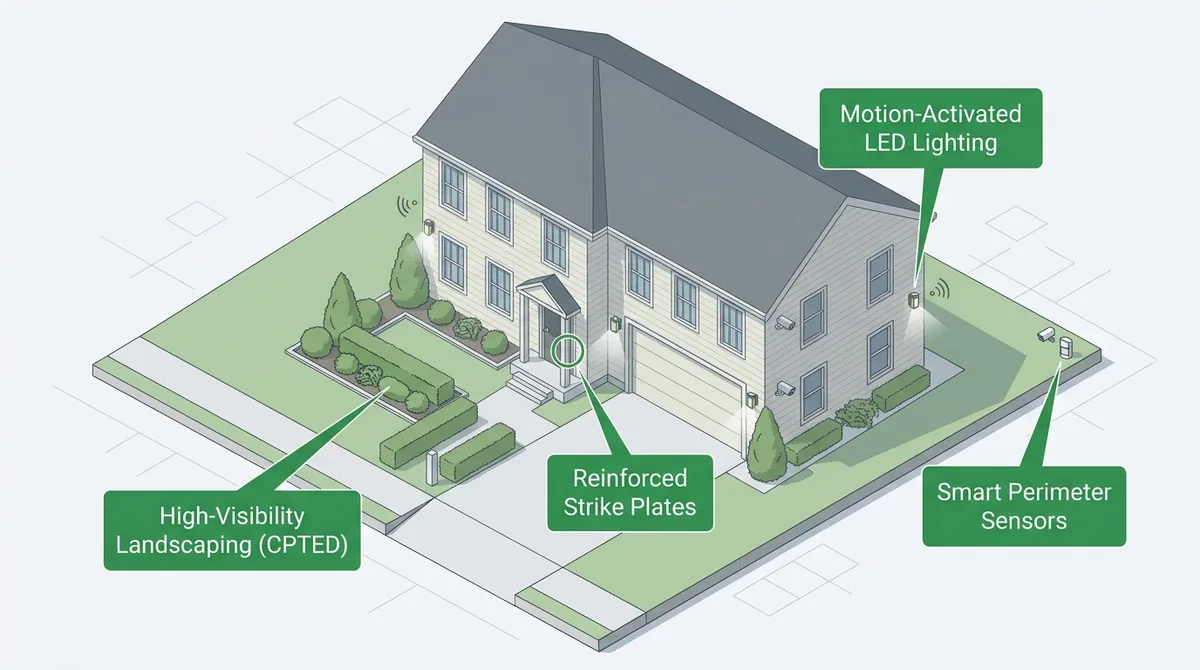
- Can I be seen? Overgrown hedges, dark entryways, and fences that block sightlines are assets to a burglar. Neighbors who can see the door are "capable guardians."
- How fast can I get in and out? An unlocked window, a flimsy lock, or a hidden door lower the effort side of the equation.
This is the core of two established criminological frameworks: Routine Activity Theory (burglary needs offender, target, and absent guardian at once) and Rational Choice Theory (the offender weighs yield against effort and risk). You don't have to build a fortress. You only have to look like more effort than the house next door.
The "Near-Repeat" Effect Nobody Warns You About
One of the most robust findings in modern criminology is the near-repeat phenomenon: when a home is burglarized, that property and its immediate neighbors face sharply elevated risk for the next two weeks. Two mechanisms drive it:
- The "boost" effect — the original offender returns because they know the layout, the neighbors' response, and escape routes, and they know insurance will replace the stolen goods within weeks.
- The "flag" effect — the first break-in marks the street as soft, and neighboring homes with identical architecture are assumed to share the same weaknesses.
| Window after a nearby burglary | Re-victimization risk | Driver |
|---|---|---|
| 0–14 days | Sharply elevated | Original offender familiarity ("boost") |
| 15–60 days | Elevated | Local criminal awareness ("flag") |
| After 60 days | Returns to baseline | Attention shifts elsewhere |
If a house on your block gets hit, the two weeks after are exactly when to double-check your own locks and lighting.
The Modern Burglar Scouts From a Phone
Physical "casing" has largely moved online. Real estate listings hand over interior photos and floor plans that let an offender pre-plan a path to the master bedroom and be in and out in under ten minutes. Social media is worse: real-time vacation posts and airport check-ins are effectively an "open house" invitation, and photos can carry EXIF metadata revealing your exact GPS location. The habit worth breaking: post travel after you're back, not while you're away.
How They Actually Get In (Not Lock-Picking)
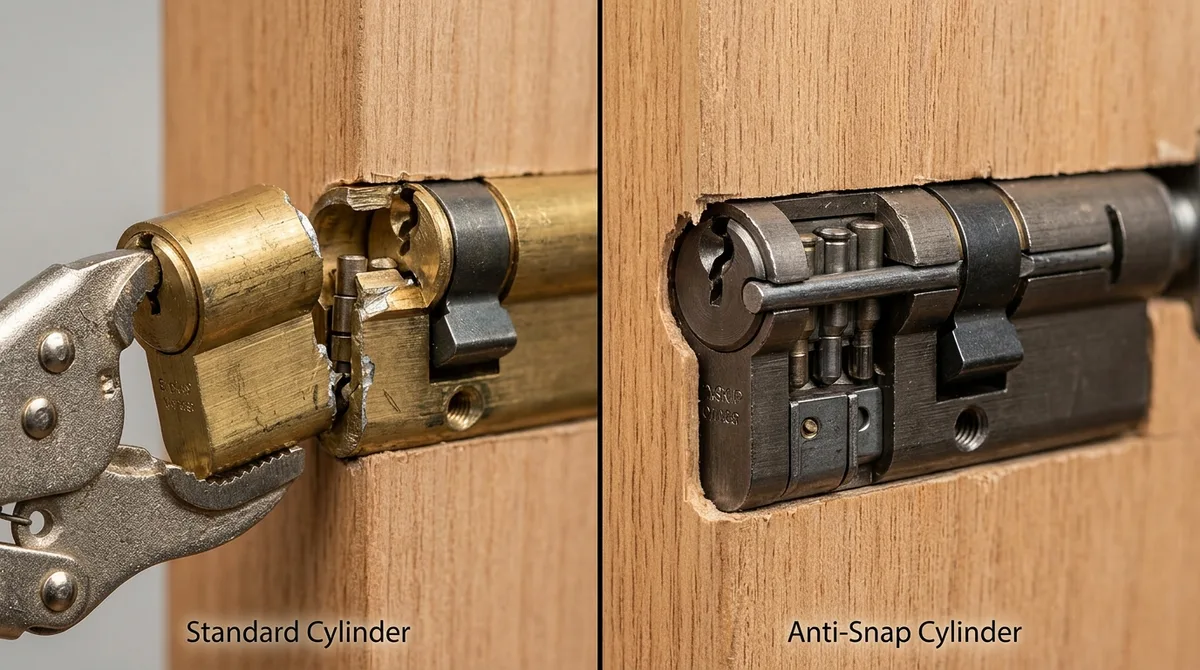
Cinematic lock-picking is a myth. Real entry is brute and fast:
- Lock snapping: standard euro-profile cylinders can be physically snapped in half in under ten seconds with basic tools. Anti-snap cylinders fix this.
- Frame failure: the weak point in most locked doors isn't the lock — it's the wooden jamb. A kick forces the deadbolt through thin wood unless a reinforced strike plate with three-inch screws reaches into the wall studs.
- Sliding doors and upstairs windows: sliding glass doors often lift off tracks or bypass with a screwdriver, and second-floor windows are frequently left unlocked.
Notably, around 30% of burglars enter through a door or window that was simply unlocked — no force required. Treat any compromised entry point with the same urgency as a broken lock, the way you'd treat a buzzing electrical fault.
What Actually Deters — and What's Delusion
Where official advice and ex-offender accounts diverge is instructive:
- Monitored alarms work. Surveys of convicted burglars consistently show a large share will abandon a target on discovering an alarm. Unmonitored "local" alarms are weaker.
- Dogs deter through noise, not teeth. Discussions in home-security communities agree that most dogs can be neutralized with food — but the barking raises detection risk, which is the burglar's core fear. A "Beware of Dog" sign with no bowls or worn grass paths reads as a bluff.
- Static lighting backfires. A single light left on 24/7 signals nobody's home to turn it off. Variable timers and motion lights simulate real occupancy.
- Some signs invite trouble. "Protected by a gun" signs advertise valuable firearms; specific high-end alarm-brand signs can signal a house worth extra effort.
The Highest-Leverage Habits
| Habit | Why it works |
|---|---|
| Lock every door and window | Eliminates ~1/3 of all entry opportunities |
| Break down delivery boxes | Stops advertising new high-value purchases at the curb |
| Know your neighbors' routines | Makes them effective "capable guardians" |
| Use variable timers, not a single light | Simulates a living, occupied home |
| Remove the "hidden" spare key | It's the first place an intruder checks |
One timing fact worth internalizing: most residential burglaries happen between 10 a.m. and 3 p.m., when homes are empty for work and school — not at night. Your daytime security matters more than your nighttime one.
Frequently Asked Questions
What are the signs a house is being cased?
Cars driving slowly past repeatedly, strangers knocking with vague pretexts, and unfamiliar people lingering. But most modern scouting is digital and invisible — "burglar chalk code" symbols are largely an urban myth.
Do burglars come back to the same house?
Yes. A successful hit gives them knowledge of the layout and weaknesses, and they know insurance will replace stolen goods within weeks — making a return trip low-effort and high-yield.
Is an alarm or a camera the better deterrent?
An alarm is the better deterrent (prevents the crime); a camera is the better investigative tool (identifies the person afterward). A combined system is ideal.