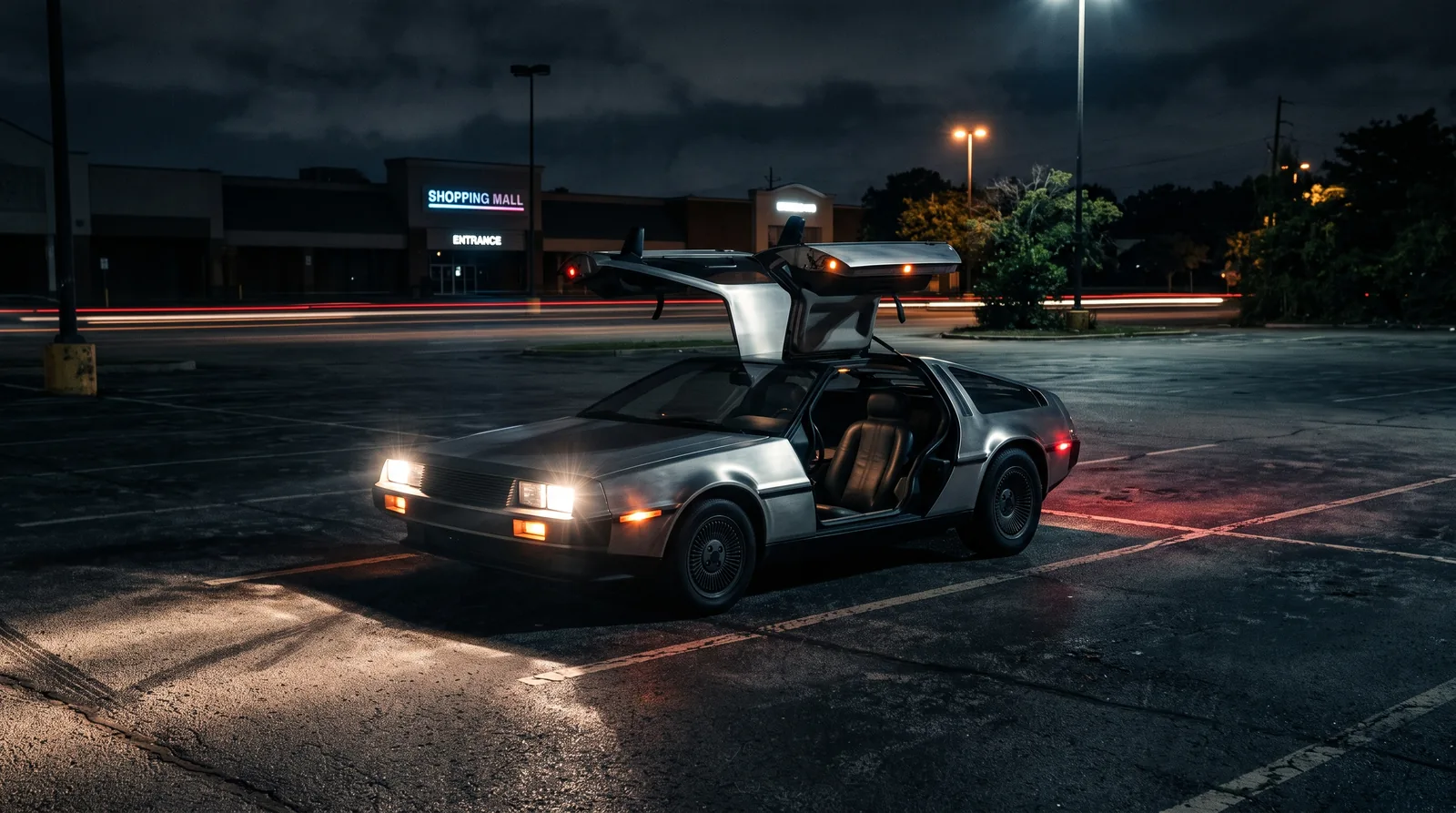
Back to the Future (1985) is the rare blockbuster that is both a perfect piece of studio filmmaking and a genuinely rigorous piece of science fiction. Directed by Robert Zemeckis and co-written with Bob Gale, it was the highest-grossing film of its year and spawned two sequels, an animated series, a stage musical and a permanent place in the cultural furniture.
The Production Nearly Didn't Happen
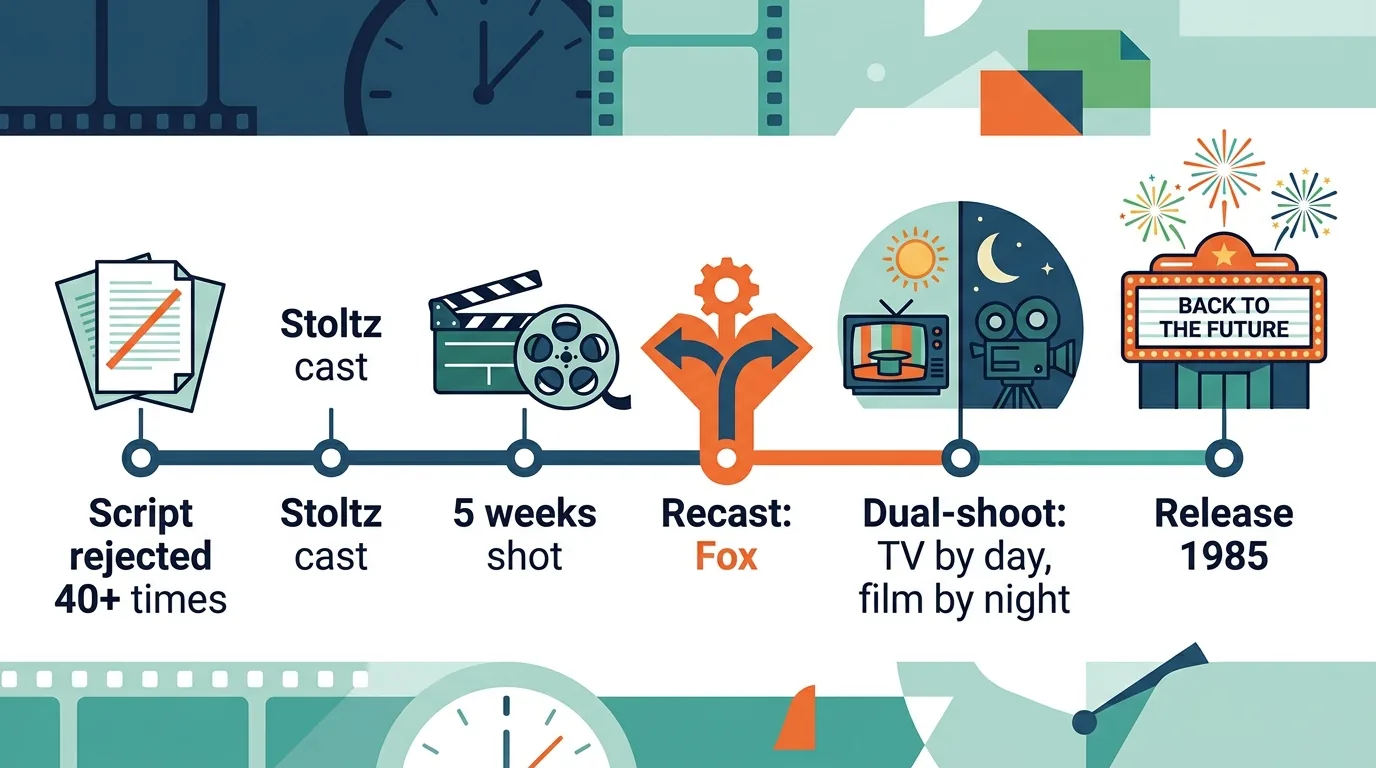
The script was rejected by essentially every major studio — reportedly more than forty times. Two opposite objections killed it repeatedly: some studios found it too tame for a market that then rewarded raunchy teen comedies, while Disney passed on the grounds that a mother developing romantic feelings for her time-travelling son was inappropriate for a family label. The film only proceeded after Zemeckis had a hit with Romancing the Stone.
The Recast
Michael J. Fox was the first choice, but was contractually committed to Family Ties and unavailable. Eric Stoltz was cast and shot for roughly five weeks before Zemeckis and Gale concluded the performance was too dramatic for what the film needed — the role required comic lightness, not intensity.
Recasting a lead five weeks into principal photography is close to unheard of, and enormously expensive. Fox ultimately shot the film while still working on the television series, filming Family Ties during the day and Back to the Future at night for months on very little sleep. Traces of the Stoltz production survive in a handful of wide shots.
The DeLorean Was Not the First Idea
The time machine was originally a refrigerator, powered by an atomic explosion. It was changed for two reasons: mobility made for better filmmaking, and Zemeckis was concerned children might imitate it by climbing into refrigerators. The DeLorean DMC-12 was chosen for its stainless steel body and gull-wing doors — the in-film joke being that its appearance would make 1955 residents mistake it for a spacecraft.
The Cast
| Actor | Character |
|---|---|
| Michael J. Fox | Marty McFly |
| Christopher Lloyd | Dr. Emmett "Doc" Brown |
| Lea Thompson | Lorraine Baines McFly |
| Crispin Glover | George McFly |
| Thomas F. Wilson | Biff Tannen |
| Claudia Wells | Jennifer Parker |
Crispin Glover did not return for the sequels following a contract dispute; the character was worked around using prosthetics and reused footage, which led to a lawsuit and changed how the industry handles actor likeness.
How the Timeline Actually Works
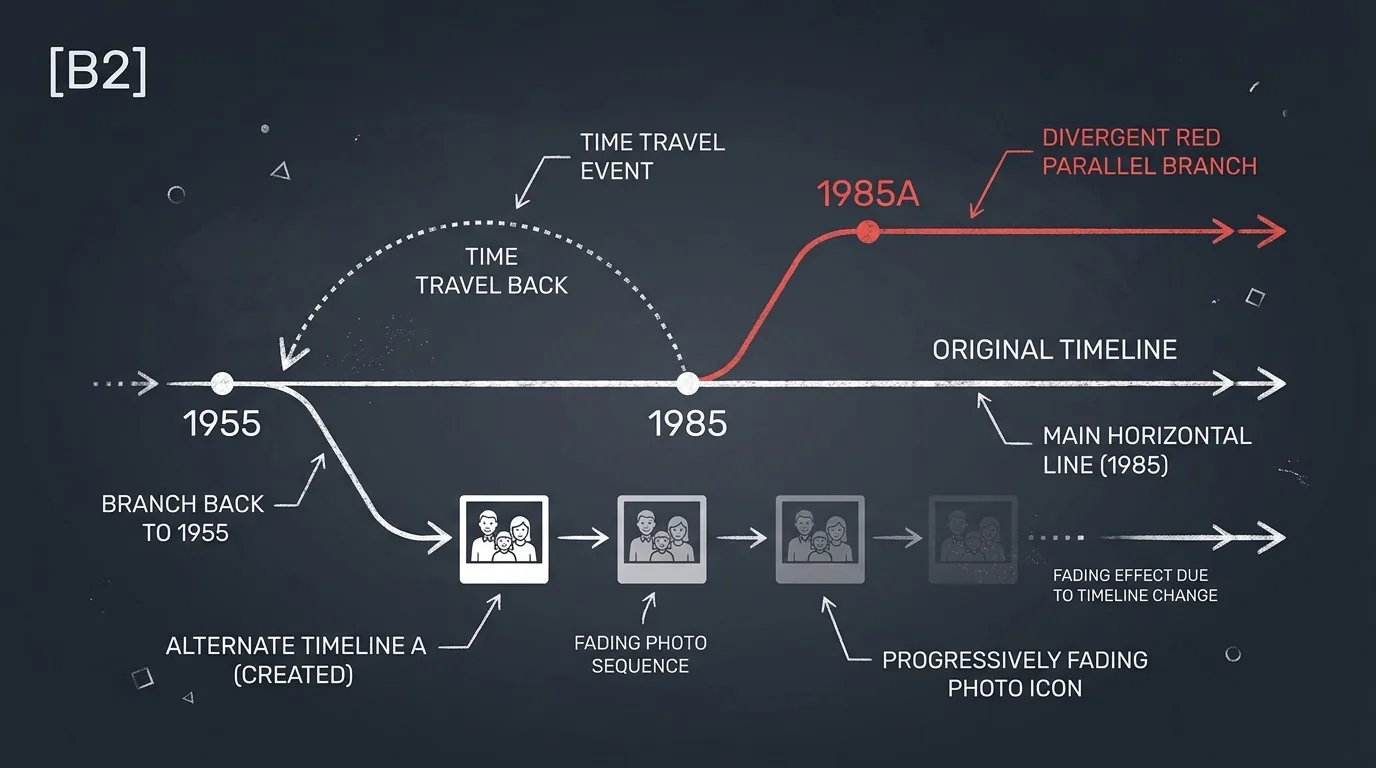
The trilogy uses a mutable single timeline — changes to the past overwrite the present, with effects propagating gradually rather than instantly. That gradualness is the reason the famous photograph fades progressively rather than vanishing, and it is what gives the plot its ticking clock.
- 1985A — the dystopian timeline created when old Biff delivers the sports almanac to his younger self in 1955. Doc's whiteboard explanation in Part II is one of the clearest pieces of exposition in the genre.
- The 2015 problem. Part II depicted October 21, 2015. The real date passed in 2015 without hoverboards or flying cars, though it did produce a global wave of coverage and the film's second cultural peak.
- The key numbers. 88 miles per hour to trigger displacement; 1.21 gigawatts of power required; the flux capacitor as the enabling component. These are deliberately arbitrary, and the film is better for not explaining them.
The Paradoxes — And Why They Mostly Hold
The trilogy's internal logic is more consistent than most, but not airtight. The genuine issues:
- The parents don't recognise Marty. George and Lorraine spent a formative week with a boy named Calvin Klein who looks exactly like their eventual son — and never comment on it across thirty years. Gale has acknowledged this and offered the reasonable defence that people's memories of faces decades earlier are unreliable. It remains the largest hole.
- The self-consistency problem. If the timeline is overwritten, the Marty who returns to 1985 has memories of a childhood that no longer occurred. The films acknowledge this and simply move on, which is the correct dramatic choice.
- "Johnny B. Goode." The gag where Chuck Berry's cousin hears Marty play implies the song has no origin — a bootstrap paradox. This is played as a joke rather than a mechanism, and is generally accepted as such.
- Erased-photo logic. Why some things fade gradually while others change instantly is inconsistent. It is a dramatic device, not a rule.
What the films get genuinely right, and what most time-travel fiction does not, is committing to one model and applying it consistently within each film. That discipline is the reason audiences can follow Part II's overlapping timelines without a chart.
The Legacy
For a modern comparison in how legacy properties are handled today, see our coverage of Christopher Nolan's 2026 film.
Zemeckis and Gale hold contractual control of the property and have repeatedly and publicly refused a remake or reboot — an unusual position in a franchise-driven industry, and one of the reasons the trilogy's reputation has stayed intact. The story has instead been extended through a stage musical, which opened in the West End before transferring to Broadway.
Frequently Asked Questions
Why was Eric Stoltz replaced in Back to the Future?
He had filmed for roughly five weeks when Robert Zemeckis and Bob Gale concluded his performance was too dramatic for a role that needed comic lightness. Michael J. Fox, the original first choice, became available and replaced him — an extremely rare and expensive mid-production recast.
How fast does the DeLorean need to go?
88 miles per hour, with 1.21 gigawatts of power supplied to the flux capacitor. The figures are deliberately arbitrary and never explained scientifically.
What date does Marty travel to in Back to the Future Part II?
October 21, 2015. The real-world date passed in 2015 and generated a global wave of coverage comparing the film's predictions with reality.
Why don't Marty's parents recognise him?
The films never address it. Co-writer Bob Gale has argued that memories of a face from thirty years earlier are unreliable enough to explain it. It remains the trilogy's largest acknowledged plot hole.
Will there be a Back to the Future remake?
Robert Zemeckis and Bob Gale hold contractual control over the property and have repeatedly refused a remake or reboot. The story has instead been extended through a stage musical.
Why was the time machine a DeLorean?
It was originally a refrigerator powered by an atomic blast. That was changed because a vehicle allowed more interesting filmmaking and because Zemeckis was concerned children might imitate it by climbing into refrigerators. The DeLorean's stainless steel body and gull-wing doors supported the in-film joke that 1955 witnesses mistake it for a spacecraft.