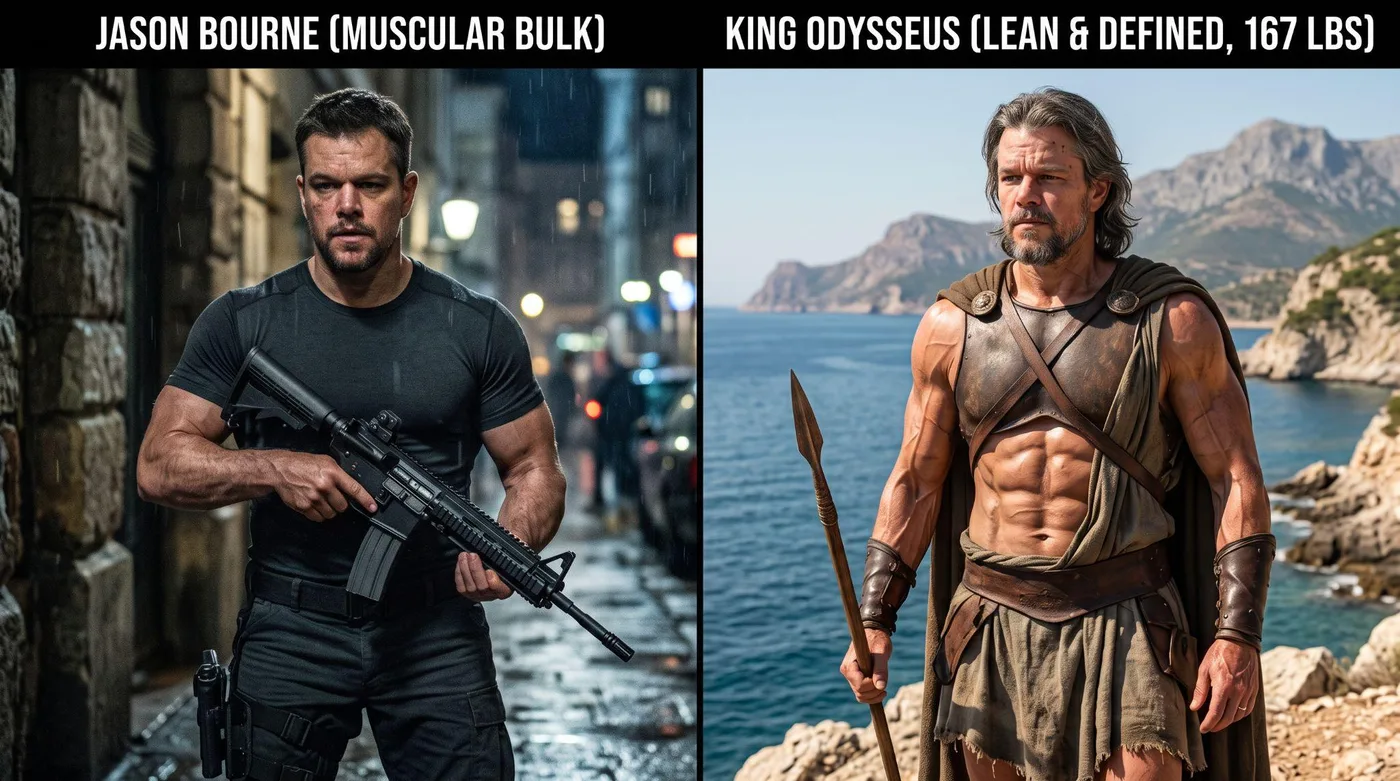
At 55, Matt Damon walked onto the set of Christopher Nolan's The Odyssey weighing 167 pounds — the lightest he had been since high school and roughly 30 pounds under his usual walking weight. The transformation was not vanity. Nolan wanted a "lean but strong" Bronze Age warrior, and the actor rebuilt his diet and training around that brief. What most coverage misses is that the physical change was one part of a much larger production experiment: a 173-minute epic shot entirely on 15/70mm IMAX film, with a 300-pound soundproof camera housing and a linguistic arc hidden inside the dialogue.
The Gluten Cut That Became Permanent
Damon has said the biggest single lever in the weight loss was the elimination of gluten. He adopted the change to hit Nolan's target weight, then discovered — with his doctor — that he had significant, previously undiagnosed sensitivities to the protein. Cutting gluten resolved chronic inflammation and fatigue he had lived with for years. He has kept the diet post-production, switching to gluten-free beer and skipping the pizza-making rituals he used to share with co-stars.
Health writers have been careful to add context: a gluten-free diet is not a general-purpose weight-loss tool, and unmanaged gluten avoidance can create B-vitamin and fiber gaps. Damon's result reflects his specific biology, not a universal protocol.
The Training: Posterior Chain First
Damon worked with long-time trainer Jason Walsh on a program built around functional strength and joint recovery — a nod to the back and shoulder issues that have followed him since the Bourne films. The plan is closer to an off-season athlete's than a bodybuilder's.
| Training pillar | Primary work | Objective |
|---|---|---|
| Functional pulling | Weighted chin-ups, T-bar rows | Posterior-chain thickness and "V-taper" |
| Compound strength | 5×5 deadlifts, hack squats | Foundational power and bone density |
| High-intensity conditioning | 500 m rowing intervals, 30-second sprints | Caloric burn, cardiovascular reserve |
| Mobility & recovery | Bear crawls, planks, VersaClimber | Injury mitigation given prior back/shoulder history |
The published summaries in fitness press disagree on emphasis — some describe a bodyweight-heavy approach, others a barbell-forward plan — but the trainer-cited pillars above show up consistently. The important contrast is with Damon's 1996 Courage Under Fire transformation, when he lost 50 pounds in 100 days and was warned by a doctor the crash could have "shrunk his heart permanently." The Odyssey was a slower, controlled reduction.
The 15/70mm Bet: Why the Camera Weighed 300 Pounds
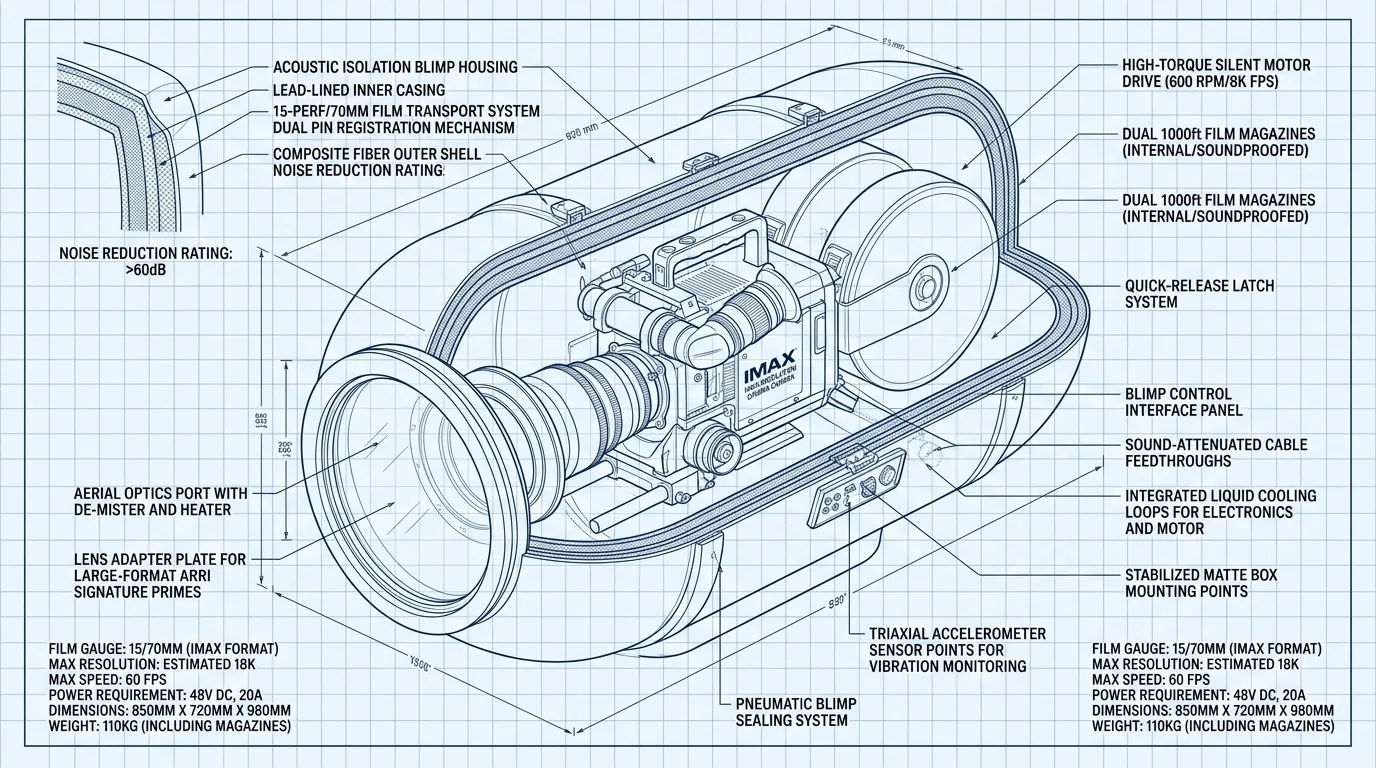
The Odyssey is the first feature shot entirely on 15/70mm IMAX film — a format with roughly 18K equivalent resolution and a 1.43:1 near-square aspect ratio. The obstacle historically was noise: the mechanical clatter of the IMAX camera made live dialogue recording impossible. Nolan and IMAX responded by developing the "Keighley" camera and pairing it with a soundproof "blimp" housing that Damon described as "the size of a coffin." The rig runs to about 300 pounds and requires steel-plated dollies to move.
The scarcity of the exhibition format is a story in itself. Only 41 theaters worldwide can project the native 15/70mm print, delivered as a 17-kilometer reel weighing 240 kg. Fans have flown between continents to see the film as Nolan intended — a phenomenon covered in our earlier reporting on the release.
| Format tier | Aspect ratio | Image retained | Notes |
|---|---|---|---|
| IMAX 15/70mm film | 1.43:1 | 100% | Native format, ~18K equivalent |
| IMAX with Laser GT | 1.43:1 | 100% | 4K digital, high brightness |
| Standard digital "IMAX" | 1.90:1 | ~60% | Cropped top/bottom — colloquially "LieMAX" |
Dialogue as Structure: The "Dad" to "Father" Arc
Audiences on the r/ChristopherNolan discussion threads have argued for months about the film's contemporary phrasing. The most cited example is Telemachus (Tom Holland) calling Odysseus "Dad" — jarring in a Homeric context. More careful reads on those same threads point out that the word shifts to "Father" only in the final act, exactly as Telemachus assumes the throne. The choice is a linguistic marker for the son's ascension, not sloppy translation, and it echoes the approach of Emily Wilson's modern verse translation.
The "Athena" Reveal and the Unreliable Narrator
Zendaya's Athena is not depicted as a literal goddess. She appears to Odysseus in visions, wearing the face of a priestess he watched slaughtered during the sack of Troy. That single choice reframes the film: the monsters and gods can be read as manifestations of Odysseus's guilt and PTSD, not supernatural obstacles. It's the strongest argument for the "unreliable narrator" reading that has taken hold in cinephile forums — and it is why the movie plays more like a psychological thriller than a mythic epic.
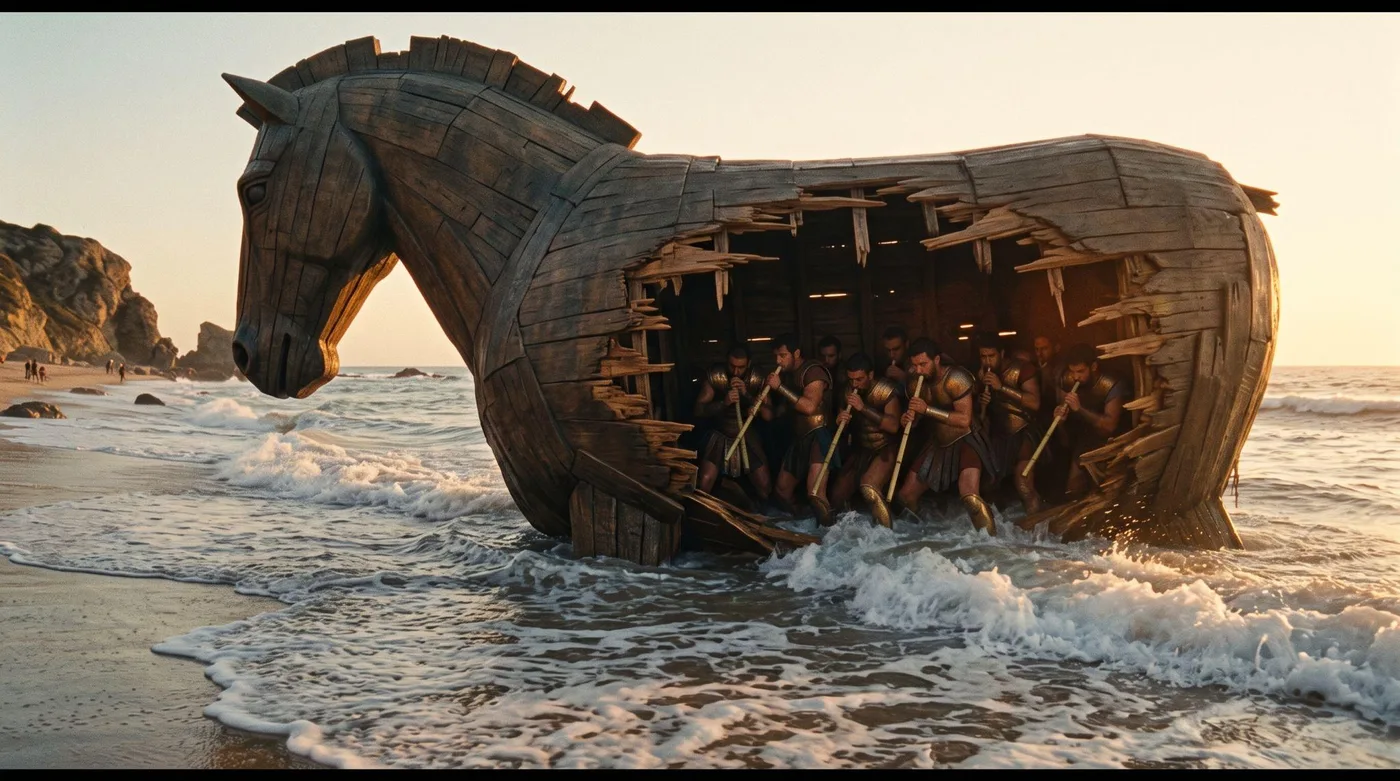
Nolan also reworks the Trojan Horse. In this version it is not a wheeled construct but a half-sunk offering to Poseidon, mired in the tide. The logic is coldly practical: the Trojans only accept it as a genuine religious relic because it looks like an actual shipwreck. Inside, some soldiers drown as the tide rises; the rest hold their breath in filth and silence.
Production as Expedition
Damon has described the shoot as "an expedition rather than a movie." Nolan filmed on location across Morocco (Troy), Sicily and Favignana (Ithaca), Scotland (Circe's island), Iceland (the Underworld), and Greece (the Cyclopes) with almost no green screen. For the Laestrygonians sequence, the "giants" were achieved with forced perspective — Damon acted against a 4'5" female stunt double, Devyn Dalton, so that seven-foot stunt performers reading opposite her scale correctly on screen.
Money and the "Nolan Effect"
With a reported $250 million budget, The Odyssey is one of Nolan's most expensive films. Ensemble salaries came in well under standard market rates — a pattern industry watchers have started calling the "Nolan effect."
| Actor | Reported upfront base | Typical market rate |
|---|---|---|
| Matt Damon | $4–5 million | Up to $25 million |
| Tom Holland | $3.5–4 million | ~$20 million (Marvel tier) |
| Zendaya | ~$5 million | $8–10 million |
| Anne Hathaway | $4–5 million | $15 million |
Backend deals may push some totals higher over time, but the upfront concessions are the story: A-list talent taking a haircut for a fully analog production. Salary figures across trades are estimates; none are formally disclosed.
What Actually Cleared the Air of Rumor
- The gluten cut wasn't a diet fad. Damon's medical team framed it as an inflammation fix that also produced the weight loss target.
- The "modern" dialogue is structural. The shift from "Dad" to "Father" is used as a coming-of-age marker for Telemachus.
- The stunt double reveal is not CGI. Forced perspective did the work practical VFX gets credit for.
What remains genuinely contested: the exact workout methodology (bodyweight vs. barbell dominant), the salary figures above, and whether Nolan's decision to omit Zeus and Poseidon reads as bold reinterpretation or as gatekeeping the mythology.
Frequently Asked Questions
Why did Matt Damon lose so much weight for The Odyssey?
Nolan wanted a lean, war-worn Odysseus. Damon dropped to 167 pounds through a permanent gluten cut and a posterior-chain-focused training split, not the crash dieting he used on Courage Under Fire in 1996.
What is the IMAX "blimp" on The Odyssey?
A 300-pound soundproof housing built by Nolan and IMAX for the "Keighley" 15/70mm camera. It muffled the mechanical noise enough to record dialogue live on the world's highest-resolution film format.
Is The Odyssey shot entirely on IMAX 70mm film?
Yes. It is the first feature shot 100% on 15/70mm IMAX. Only 41 theaters worldwide can project the native 1.43:1 print; other cinemas show a cropped 1.90:1 version that loses roughly 40% of the vertical image.
Did Matt Damon stay gluten-free after the film?
Yes. He has said giving up gluten resolved long-standing inflammation and fatigue and has kept the change permanent post-production.