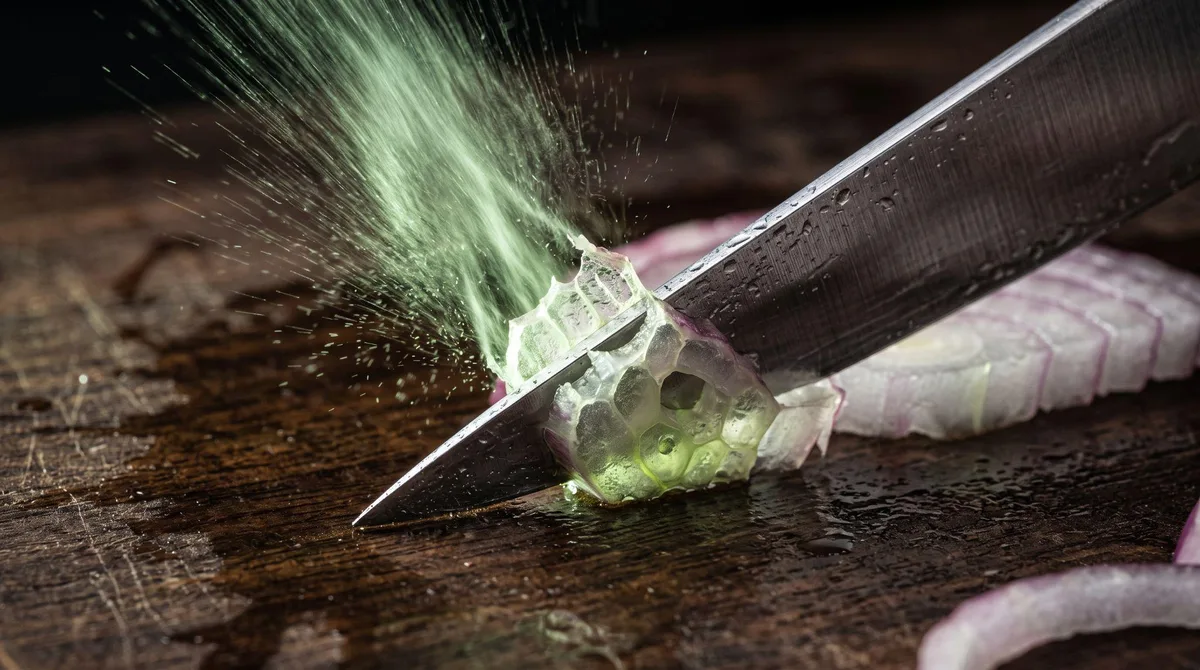
The tears from cutting an onion aren't a metaphor — they're your eyes literally producing acid. When you damage an onion cell, you set off a chemistry cascade whose product forms sulfuric acid on your cornea. Once you understand the mechanism, the useful preventions get obvious — and the folk remedies that don't work fall away.
The Chemistry, in Plain Terms
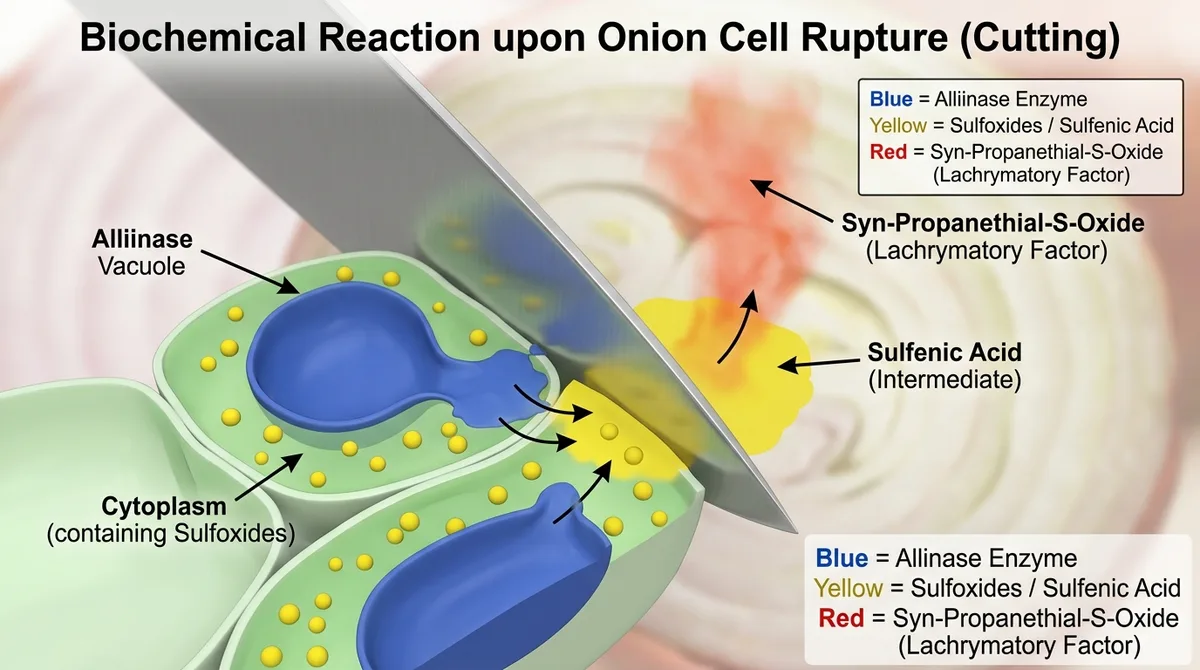
Intact onion cells store two ingredients in separate compartments: sulfoxides in the cytoplasm and an enzyme called alliinase in tiny sacs called vacuoles. Slice or crush the cell and the two mix. The alliinase converts sulfoxides into sulfenic acid, which almost immediately rearranges — with help from a second enzyme called the lachrymatory factor synthase — into the volatile gas syn-propanethial-S-oxide, or LF (lachrymatory factor).
LF is light, volatile, and rises with air currents. When it reaches your eyes and hits the aqueous tear film, it reacts to produce sulfenic acid derivatives and, ultimately, a small amount of sulfuric acid. Your eyes' nerve endings register this as pain; your tear glands respond by flooding to wash it away.
Not All Onions Do This Equally
- Yellow and white onions have the highest sulfoxide content — they're the classic tear-jerkers.
- Red onions generally produce less LF but not zero.
- Sweet onions (Vidalia, Walla Walla) are grown in low-sulfur soil, producing much less LF.
- Shallots and leeks vary but generally cause less irritation than yellow onions.
Prevention: What Actually Works
Use a Sharp Knife
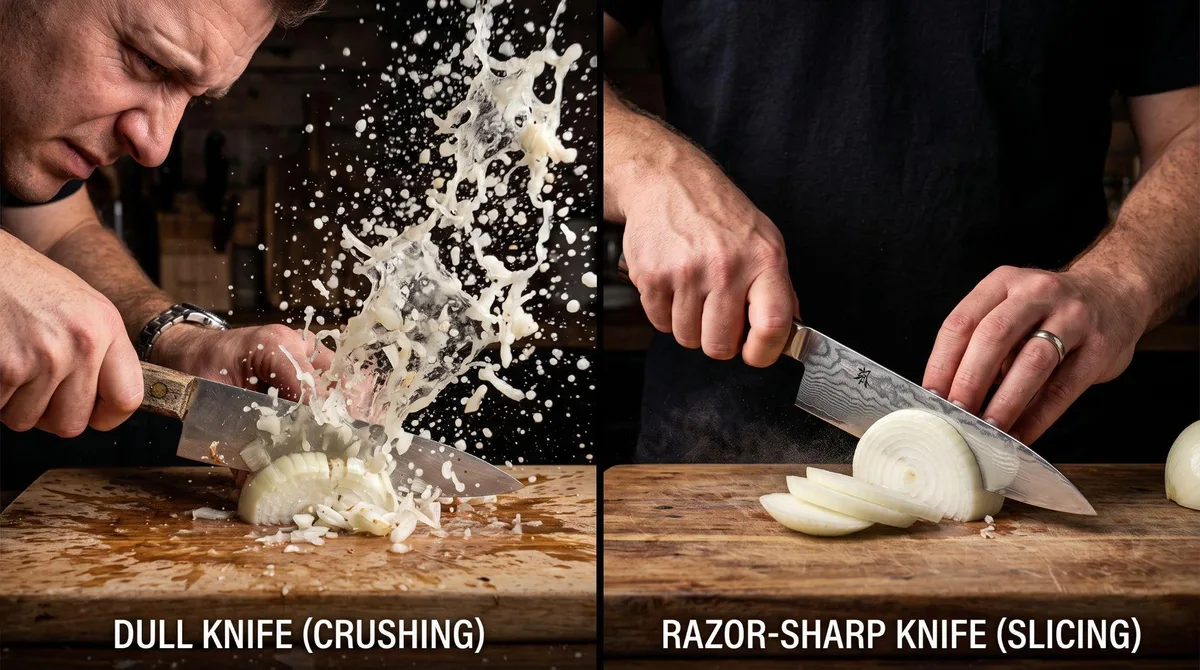
This is the most reliable trick and the least dramatic. A sharp knife slices cells cleanly; a dull knife crushes them, exposing far more contents and releasing dramatically more LF. If you rarely sharpen your knives, you're doing this to yourself.
Chill the Onion First
Fifteen minutes in the freezer or 30 in the fridge slows the enzymatic reaction. LF still forms, but at reduced concentration. Don't freeze the onion — chilled works; frozen makes it slippery and hard to cut safely.
Cut Near a Vent or Under Running Water
LF is a gas — physical airflow moves it away from your face. A range hood at high speed, a nearby open window with a fan blowing outward, or cutting on a cutting board next to the sink with the faucet running all reduce exposure.
Wear Actual Sealed Goggles
Regular glasses don't help — LF flows around the edges. Only goggles that seal against the skin (swim goggles, safety goggles) block it. Effective, undignified.
Cut the Root Last
The root end contains the highest concentration of sulfoxides. Trim the top and peel from there; save the root for the final cut. Reduces total LF release significantly.
Popular Tricks That Don't Actually Work
Cooking communities regularly test these — and the results are consistent:
- Bread in mouth: no consistent effect. The theory (absorbing LF as it passes) doesn't survive the physics.
- Vinegar on cutting board: minor effect at best. Doesn't neutralize LF meaningfully.
- Match in mouth: old wives' tale with no supporting evidence.
- Onion under water: works while it's under water but you can't really chop that way for long.
Frequently Asked Questions
Why don't chefs seem to cry when cutting onions?
They use sharp knives, work fast, and often have airflow (kitchen vents) they don't consciously notice. Also, chronic exposure builds mild tolerance — the first onion of the day still stings.
Does contact-lens wearing help?
A little. Lenses cover part of the cornea, reducing the surface area where LF can react. It's a side effect, not a strategy.
Are there tear-free onion varieties?
Yes — sweet onions like Vidalia are naturally low-LF because they grow in low-sulfur soil. Genetically modified "tearless" onions have been developed but aren't widely commercialized yet.