Annual Recurring Revenue (ARR) is the single number the SaaS economy organizes itself around. It's not cash in the bank and it's not accounting revenue — it's the annualized value of a company's active subscriptions, and it functions as the primary lever for valuation, the benchmark for growth, and a psychological anchor for founders. Understanding what it includes, what it deliberately excludes, and how it gets massaged is essential to reading any SaaS business honestly.
The Definition (and the Argument Inside It)
There are two competing definitions, and the gap between them causes real friction:
- Contracted ARR: revenue from contracts with a term of 12 months or more. The conservative, enterprise-native definition.
- Annualized Run Rate: current Monthly Recurring Revenue (MRR) × 12. The "SaaS-native" shortcut.
The difference matters. If a company has 10% monthly churn, its MRR × 12 projection is fiction — the customer base would erode long before that annual figure could be collected. Markets have grown appropriately skeptical of run-rate ARR for high-churn businesses.
How It's Actually Calculated
Proper ARR tracks momentum through five components:
Current ARR = Prior ARR + New ARR + Expansion ARR − Churned ARR − Contraction ARR
And rigorous exclusion of non-recurring elements separates a credible figure from an inflated one:
| Include in ARR | Exclude from ARR |
|---|---|
| Core subscription fees | Setup and onboarding fees |
| Recurring add-ons and seat charges | Professional services and consulting |
| Contractual committed minimums | Variable, non-committed overage fees |
| Annualized multi-year contract value | One-time training or hardware sales |
Founders who fold setup and services fees into ARR get a "valuation haircut" the moment due diligence strips them back out.
Why the Obsession? The SaaS Valuation Gap
In traditional business, you're valued on current profit (EBITDA). SaaS breaks that model. Companies spend heavily upfront on customer acquisition (CAC), and accounting rules force that cost to be expensed immediately — producing negative EBITDA for years even in healthy businesses. But once a customer is acquired, the marginal cost of serving them in year two or three is minimal. ARR is the shorthand for that future profit capacity: it measures the size of the compounding engine.

The Valuation Engine: Multiples and the Rule of 40
SaaS companies are valued as a multiple of ARR, and the multiple hinges on the balance of growth and efficiency — captured by the Rule of 40: revenue growth rate (%) + profit margin (%) should exceed 40. Best-in-class companies can command 10–12× ARR; undifferentiated or high-churn businesses get compressed toward 3–4×.
| ARR stage | Typical multiple | Key value driver |
|---|---|---|
| $500K–$2M | 2.5–4× ARR | Proven recurring model |
| $2M–$20M | 5–8× ARR | Scale, retention, defensibility |
| Over $20M | 7–12× ARR | Rule of 40, public comparables |
Not All ARR Is Equal: "Quality" Matters
Two companies can both report $10M ARR and be worth wildly different amounts. High-quality ARR has:
- High net revenue retention (NRR): above 100% means the existing customer base grows even with zero new sales — a compounding effect.
- Low customer concentration: if one "whale" account is more than ~15% of ARR, a single cancellation can break the company.
- Low involuntary churn: failed credit cards silently erode ARR; disciplined companies recover ~70% through automated dunning.
The Technical Gap: ARR vs. GAAP Revenue

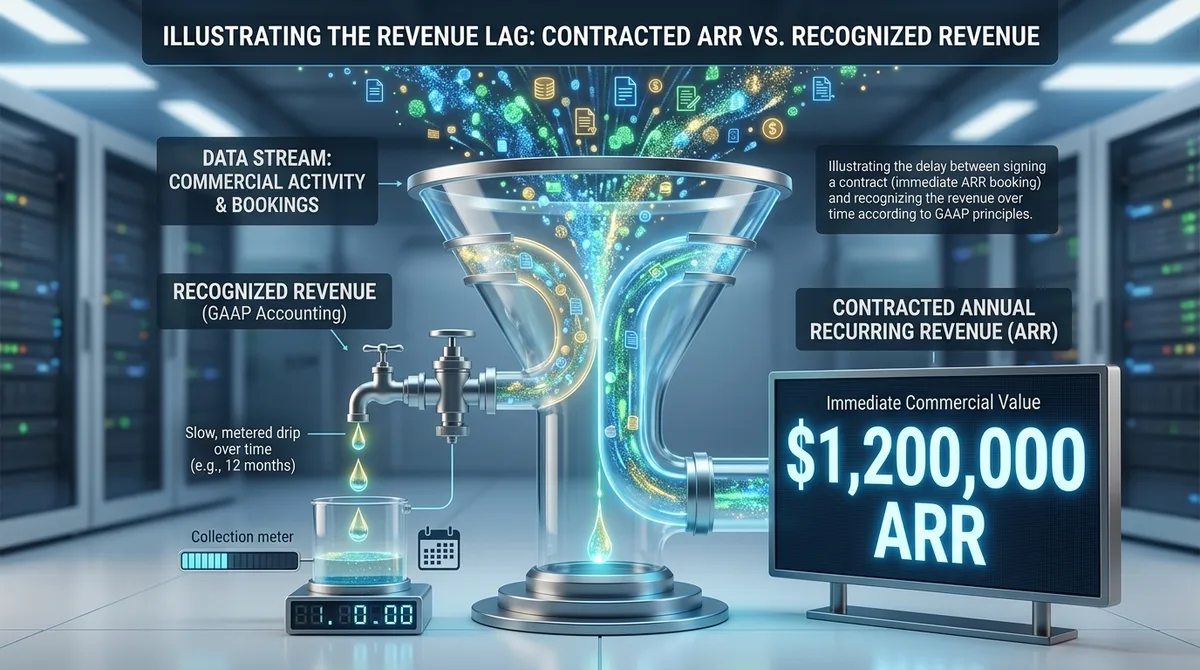
A trap for founders: ARR is not the same as accounting revenue. Under ASC 606, revenue is recognized ratably as the service is delivered. Sign a $120,000 annual contract in January and you add $120,000 to ARR immediately — but your income statement shows only $10,000 that month, with $110,000 sitting as "deferred revenue."
The "Dirty Truth" of Reporting
Community discussion among founders on SaaS operator forums reveals how much latitude exists in the number. CFOs get categorized as "aggressive," "Goldilocks," or "conservative." The recurring warnings: an ARR figure is "essentially a lie" if involuntary churn from failed cards isn't managed, and buyers heavily discount ARR when the founder is still the primary salesperson — "founder dependency" means it isn't yet a scalable asset. As the widely-repeated line goes: revenue is a vanity metric, but ARR is a sanity metric — only if measured honestly.
How AI Is Reshaping ARR in 2025–2026
The traditional per-seat pricing model is increasingly seen as a "tax on growth" now that AI agents let companies do more with fewer employees. The industry is shifting toward usage- and outcome-based pricing that scales with value delivered rather than headcount. "ARR per full-time employee" is now a headline metric, reaching $200,000+ at mid-market firms. This connects to the broader pattern of why big tech keeps reorganizing around compute rather than labor.
Frequently Asked Questions
What's the difference between ARR and GAAP revenue?
ARR is a management metric — the annualized value of active subscriptions. GAAP recognized revenue is an accounting figure recorded only as the service is delivered, lagging ARR and recognized ratably across the subscription term.
Should one-time setup fees be included in ARR?
No. ARR should include only recurring revenue. Folding in setup or professional services fees inflates the metric and leads to valuation discounts during due diligence.
How does the Rule of 40 affect valuation?
A combined score of growth % + margin % above 40 marks a high-performing company that typically commands a much higher ARR multiple.