
As of March 2026, Forbes assessed Taylor Swift's net worth at approximately $2 billion — roughly double the figure at which she first crossed into billionaire status in 2024.
The number is widely reported. The structurally interesting fact is rarely stated: Swift is one of very few musicians whose fortune comes overwhelmingly from music itself — touring, recordings and publishing — rather than from a spirits brand, a cosmetics line, or a technology investment. Most billionaire musicians got there by selling something other than music.
Where the Money Came From
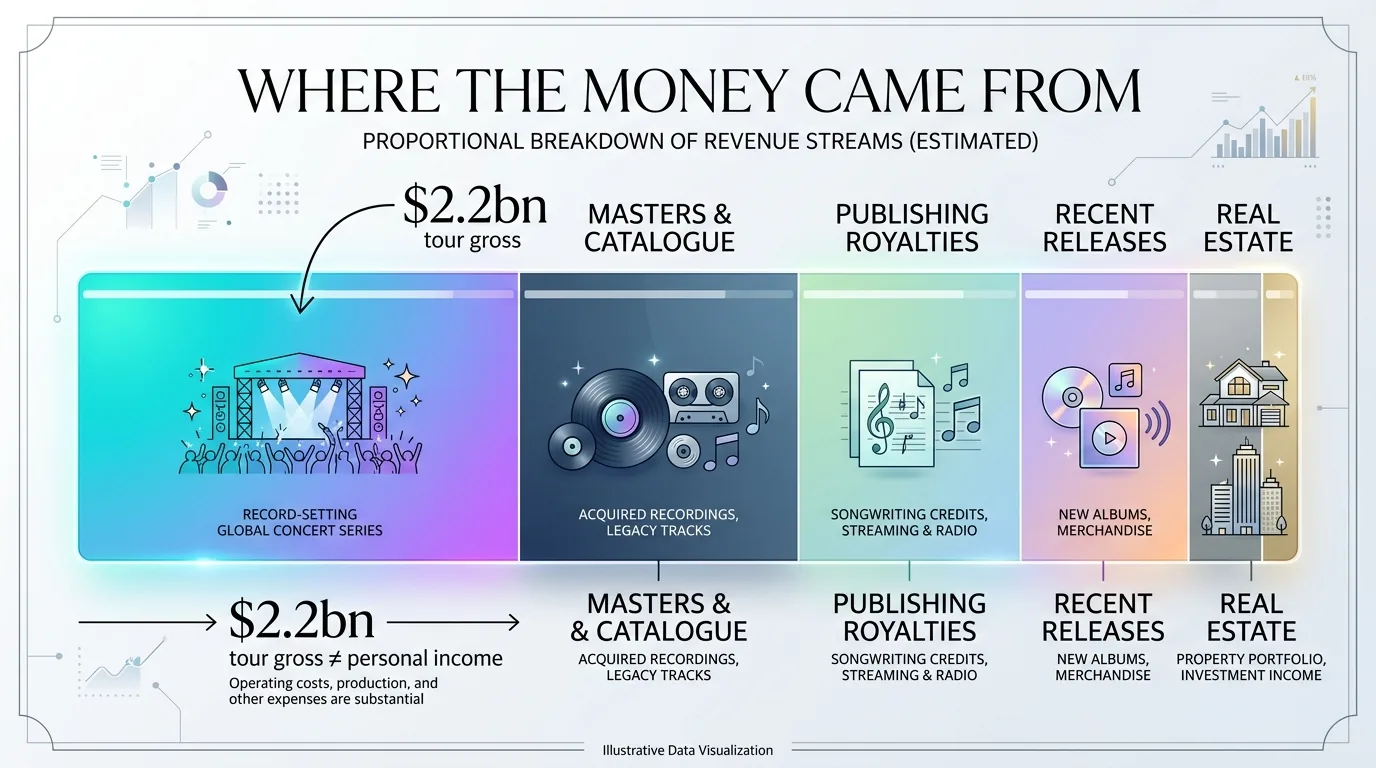
1. The Eras Tour — the single largest driver
The Eras Tour grossed approximately $2.2 billion, making it the highest-grossing concert tour in history by a very wide margin. Two things about that figure matter more than its size.
First, gross is not personal income. Touring revenue is split across venues, promoters, crew, production, insurance and tax across dozens of jurisdictions. Headline artists on a tour of this scale typically retain a substantial share of net profit, but it is a fraction of the gross figure.
Second, the tour generated revenue well beyond ticketing: a concert film released theatrically and then to streaming, merchandise at an unusually high per-attendee rate, and a measurable boost to back-catalogue streaming across the entire discography for the tour's duration.
2. Buying back the masters
Swift used Eras proceeds to acquire her original master recordings for a reported $360 million — closing a dispute that had run since her early catalogue was sold without her involvement.
This is the decision that most changed her long-term economics, and it is frequently misreported as purely symbolic. Owning masters means every sync licence — film, television, advertising, video game — and every stream of the original recordings pays her rather than a third-party rights holder, in perpetuity. For a catalogue with this level of ongoing demand, that is an appreciating asset rather than a one-off purchase.
3. The re-recordings
Before the buyback, Swift re-recorded much of her catalogue as "Taylor's Version" releases. The strategy did two things at once: it generated substantial new revenue from albums audiences already owned, and it devalued the original masters by redirecting streaming and licensing demand toward versions she controlled — which materially affected the price and dynamics of the eventual buyback.
It has since been widely cited as changing industry norms around artist ownership, and newer recording contracts increasingly address re-recording rights explicitly as a direct result.
4. Catalogue and publishing
Swift writes or co-writes her material, meaning she collects publishing royalties in addition to recording royalties. This is the quiet compounding engine: publishing pays out on every stream, cover, radio play and sync indefinitely, and it does not require her to do anything further.
5. Recent releases and real estate
Albums including The Tortured Poets Department and The Life of a Showgirl contributed additional revenue, and she holds a substantial property portfolio across several US markets. Real estate is a store of the wealth rather than a source of it.
Why Different Sources Give Different Numbers
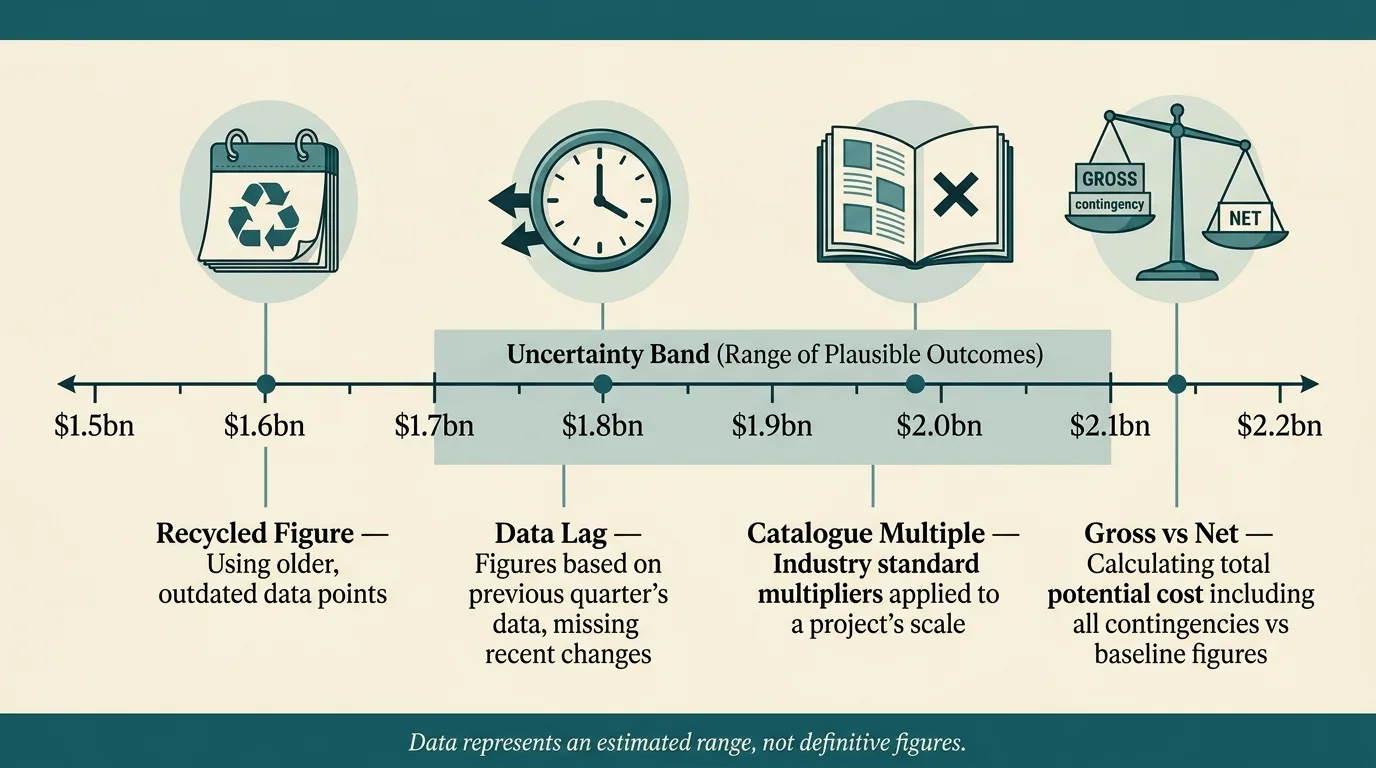
Search this term and you will find figures ranging from roughly $1.6 billion to over $2.1 billion published in the same period. The discrepancy is methodological, not a matter of one source being wrong:
- Catalogue valuation is a judgement call. Music rights are valued as a multiple of annual earnings, and reasonable analysts disagree on the multiple — particularly for an artist whose catalogue is unusually resistant to decay.
- Estimates lag reality. A figure published in one month may reflect data gathered months earlier.
- Gross versus net. Less rigorous outlets treat tour gross as personal earnings, which inflates the total substantially.
- Tax and liabilities are opaque. No outside party can see the actual position.
- Some figures are simply recycled. A large share of net-worth pages copy from one another without independent assessment, which is why an outdated number can circulate for years.
Uncertainty flag: every net worth figure for a private individual is an external estimate. Swift has never published her financial position, and no one outside her organisation knows it precisely. Forbes' methodology is the most rigorous publicly available, which is why it is cited here — but it remains an estimate, and should be read as an order of magnitude rather than a precise sum.
For how celebrity financial reporting tends to drift from source figures, our coverage of Zendaya's 2026 slate follows the same verification approach.
Context Among Musicians
Forbes places Jay-Z as the wealthiest living musician at approximately $2.8 billion. The comparison is instructive: the bulk of Jay-Z's fortune came from a champagne brand, a spirits stake and other business holdings rather than from recordings. Swift's position is unusual precisely because the music is the asset.
Frequently Asked Questions
What is Taylor Swift's net worth?
Forbes assessed her at approximately $2 billion as of March 2026, roughly double her figure when she first reached billionaire status in 2024. All net worth figures for private individuals are external estimates.
How did Taylor Swift become a billionaire?
Primarily from music itself — the Eras Tour, which grossed about $2.2 billion, her recording and publishing royalties, the Taylor's Version re-recordings, and the acquisition of her original master recordings. She is unusual among billionaire musicians in that outside business ventures are not the main driver.
How much did Taylor Swift pay for her masters?
A reported $360 million, funded largely from Eras Tour proceeds. Owning the masters means streaming and licensing revenue from the original recordings flows to her rather than to a third-party rights holder.
How much did the Eras Tour make?
Approximately $2.2 billion in gross revenue, the highest-grossing concert tour on record. Gross is not personal income — it is split across venues, promoters, production, crew and taxes across many jurisdictions.
Why do net worth estimates for Taylor Swift vary so much?
Because music catalogue valuation depends on a judgement about earnings multiples, estimates lag by months, some outlets confuse tour gross with personal earnings, and tax and liability positions are not public. Figures between roughly $1.6 billion and $2.1 billion have circulated in the same period.
Is Taylor Swift the richest musician?
No. Forbes places Jay-Z higher at approximately $2.8 billion, though most of his wealth derives from business ventures including a champagne brand and spirits holdings rather than from music.