The iPhone-versus-Android question has been asked for nearly two decades, and the honest answer has shifted. In 2010 the platforms were genuinely different products. In 2026 they do the same things, mostly equally well, and the meaningful differences have migrated away from features and into structure — governance, lifespan, lock-in, and repair economics.
Those are the differences that will actually affect you three years from now. Camera comparisons will not.
Two Business Models, Not Two Phones
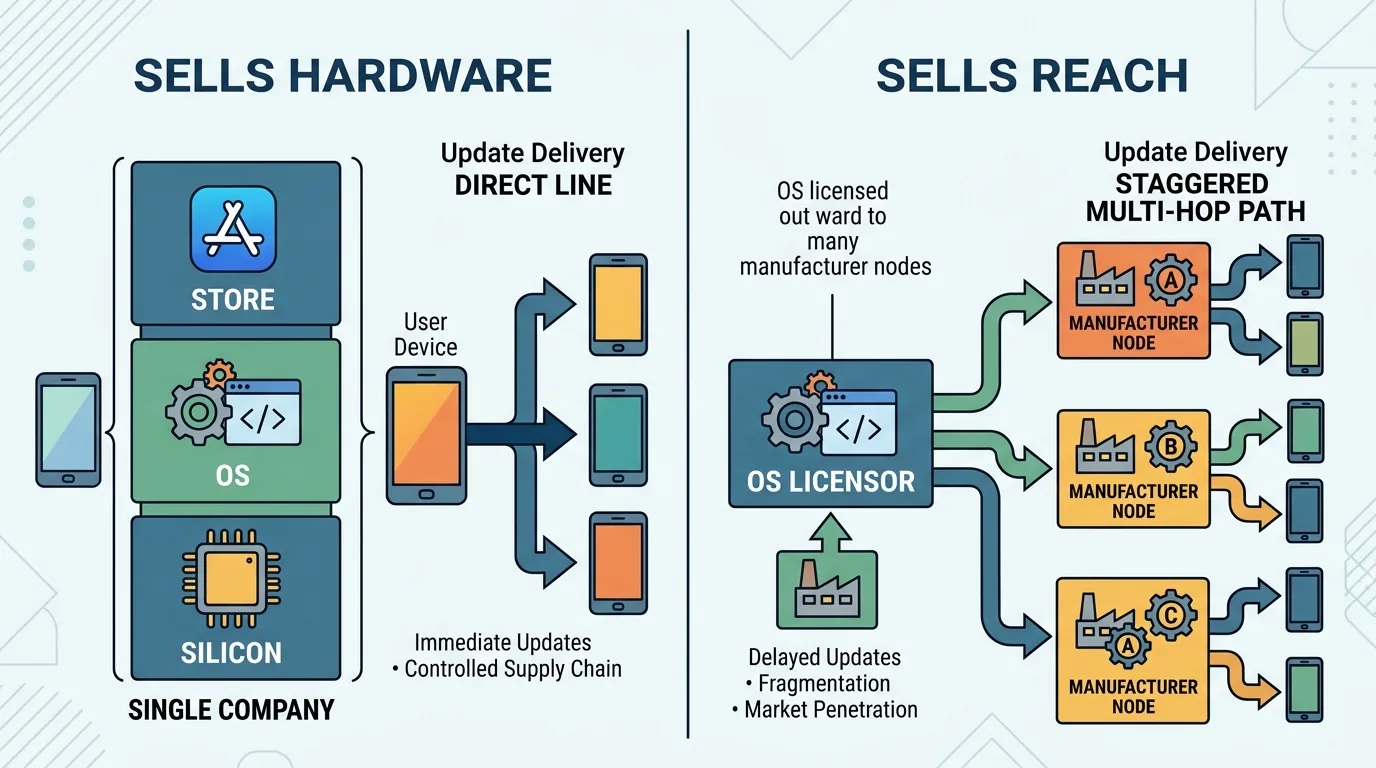
Everything downstream follows from one fact: Apple sells hardware and Google sells reach.
| iPhone / iOS | Android | |
|---|---|---|
| Who makes the hardware | Apple only | Samsung, Google, Xiaomi, Motorola, hundreds more |
| Who controls the OS | Apple, end to end | Google maintains AOSP; manufacturers modify it |
| Primary revenue | Device margin plus services | Advertising, Play Store commission, licensing |
| Price range | Mid to premium only | Entry-level through ultra-premium |
| Update delivery | Direct from Apple, same day, all devices | Via manufacturer, staggered, varies enormously |
The vertical-integration difference explains most of what follows. Apple controls silicon, OS, and store, which produces tight optimisation and long support at the cost of choice. Android's licensing model produces enormous choice and price range at the cost of consistency.
The Difference That Matters Most: Update Lifespan
If you read one section, read this one. Security update duration determines how long a phone is safe to use, and it is the single largest practical divergence between the platforms — and the least discussed in comparison articles.
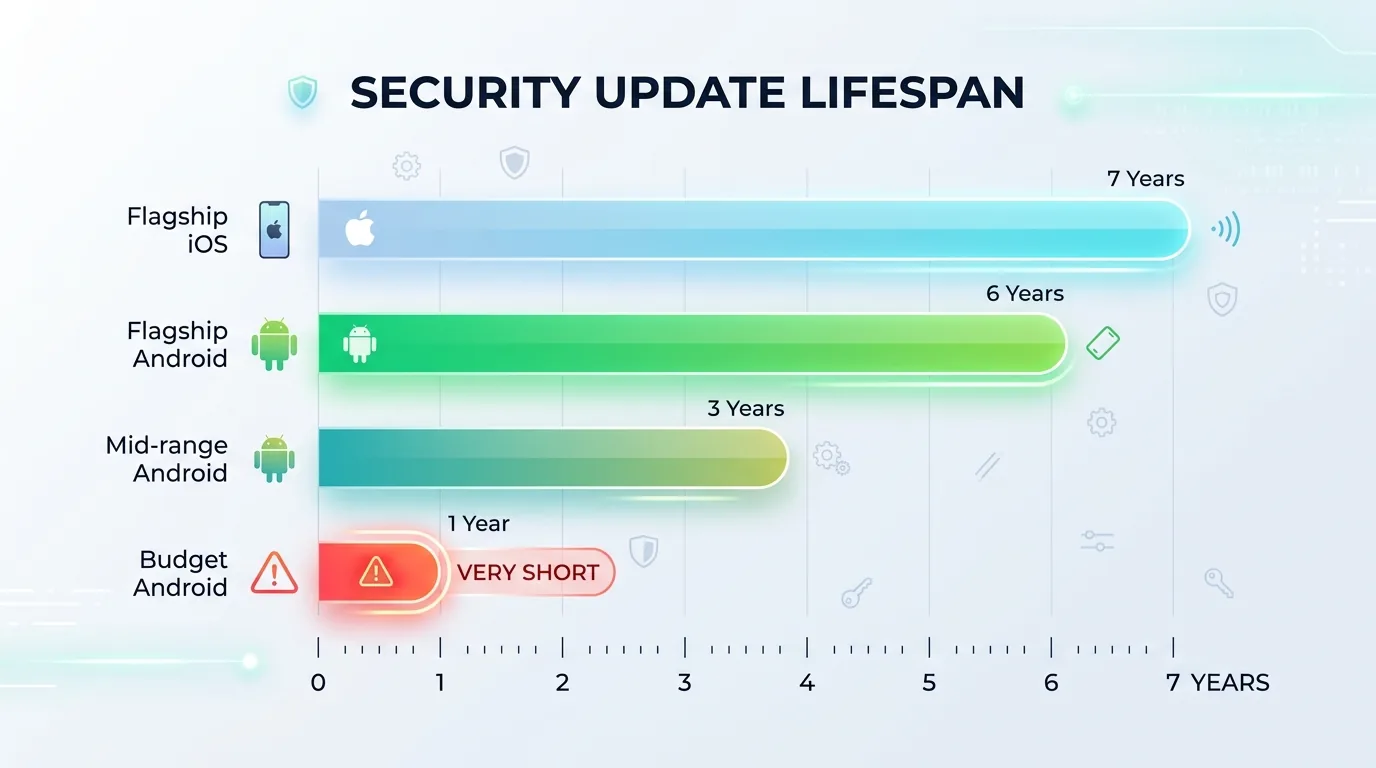
Apple has historically delivered major iOS updates to devices five to seven years old, and pushes security patches to still older hardware. Every supported iPhone receives the update on the same day, directly from Apple.
Android is bifurcated. Flagship devices from Google and Samsung now commit to seven years of OS and security updates — matching or exceeding Apple. But that commitment applies to a narrow slice of the market. Mid-range and budget Android devices commonly receive two to four years, and some entry-level hardware receives close to nothing after launch. The staggered rollout also means an "Android update" reaching your specific device can lag its announcement by months, because the manufacturer must merge it into their own OS layer first.
The practical translation: a $1,000 flagship from either platform will be safe to use for roughly the same length of time. A $250 Android phone will not, and that is a genuine security consideration rather than a snobbery point.
Openness vs. Curation — Both Are Real Trade-offs
Android permits sideloading, alternative app stores, custom launchers, default-app replacement at a deep level, file-system access, and — on some devices — bootloader unlocking and custom ROMs. iOS restricts all of this, with regulatory carve-outs in some jurisdictions.
The standard framing treats this as freedom versus safety, which is too simple. What curation actually buys is a smaller attack surface and a single accountable party; what it costs is the ability to fix or repurpose your own device. What openness buys is control and longevity — a phone abandoned by its manufacturer can often be kept current with a community ROM; what it costs is that the same mechanism enabling that is the one malicious apps exploit.
Threads on r/Android and r/apple converge on a point worth taking seriously: the majority of users never exercise Android's openness, and for them it is a theoretical benefit carrying a real security cost. For the minority who do, it is decisive.
Privacy: A Real Difference, Frequently Overstated
Apple's business model does not require your data, and it has built product around that: on-device processing where feasible, App Tracking Transparency, and public positioning against cross-app tracking. Google's business model does require data, and Android historically collected more of it by default.
Three qualifications the marketing omits:
- Third-party apps behave identically on both platforms. A social app harvests the same data on an iPhone as on a Pixel. Platform privacy controls limit what apps can take without asking; they do not limit what you agree to hand over.
- Android's controls have converged substantially. Granular and one-time permissions, approximate location, privacy dashboards, and per-app network controls all exist now.
- Apple is not a neutral party either. It runs a fast-growing advertising business and receives very large annual payments from Google for default search placement — which is precisely the arrangement that lands user queries with the company Apple's marketing contrasts itself against.
Net assessment: iOS gives you a stronger default privacy posture. Neither platform protects you from the apps you install and the permissions you grant.
Lock-in and Exit Cost
This is the factor most people underweight at purchase and most regret later. Switching between platforms carries asymmetric friction:
| Asset | Transfers cleanly? |
|---|---|
| Contacts, calendar, email | Yes, both directions |
| Photos | Yes, with effort |
| Purchased apps | No — repurchase on the other store |
| iMessage history | Poorly — a long-standing friction point |
| Apple Watch | No — iPhone only, becomes useless |
| AirDrop / Nearby Share workflows | No cross-platform equivalent |
| Ecosystem accessories | Varies; often partially functional at best |
The messaging friction has eased considerably now that RCS is supported across both platforms, bringing read receipts, typing indicators, high-quality media and encryption to cross-platform chats — which removes what was historically the most cited reason people felt unable to leave iMessage. The hardware lock-in, particularly the Apple Watch, remains absolute.
Repairability and Total Cost
Both platforms have moved, under regulatory pressure, toward parts availability and self-repair programmes. Two structural realities persist:
- Parts pairing. Components serialised to a specific device can trigger warnings or disable features when swapped, even with genuine parts. This affects both platforms and is the live battleground in right-to-repair legislation.
- Resale value. iPhones depreciate more slowly and more predictably than most Android devices, which meaningfully narrows the real cost gap over a three-year ownership period. A cheaper Android phone with a shorter support window and lower residual value is not always cheaper in total.
Who Should Actually Choose Which
Choose iPhone if: you already own an Apple Watch, AirPods, iPad or Mac; you want the longest predictable support window without researching model-by-model; you value a strong privacy default without configuring anything; you want maximum resale value; you provide tech support for family members and want fewer variables.
Choose Android if: your budget is under roughly $500 — the value at that tier is not close; you want a specific hardware capability such as extreme zoom, a folding display, a headphone jack or expandable storage; you want to sideload, customise deeply, or run custom firmware; you are embedded in Google's services; you want genuine competition on price.
It genuinely doesn't matter if: you use your phone for messaging, browsing, media, navigation and photos, and buy in the flagship tier. At that level the platforms have converged to the point where the deciding factor should be which one your existing accessories and household use — an economic argument, not a technical one. Platform-level reorganisations at both companies keep churning the details; see our piece on why big tech companies keep reorganizing.
On Market Share Figures
Comparison articles cite wildly conflicting numbers because they measure different things. Global installed base heavily favours Android — roughly seven in ten devices worldwide — because Android covers price tiers Apple does not sell into at all. Global revenue and profit favour Apple decisively. Regional figures diverge sharply: iOS holds a majority in the United States and Japan while Android dominates most of Asia, Africa and South America. Any single "market share" number quoted without specifying whether it measures shipments, active devices, web traffic or revenue is close to meaningless.
Frequently Asked Questions
Is iPhone better than Android?
Neither is better in general. iPhone offers a longer predictable support window, stronger default privacy, tighter ecosystem integration and better resale value. Android offers far more hardware choice, much better value below roughly $500, and deeper customisation. The right answer depends on budget, existing accessories, and whether you want control or curation.
Which is more secure, iPhone or Android?
Flagship devices on both platforms are comparably secure. The real gap is at the low end, where budget Android devices often receive far shorter security update support. Update lifespan matters more than platform architecture for most people.
Can I switch from iPhone to Android without losing anything?
Contacts, calendars, email and photos transfer cleanly. Purchased apps do not transfer and must be bought again. An Apple Watch will not work with Android at all. Message history transfers imperfectly, though RCS support on both platforms has largely fixed day-to-day cross-platform messaging.
Do iPhones last longer than Android phones?
In software support terms, iPhones have historically received updates for five to seven years, and current Google and Samsung flagships now match that with seven-year commitments. Mid-range and budget Android devices typically receive far less. Hardware longevity is broadly comparable at similar price points.
Is Android really less private than iOS?
iOS has a stronger default privacy posture, largely because Apple's revenue does not depend on advertising to the same degree. Android's privacy controls have converged substantially. Neither platform protects you from data collected by the third-party apps you install and grant permissions to.
Why do market share numbers for iPhone and Android differ so much?
Because different sources measure different things — quarterly shipments, active installed base, web traffic share, or revenue — and results vary enormously by region. Android leads global installed base while Apple leads revenue and holds majority share in markets such as the United States and Japan.