The Simplest Definition
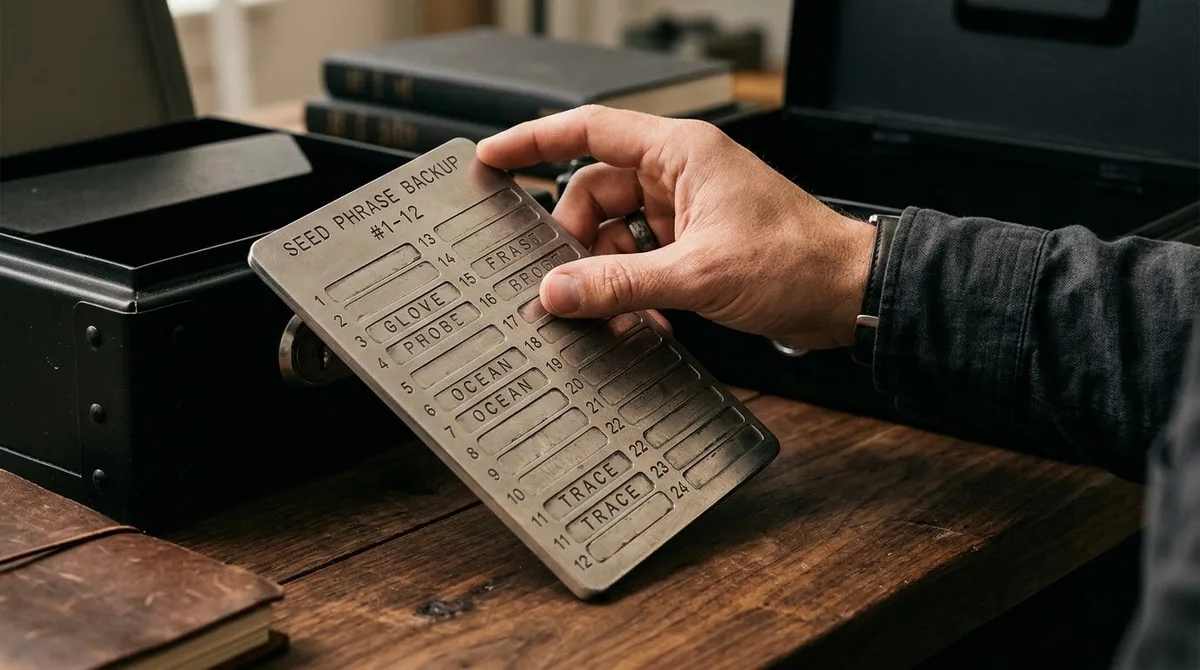
A seed phrase — technically called a mnemonic sentence — is a list of 12 or 24 ordinary English words that acts as the master key to a cryptocurrency wallet. From that single string of words, wallet software mathematically derives every private key you'll ever use, for every coin and address in that wallet. Anyone who has the phrase controls the money. Anyone who loses it, permanently loses access.
That's the reason it matters more than any password: there is no reset button, no customer service, and no bank to call. The phrase is the account.
Why It Replaced Raw Private Keys
In the early years of Bitcoin, wallets stored a separate 64-character hexadecimal private key for every address. Users who generated new addresses for privacy had to back up each key individually, and losing one meant losing the funds at that address. Hierarchical Deterministic (HD) wallets, introduced through the BIP-32 standard, changed that by letting one master seed generate an entire tree of keys. Encoding that seed as human-readable words made it dramatically easier to back up and less prone to transcription errors.
How the Words Are Actually Generated (BIP-39)
The generation process, defined in Bitcoin Improvement Proposal 39, is more precise than "random words":
- The wallet uses a cryptographically secure random number generator to produce raw entropy — 128 bits for a 12-word phrase, 256 bits for a 24-word phrase.
- It computes a SHA-256 hash of that entropy and appends a small piece of the hash as a checksum, so a mistyped word can be detected.
- The combined bits are split into 11-bit chunks. Each 11-bit chunk maps to one of 2,048 words in the fixed BIP-39 English wordlist (2^11 = 2,048).
- The final mnemonic is then run through PBKDF2 with HMAC-SHA512 for 2,048 iterations to produce the 512-bit binary seed the wallet actually uses.
The wordlist was designed for human usability: every word has a unique first four letters, so wallets can autocomplete and users can catch typos.
| Phrase length | Entropy | Total combinations |
|---|---|---|
| 12 words | 128 bits | ~3.4 × 1038 |
| 18 words | 192 bits | ~7.9 × 1056 |
| 24 words | 256 bits | ~1.1 × 1077 |
12 vs 24 Words: The Real Trade-off
Mathematically, 128 bits of entropy (12 words) is already impossible to brute-force with classical computing — the search space is larger than the number of atoms in the observable universe. 24 words provides 256 bits, matching the security level of the underlying private keys and giving a margin of safety against future quantum computing and edge-case flaws in random number generators.
The real trade-off is human. 24 words is harder to memorize and more prone to transcription errors, and transcription error is the leading cause of lost funds, not brute force. Practitioners in Bitcoin and Trezor communities routinely note that the actual bottleneck is physical security of the backup, not the number of words. For most retail users, 12 is genuinely enough; 24 is a defensible choice for very high-value cold storage.
The "25th Word" (Optional Passphrase)
BIP-39 allows an optional passphrase — sometimes called the "25th word" — that gets mixed into the PBKDF2 step. Unlike the 24 words, it can be any string of any length. Because it changes the derived seed, adding or removing even a single character produces a completely different wallet from the same 24 words.
This enables plausible deniability: the base 24 words open a decoy wallet with a small balance, while the 24 words plus passphrase open the real wallet. But there is no recovery for a forgotten passphrase. The 24 words alone will silently open the empty decoy wallet with no indication that a hidden one exists — a scenario documented repeatedly in wallet support threads where users lose years to unrecoverable typos.
Derivation Paths: Why Your Balance Sometimes Shows Zero
Once the 512-bit seed exists, the BIP-32 standard turns it into a tree of keys, and BIP-44 organizes that tree into a standard structure. Different address formats use different branches of the tree:
| Standard | Address type | Address starts with |
|---|---|---|
| BIP-44 | Legacy | 1... |
| BIP-49 | Nested SegWit | 3... |
| BIP-84 | Native SegWit | bc1q... |
| BIP-86 | Taproot | bc1p... |
When someone restores a seed into a new wallet and sees a zero balance, the funds are almost never lost — the new wallet is just scanning a different branch. Manually selecting the derivation path used by the original wallet usually reveals the missing coins.
Real-World Failure Modes That Official Docs Skip
The Gap Limit Trap
Wallet software scans the blockchain for addresses with a transaction history. To save time, it typically stops after finding 20 consecutive unused addresses in a row. Someone who generated 100 addresses but only used the first 5 and then skipped ahead to address 50 will see a partial balance — the software gave up scanning at address 25. The funds are safe on the blockchain, but invisible until the gap limit is manually raised in the wallet's advanced settings.
The "It Only Touched My Phone for a Second" Problem
The single most consistent warning across security-focused communities is that a seed phrase becomes compromised the moment it touches an internet-connected device. Malware routinely scans for anything resembling the BIP-39 wordlist in cloud backups, screenshots, note-taking apps, and clipboard history. Once the phrase has been photographed, typed, or synced, treat it as burned.
Multisig Isn't Just the Seeds
A 2-of-3 multisig setup — where two of three seed phrases are needed to move funds — is a strong protection against a single-point compromise. But it has a subtle recovery requirement: the seed phrases alone are not enough. Recovery also requires the wallet descriptor, which encodes the public keys and derivation paths for all participants. Without that metadata, the seeds are "keys without a lock."
Storing It Physically: Beyond Paper
Paper is vulnerable to fire, water, mold, and fading. Metal storage is the standard for anything non-trivial. But not every metal solution survives disaster equally. Independent stress tests by security researcher Jameson Lopp — which have subjected commercial metal backups to blowtorches, acid, and hydraulic presses — have consistently shown that tile-based systems (small letter tiles held in a frame) are the most fragile: a bent frame or failed retaining door can spill the tiles and destroy the phrase. Deep-stamped stainless steel plates and washer-based systems (letters stamped into hardware washers bolted together) reliably survive the worst conditions.
A widely recommended structure is a 3-2-1 rule: 3 total copies, on 2 different mediums (one metal, one archival paper), with 1 copy stored off-site — safe deposit box, a trusted family member's home, or a second property.
Beyond BIP-39: Other Standards Worth Knowing
| Standard | What's different | Where it's used |
|---|---|---|
| BIP-39 | The universal 12/24 word standard | Almost every hardware and software wallet |
| SLIP-39 | Splits the seed into multiple shares (e.g. 3-of-5) using Shamir's Secret Sharing | Trezor; high-value social recovery setups |
| aezeed | Encodes a "wallet birthday" so scans can skip old blocks | Bitcoin Lightning Network (LND) |
| Electrum | Uses its own versioning system, intentionally not BIP-39 compatible | Electrum desktop wallet |
SLIP-39 shares are not backward compatible with BIP-39, so a Trezor SLIP-39 backup cannot simply be restored into a Ledger. This is worth confirming before adopting a non-standard backup scheme.
Common Misconceptions
- "The coins are in the wallet." They aren't. Cryptocurrency exists only as entries on the blockchain. The wallet — and the seed phrase — is just a tool for managing the private keys that authorize movement of those entries.
- "If I delete the app, I lose the money." As long as the seed phrase is safely stored, deleting the app or destroying the hardware device changes nothing. Importing the words into any compatible wallet restores full access.
- "Uppercase or lowercase matters." The BIP-39 wordlist is entirely lowercase. Most wallets auto-correct case. The order of the words, however, is absolute.
- "A brain wallet from a favorite quote is safer because it's in my head." The opposite. Attackers run dictionary attacks against billions of common phrases and monitor the resulting addresses. Funds sent to brain-wallet addresses derived from famous quotes are usually swept by bots within seconds.
The Bottom Line
A seed phrase is the price of true self-custody: no bank means no help. Generate one on a reputable hardware wallet, verify the backup with the manufacturer's recovery-check tool, store the words on a fire-resistant metal medium (never in a photo, cloud note, or text file), and use a passphrase if — and only if — you have a rock-solid system for remembering it. Done properly, that string of 12 or 24 words is one of the most secure objects a person can own.
Frequently Asked Questions
What is a crypto seed phrase?
A seed phrase is a list of 12 or 24 ordinary words that acts as the master key to a cryptocurrency wallet. Every private key in the wallet is mathematically derived from it, so anyone with the phrase controls the funds and anyone who loses it loses access permanently.
Is a 12-word or 24-word seed phrase more secure?
A 12-word phrase provides 128 bits of entropy, which is already impossible to brute-force with current computing. 24 words provides 256 bits as a margin against future risks, but is harder to record accurately — and transcription error, not brute force, is the leading cause of lost funds.
How should I store a seed phrase safely?
Store it offline on a fire-resistant metal backup, never in a photo, cloud note, or text file. A common approach is three copies across two mediums with one stored off-site, and never letting the words touch an internet-connected device.