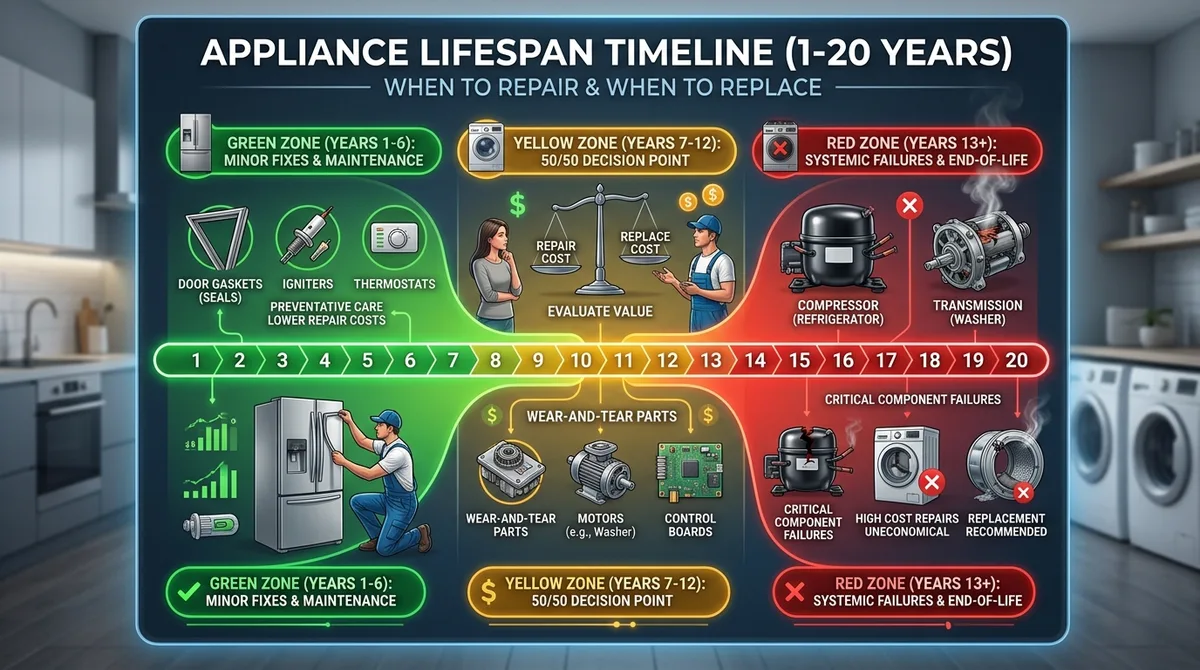
When an appliance breaks, "just replace it" feels decisive — and is often the more expensive choice. The right call depends on the appliance's brand tier, the nature of the failure, the hidden costs of installation, and a bit of math most people skip. Here's the framework technicians and cost analysts actually use.
Start With the 50/50 Rule
The baseline heuristic: replace if the appliance has passed 50% of its expected lifespan AND the repair costs more than 50% of a comparable new unit. Both conditions have to be true. A $400 repair on a 15-year-old premium Sub-Zero can be entirely rational; the same $400 on a 5-year-old budget unit is money down the drain. Which means the rule only works once you know the tier.
Lifespan Depends Heavily on Brand Tier
| Appliance | Budget tier | Mid-range | Premium |
|---|---|---|---|
| Refrigerator | 8–11 yrs | 11–15 yrs | 18–25 yrs |
| Washing machine | 7–10 yrs | 10–14 yrs | 15–20 yrs (Miele/Speed Queen) |
| Dishwasher | 6–9 yrs | 9–12 yrs | 15–20 yrs (Bosch 800/Miele) |
| Range/oven | 9–13 yrs | 12–16 yrs | 20–25 yrs (Wolf/Viking) |
| Microwave | 5–8 yrs | 8–10 yrs | 10–14 yrs |
The "they don't build them like they used to" complaint is broadly true for budget tiers — but premium brands still engineer for 20-year service cycles with all-metal construction.
The Better Math: Cost Per Year of Remaining Life
The 50/50 rule is a shortcut for the real calculation. Divide each option's cost by years of life it buys:
- A $400 repair that extends life by 5 years = $80/year
- An $800 replacement lasting 12 years = $67/year
Here replacement wins — but only because you ran the numbers.
Isolated Failures vs. the "Death Knell"
The type of failure often decides it before the math does:
- Worth repairing (isolated): igniters, door seals/gaskets, clogged drain lines, fan motors, heating elements, belts, thermal fuses, drain pumps.
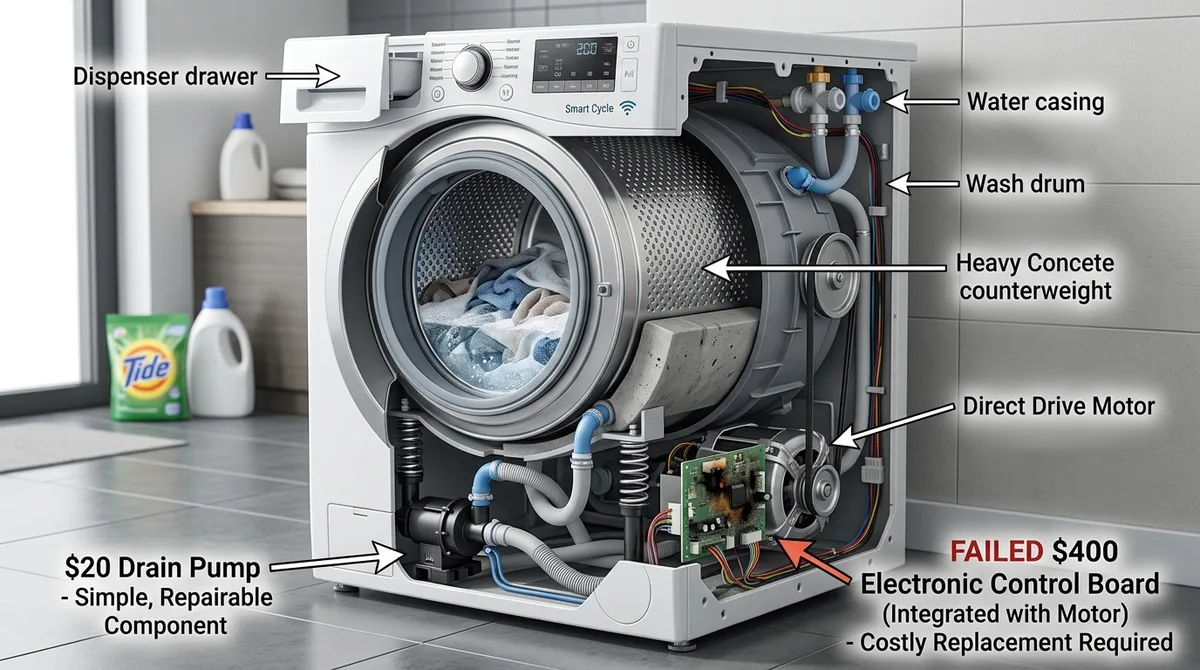
- Lean toward replacing (systemic): refrigerator compressor or sealed-system refrigerant leaks; washing machine transmission or a cracked drum "spider." These are labor-intensive teardowns whose cost exceeds most machines' value past ~5 years.
The Complexity Penalty on "Smart" Appliances
A counterintuitive finding: connectivity reduces reliability. Appliance repair professionals report — backed by reliability surveys — that Wi-Fi/Bluetooth-connected appliances show roughly 30% more problems than non-connected equivalents, mostly from electronic control boards failing in heat and humidity. Useful mental test: "Would I buy this used, X-year-old appliance for the price of this repair?" If no, replace.
The Hidden Cost Iceberg of Replacement
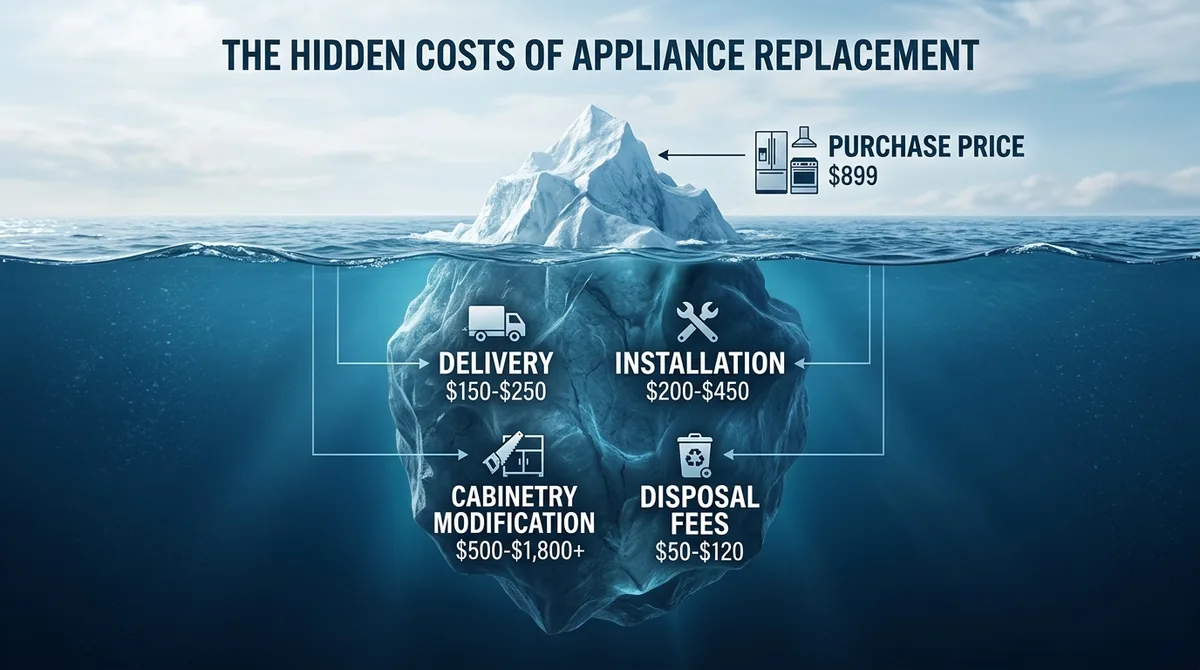
The sticker price is the tip. Below the waterline:
| Hidden cost | Typical range |
|---|---|
| Delivery | $50–$150 |
| Installation labor | $80–$350 (higher for gas ranges, built-ins) |
| Haul-away / disposal | $25–$75 |
| Cabinetry modification | $200–$1,000 |
| Electrical upgrades | $300–$800 |
These easily add $250+ — and cabinetry or electrical work can inflate a "bargain" by 50%.
When Efficiency Savings Actually Justify Replacement
A 2010-era refrigerator uses roughly twice the electricity of a modern Energy Star model — but that only saves ~$75–$100/year, meaning 10+ years to recoup an $800–$1,200 purchase on energy alone. What changes the math is incentives: the federal Energy Efficient Home Improvement Credit covers 30% of qualifying upgrades (up to $3,200/year, including $2,000 for heat pumps).
The Carbon Angle
For appliances under ~15 years old, repair is almost always the greener choice. Manufacturing a refrigerator produces around 2,300 pounds of CO2 — accounting for 30–50% of lifetime emissions. It takes 5–15 years of a new unit's energy savings just to pay back that manufacturing debt.
The Bottom Line
Repair a failure in the first ~7 years — the appliance's most reliable stretch is still ahead. Once a unit needs its third significant repair in two years, it's in cascading failure. Lean toward repairing durable cooking ranges and dryers; lean toward replacing budget dishwashers and fridges facing sealed-system failures after year eight. And never skip the $75–$150 diagnostic fee — it prevents replacing a whole machine that only needed a $20 fuse.
Frequently Asked Questions
Is it worth repairing a 10-year-old refrigerator?
For a simple top-freezer model or a premium brand, often yes. For a standard French-door or side-by-side unit, a $400+ repair at year 10 is risky since it's approaching the year-11 failure spike.
How long must manufacturers keep spare parts available?
Under emerging Right to Repair rules, manufacturers are generally expected to supply parts for 7–10 years after a model is discontinued.
Do smart appliances last as long as traditional ones?
Statistically no — connected appliances show roughly 30% more reported problems, mainly from control-board failures.